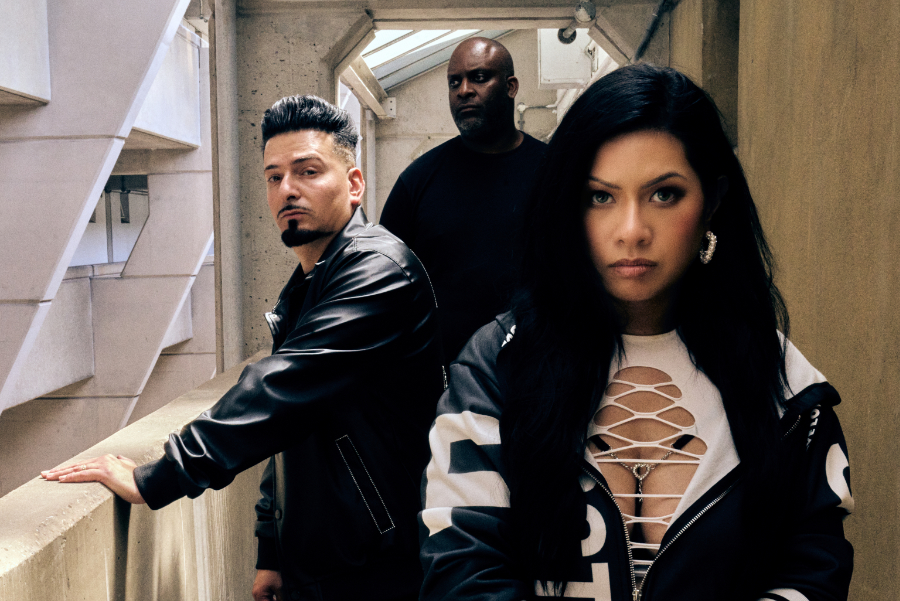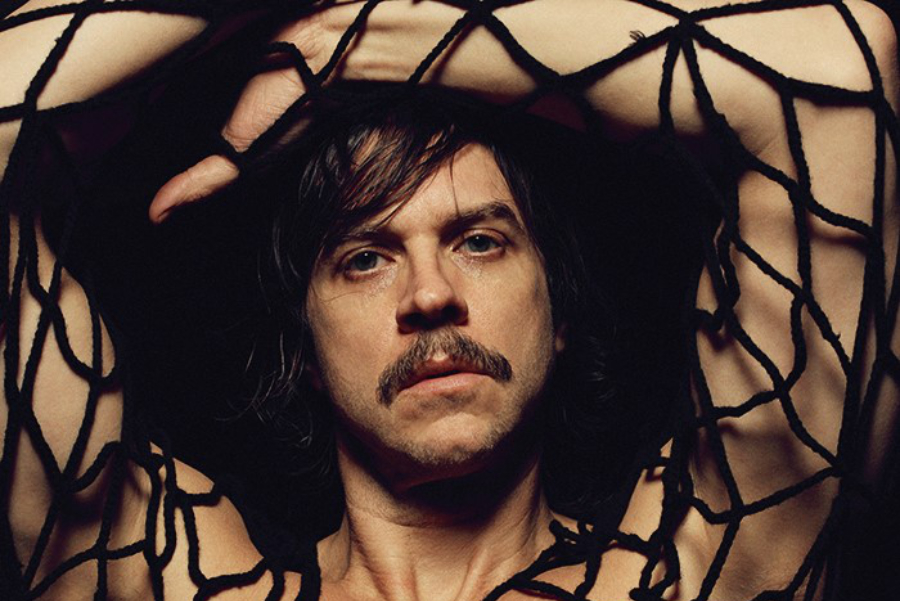
Call them art pop, call them electroclash, call them pretentious if you like… but there’s no doubting the force with which Fischerspooner burst forth into the electronic music landscape at the start of the century, with the blistering single Emerge and accompanying album, #1.
The New York group, headed up by Casey Spooner and Warren Fischer, alongside a motley crew of performers and vocalists, would go on to release four albums in total, with #1 followed by Odyssey (2005), Entertainment (2009) and Sir (2018). Each blurred the lines between synthpop, electro, punk, musical theatre and cabaret – with echoes of the art world from which they, ahem, ’emerged’.
Demon Music Group have just re-released their debut album – in a hot-pink vinyl edition, no less – to coincide with Record Store Day Black Friday (27 November), which is the first in a series of reissues leading up to the release of a Fischerspooner box set in summer 2027.
To mark the release, 909originals caught up with Casey Spooner to talk about the origins of one of electronic music’s more avant-garde phenomenons.
Hi Casey, thanks for talking to us. Why is now a good time to reintroduce the world to #1?
Basically, our licence deal expired with Universal. So we needed somewhere to put everything.
For me, Demon is just such the perfect fit because they’re part of the BBC, so they really know how to archive and deal with historical materials. So it’s great to have someone with that experience and the resources to gather all the work of 20 years that was spread out over self-releases and independent releases, and then another release and then a bigger release.
It was just all over the place – there’s stuff in the art world and a broad spectrum of archival materials. It was always something I wanted to do – I wanted to place everything someplace, historically. It’s a lot to manage and archive, you know?
So, the box set is going to bring together the four albums, I’d imagine, along with all the other linked art projects and things like that. Is that correct?
There are so many remixes and so many album covers. There’s also amazing unseen stuff. There’s so much material that hasn’t been seen, and a documentary that was started that no one finished. And film footage of every performance. There’s a lot of material that’s just kind of waiting to come to fruition.
And I guess, in that sense, you get to tell the Fischerspooner story more on your own terms, if you know what I mean. Because obviously, when you hit it big musically, the idea and art project that was Fischerspooner became more music-led.
We definitely transitioned into the entertainment industry, out of the art world.
So you get to redefine the origin story, and present your own take on it?
Yeah. And I think it’s cool because at the time, it was a lot for people to handle. They thought it was just so pretentious, which I didn’t mind.
I’m also very happy with the level of success we had when we had it, how we had it. It was such a rock and roll fantasy. And I love showbusiness… to a degree. I way prefer being in the art world.
The art world is really where I come from. It’s what I studied. It’s my community. But it is cool to make something that all of a sudden reaches a really insanely broad audience that you would never reach if you were just showing in galleries and museums.
I like a little bit of showbusiness – not too much, because it’s really a brutal machine. And no matter how much you try to say, like, ‘Oh, I can handle it’ or ‘I have creative control’, it just gets too big. It’s too complicated. There are too many people involved. There’s too many opinions.
It’s really hard to get a good idea through. You really have to be a bitch. And I don’t really like being a bitch. I come from a place of positivity. I don’t feel like biting some dumb dude in marketing so I can release an insane album cover that’s gorgeous and political and sexual.
Does that come down to maturity, Casey? That your attitude now is maybe different to what it was when you started?
No, when we finished Odyssey [Fischerspooner’s second album, released in 2005], I was over it. I hated working in the entertainment industry. It was not my process.
Because, like you said, all of a sudden it became a music-led project. Before, we had a very idiosyncratic process. I didn’t realise it at the time – that’s what made it successful.
We would make a song, and then we would make an image, and then we would do a performance, and then we would film the performance. It all kind of grew and fed off each other. When you saw the image, then you kind of felt the sound. And when you heard the sound, then you understood the film.
So everything was kind of built in to this really aesthetic unification. There’s this German term I love, Gesamtkunstwerk, which means total art. It’s basically the idea behind opera. You create a total art.
But Fischerspooner was not just about the art. It was also about the marketing and the promotion. We used to treat it in a Warholian way – we loved to lie to the press. Nobody cared about the truth. I mean, I loved to openly lip-sync. I was not up there trying to be a singer.
I love being a performance artist more than a singer. So I didn’t worry about proving myself vocally. And when I didn’t have to worry about that, it really opened up so much that I could do performance-wise.
Because if you’re really singing, you can’t dance and change costumes and do theatre. If you’re really singing, you kind of have to stand still. Or you have to learn how to run on a treadmill in high heels.
I’m sure you have no issue with that.
I’m getting old [laughs].
You mentioned the word ‘pretentious’. I’d argue that, more than pretentious, it was kind of like a confrontational approach to spectacle at the start – that kind of tension between substance and spectacle, the music and the performance. That’s obviously encapsulated in the video for Emerge, which is just a spectacular colour kaleidoscope of performance. Was there a point at the start, when the music thing really started kicking off, that you were having a creative tension there? Were we going to be musicians, or were we going to stick to what we were already doing?
No, it wasn’t that. It just didn’t yield the best creative product. It didn’t yield the best creative work. And it wasn’t the best process for me because it was basically two years of focus only on music, only money put into music, booking music studios, hiring producers.
It was just music, music, music, music, mixing music, mastering music. And everybody spent way too much money on the music, which was frustrating, because I felt like I watched the budget spiral out of control and there was nothing I could do about it. So that put a lot of pressure on the album to have a hit.
And then, after all that pressure, and the songs are good and everything’s in place, then everyone’s like, ‘OK, now make an incredible album cover’. And you’re like, ‘Wait, dude, I spent three years developing image and performance. You can’t just say, we need an album cover in two weeks’.
I need four photo shoots. I have to do tests. I have to have as much resources as the music. Why does the music department get all the money and I get nothing? And then I have to turn out a Broadway show? So I was just like, ‘This is not working. I’m not interested’.
I never wanted to be a rock star. I dated Michael Stipe [REM lead singer] when I was 18. I saw what it was like literally to be a rock star. I wanted nothing to do with it. It was a hellish life.
Yes, you have money. Yes, you have power, but you have no privacy and you have to deal with all these stupid executives. And that’s just not my vibe.
#1 originally came out on International Deejay Giglos, DJ Hell‘s label. How did you come to meet him?
What happened was that we did a performance at this show. We would do lots of show – a show a month for about two years, just nonstop.
Were these big performance-type shows?
No, it was any kind of performance. You name it. It was a gallery, a bar, a museum, a fashion show – any invitation. We took it. And it was good because it was a development period.
One of the shows that we did was for this thing called Simon Says, which was an arts guide. They were doing an art-themed night – it was a group show. Antony and the Johnsons, aka Anohni, performed. We performed – I can’t remember who else- and John Selway DJed. He had a record label called Serotonin.
He saw us perform Emerge and he freaked out. I think Warren and he were in the booth, and John was like, ‘I want to release the song’. So we signed a six-month licence with John Selway, and then he gave that print to DJ Hell.
It was about a thousand copies – a single with Emerge and Turn On. That was the first music business release.
That must have been exciting – were you like ‘OK, let’s be rock stars’?
No, I was really happy in the art world. We had a great setup. I would do these spectacular shows in the art world with amazing budgets and the chicest audiences in glamorous museums and galleries.
I had a huge studio space, and I had a salary and a stipend and a budget. And so I was like, I don’t need showbusiness. We’re good. I’m set with this. I’ll stay right here.
We went to Berlin and performed at Klaus Biesenbach’s really cool museum, KW [Kunst-Werke Institute for Contemporary Art], in the summer of 2000. And then DJ Hell wanted us to perform at his party for Love Parade.
So there was sort of this double Berlin thing that just happened to happen in the summer of 2000. It was super fun. It was like my Little Rascals fantasy – we all went to Berlin together for the first time. And it was a huge success. We connected with the city. We connected with the vibe.
There was something that was so perfect about our aesthetic that really connected with Berlin, in a kind of surprising way. Berlin is this dark, techno-heavy place, rising up from the ashes, kind of anti-capitalism, etc. They made an aesthetic out of ruins, which is so beautiful. Berlin did that for herself.
When we came, I didn’t realise that we had this kind of Weimar-ish cabaret look. I was wearing white face and had this kind of Hollywood-ish twenties look. It had this sort of Weimar thing about it that I didn’t realise.
And then I learned more about the history of performance in Berlin. And I was like, ‘oh, my God, I get it’. We kind of look like Cabaret – like queer cabaret techno.
So they really connected to it, visually and obviously sonically, because it was electronic. But it also had this glossiness that was more New York. Sometimes the New York glossiness really pops nicely in Berlin.
The electroclash movement was just getting started at that time. What was your view of the scene, coming from the US into what was very much a European electroclash movement? You had Miss Kittin and The Hacker, Vitalic, artists like that, and DJ Hell, obviously. What was your initial impression of what was going on?
I was a very serious artist in the art world, doing really obtuse, very obscure experimental theatre and performances that maybe 300 people would come to. They were very intense, super intellectual and very labour-intensive. And then I started doing this kind of silly project where I pretended to be a pop star, mostly because I thought it was temporary.
My plan was to only do it for one year. It was supposed to be from 1999 into 2000. It was going to be my turn-of-the-millennium show, and then once it was 2001, I was done. I’d move on. I’d go back to my serious work.
And then it just spiralled and kept growing in a way that was surprising… and yet not surprising because I was coming with already a decade of performance behind me. I kind of knew how to handle every kind of situation, very DIY.
I literally will never forget the first time I heard Peaches’ F**k the Pain Away. It was a Monday night. I walked into Gavin Brown’s bar, Passerby [on West 15th Street in New York]. I heard F**k the Pain Away and I literally walked right up to the DJ, and I was just like, what in the hell is this?
It was the same feeling as when I first heard Smells Like Teen Spirit. I was in the kitchen. I was in Chicago. It was about 10.30 in the morning. It was on cassette. And I remember being like, ‘I found my sound. I found my sound’.
Obviously, you didn’t consider yourself to be part of the electroclash movement, but you were ultimately lumped into that.
Well, it happened all of a sudden. It’s weird, because we had been working for about three years. So everything was really pretty well defined. And I think that’s why the timing was interesting, because we had spent about three years developing film and photography and performance and graphic design and costume and everything, built for the art world.
And then Napster took off, and we started self-releasing music. And at first, we weren’t even releasing music. We were just doing performances and people were coming to the shows and they were like, ‘Will you please sell the music?’ So then we just started making CDs that we sold at the shows.
Then #1 came out, and Emerge really was the trailblazer for the album. But obviously, there’s lots of other good stuff and some experimental stuff on there. There’s that cover of Wire’s The 15th…
That’s all Warren. I had nothing to do with that. He was the one who brought that in. He was more like the prog-rock dude who wanted to prove his depth of knowledge.
OK, so that was kind of one for the bedroom nerds.
Yeah, that kind of shoegazer thing. That wasn’t my vibe. I was like, ‘OK, cool, whatever. I’ll do it.’ But what are they saying? I can’t understand the lyrics, but the vibe is good.
It was hard for me because it was in an English accent, and I was like, ‘am I going to have to do [adopts English accent] ‘providing… deciding’? I don’t think I can do that’.
It was like an acting challenge. You get a script that has been performed, and other people know it. It’s famous. It’s like Hamlet – you’re going to do the soliloquy. How do you interpret it? It’s fun to do those sort of creative exercises to see how you can interpret other material.
Talking about interpretation, Emerge has obviously been interpreted in so many different ways. Some people suggest it’s about accepting mediocrity, some people see it as being about striving to distinguish yourself from everybody else. What was the inspiration behind Emerge?
We got booked to perform at these music shows at MoMA PS1 in New York. It was called the Warm Up Series. All summer long, on Saturdays or Sundays, they would have this concert series in the courtyard of the museum.
We did a performance in the museum, and I designed the costumes. They were amazing, but incredibly uncomfortable – latex in a heatwave – but gorgeous. Also, I had written an artist statement. I thought, ‘We’re doing a museum show, so we should print out a piece of paper that describes what the project is, so people understand what they’re seeing’. Let’s treat it like a museum work.
And then I thought, ‘why don’t we perform the artist statement?’ You’re a performance artist and you’re performing your manifesto at the institution.
So Emerge started from the original artist statement. It’s on our Instagram page. It has the ‘sounds good, looks good, feels good’, and there’s some stuff that you can’t hear because it’s got so many effects on top of it. There’s a vocal that’s kind of doing this [makes garbled sound].
Yeah, I know that part.
That’s actually saying ‘suspension of disbelief’. It’s talking about the conceit of theatre and the fourth wall and the suspension of disbelief. So it’s very philosophical – it’s really about being an artist and trying to attack language.
Language is always growing and always shifting with culture, because we’re always adding things or taking things out, or language is shifting. And so that’s how, as an artist, you’re always kind of struggling between, ‘OK, am I cliché? Am I making something that’s already been made? Why am I making this?’
Or you’re doing something so advanced and complex, beyond people’s aesthetic comprehension, that you’re kind of lost in obscurity.
So I felt like I was really wrestling with those two things because I had been working in a language that was impenetrable. Then I was interested in a language that was completely cliché. And so I was trying to merge the impenetrable with the cliché.
Is that why the track builds to such a crescendo – because of that tension? It starts so quietly, and it ends with an absolute explosion, a primal scream, even.
To me, that’s all about arrangement. That was really fun, working on that arrangement – Nicolas Vernhes really deserves a lot of credit. He was the boyfriend of Cindy Greene, who sings on the Fischerspooner album.
Cindy and I were roommates, and she was dating Nicholas, and we really clicked. He had a recording studio, so that’s how we ended up working with him.
Nicholas ended up being a brilliant producer, an amazing engineer, really smart, very philosophical… and French. I felt like he was really finessing us in simple and intellectual ways. He understood the intellectual component.
And I think that’s why he wanted to keep working with us, because when we went into the recording studio and worked on about three songs – the first three songs – for what was supposed to be three days, it turned into about two months.
During those two months, it was like, ‘Oh, wait, if we’re working so hard to create this vocal sound, why am I going to try to recreate that on stage? Why don’t I just do some of this other performance stuff that I do?’ Then I could take the idea of the song and show you more of that on stage, instead of trying to replicate a technical step that isn’t giving you more of the story.
The Fischerspooner story doesn’t end with #1 or Emerge, of course, and 909originals has lined up a second interview with Casey in the new year, to coincide with the launch of the forthcoming Fischerspooner box set. Stay tuned to 909originals for more. The re-released #1 is out now on Demon Music Group – more information here. [Main photo by Ryan Pfluger]
About Post Author