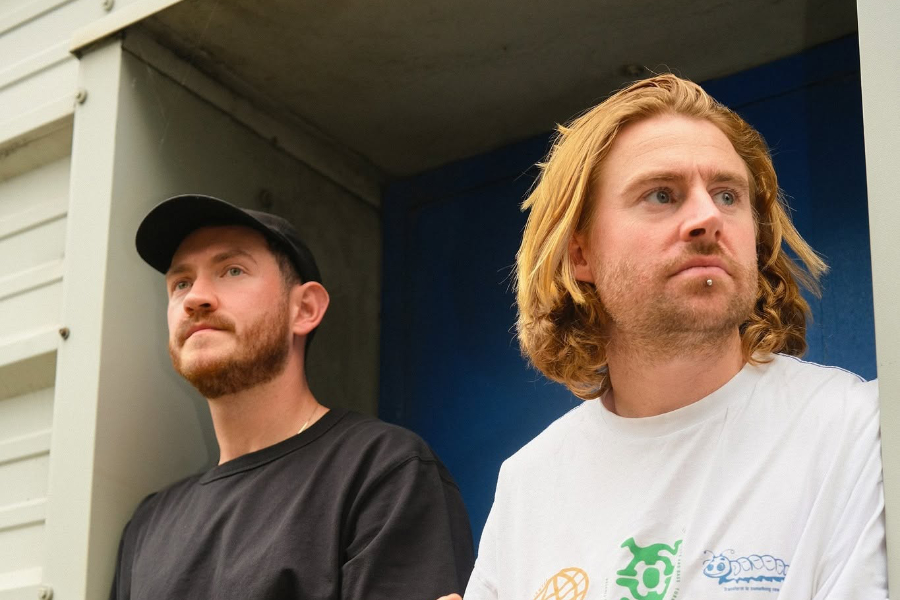
Club showmanship reaches new heights when Revival House Project is in town. The globally touring, glittering collective of standout vocalists, musicians, producers and DJs bring heart, soul and authenticity to audiences, raising the roof as well as vibrations.
But behind these high vibes is a mindful approach to fair recognition and authorship for their artists, in an industry where we need to raise real voices more than ever.
During the tail end of the pandemic, in the abyss of uncertainty, Christopher Peyton (commonly known as Peyton), founding member of Revival House Project, planted the seeds for what would become an incredible musical journey.
Having worked with glossy house music institutions like Hed Kandi, Revival House Project represents arguably Peyton’s greatest endeavour to date. What started as a novel idea is now pulling in global audiences and lighting up stages around the world. With 2026 highlights including I’m Gonna Make It with Kathy Brown and Mousse T, and the funky house stormer and Wh0 remix of Music in Me with Anelisa Lamola clocking up listening figures on Spotify, the collective is steamrolling into the summer.
But to experience the full splendour of the collective is to experience them live. With more performances at Ibiza’s Glitterbox planned, and recent appearances at legendary venue House of Yes in Brooklyn, it’s apparent Revival House Project is going from strength to strength.
So, when I had the opportunity to chat to Peyton himself at a smart West London studio, I jumped at the chance.
“Not just a normal label, but a label with a heart” is one of the many descriptions of Revival House Project that Peyton shares during our conversation. But is so much more: a collective of producers, singers and musicians injecting glitter and goosebumps into every performance.
With a vocal-first approach to authentic house music, one of the project’s USPs is putting singers and vocalists on the podium as well as on the artwork. With transatlantic roots and influences, Revival House Project emerged from the darkness of the global pandemic.
At its conception, whilst living in Ibiza, Peyton wasn’t completely clear on how the project would unfurl. But what he did know was that there was a call for authentic house music. And it couldn’t have come at a better time.
“At some point I got a call from a good friend in LA,” he says. “He was like, ‘What’s going on with dance music?’ Because like me, he was a real lover of house music, and like me likes soulful, uplifting, gospel-tinged vocal house music.
“He was saying how he found the dance and house music coming out at that time predictable and frustrating. So he was like, ‘can you help me? I want to make some great music’. It wasn’t about setting up a label in the beginning, or music for public consumption. It was literally about him just being frustrated and thinking, ‘can we pull together some great artists?’
The ethics behind Revival House Project are strong. Singers get fair exposure in the spotlight – unlike many dance and house music tracks where vocalists sometimes get relegated to ‘featured’ status, or producer-centric marketing. Peyton is also a strong advocate for fairer pay in the industry.
“The chances of you getting a return on whatever your investment is in a track is pretty minimal,” he says. “You’re making music so that you’ve got something to release and can be somebody that a club might want to book if you’re a DJ. If you’re a singer, you’re making music so that you’ve got songs out there and can get bookings, but the money is not ever really going to come back in from the music unless it blows up and gets streamed millions and millions of times. It’s a hard time for musicians, really, in that regard.
“Nobody’s going to be paying for artists to come and sing on the record. They’re not going to be paying for a proper pianist like the way David Morales used to bring in Eric Kupper to play on a great house record. This isn’t happening anymore.”
With the rise of sampling and AI, Peyton has a fair point. And authenticity is what makes Revival House Project so special. He explains how it developed as a project.
“I got in James Reynolds, whose lovely Voxpod studio we’re in today,” he says. “He is an incredible producer and has done a lot of house music, as well as all kinds of other music over the years. This was during the pandemic. All the artists had no work.
“I was able to call in some of the big names in house music, people that are part of the fabric of the story of house. People like Kathy Brown, who really is a legendary artist. She’s part of this project, and is going on 35 years in the industry.”
Brown, who like Peyton came from a gospel background in the States, is one of Revival House Project’s more prominent lead singers. Perhaps best known for her vocals on dance classics like Turn Me Out and Soul Central’s Strings of Life/Stronger on My Own, she is undoubtedly one of the most celebrated voices in house music, and well deserving of legend status.
Still going strong with the collective – featuring on multiple Revival tracks – she has also weathered some storms, having returned to music following her Stage 4 cancer diagnosis in 2023, coming out fighting and still delivering blisteringly uplifting performances.
Other lead vocalists include Imaani and Phebe Edwards, who has fortified the collective’s sound on their take on Aretha Franklin’s Think. The single was recently rereleased with a jubilant John Morales M+M rework. And of course there’s Peyton, whose infectious vivacity lights up live performances time and time again.
But back in the post-pandemic gloom, in its infancy and after fleshing out the initial concept, the project was only just evolving into what it is now. Brainstorms on how to pitch solid house music to the masses were hashed out. Peyton expands on how the ‘revival’ element was decided, citing his US counterparts’ lack of knowledge on house music as a contributor.
“I was able to bring in these incredible artists who came and worked on the records,” he says. “We brought in musicians, and we decided at that time my friend wanted to make some reworks of records that were well known. Because his friends didn’t really identify with house, you know? Men of a certain age – these American mates – on a Friday night, it’s all Bruce Springsteen and Tom Petty. My friend’s like, ‘I want them to get it’, so it’s a record they are familiar with, but it’s house. So that’s how the USP of reworking big records that are already established came about.’
But the collective didn’t just dip their toe in with one single. In 2022 they released five huge, rousing tracks, complete with gospel choir, including George Michael’s Freedom and Jackie Wilson’s Your Love Keeps Lifting Me Higher. Their first release was a take on Michael Jackson’s Earth Song, and the collective started off strong, recording at the world-famous Abbey Road Studios.
“I’ve been putting gospel choirs on my records for years, but via myself, maybe one other,” says Peyton. “If I was really feeling fruity maybe I could afford two others, and then stacking, stacking, stacking vocals. So a lot of my records sound like they have these big gospel choirs on them, but they were really just me doing different voices five different times.
“So, we had this gospel choir in Studio 2 of Abbey Road Studios. Wow – that was just absolutely mind-blowing. And we had Imaani in to do Best of My Love. At one point we did a record with Emeli Sandé. We had Jools Holland on the piano.
“It felt like it was the start of something auspicious. But there’s something about being in that place that is kind of humbling and inspiring. You recognise that whatever you’re doing, you’re standing on the shoulders of these people who have come before you, and that as a musician you are connecting to that rich legacy of talent. I think any artist who gets the opportunity to work somewhere like that would say that it’s a real ‘wow’ moment.’
“And then we just kept going. We kept making more records, and I think at this point– because it really was incredible – it felt a little selfish not to share them with the world, even if it was just to put them out so that people could have them. I mean, you can’t hide them under a bushel.
“Little by little, we started changing the way we were thinking, because we were giving artists work during a time when there was no work. That began to almost feel like a foundation or something, an organisation that can help, not just by giving people money, but connection – a support system. Do what the good Lord put you on this earth to do, and make some money with it.
“A lot of people were a few months away from the bread line at that time, and most artists don’t have the kind of savings to get through a two-year pandemic.
“This is not just a normal label, this is a label with a heart. We’re celebrating artists and giving them opportunities to make some money – giving them a fair split on the tracks. In our promotions and social media marketing, we’re making a big deal about these artists, getting their names more authored, more shouted about, more known, so that they have opportunities beyond what we’re doing. We don’t clip any wings.”
Listening to Peyton’s passion about the Revival House Project somewhat echoes his Virginian Pentecostal roots. Spirituality comes up several times during our conversation. He believes there is something bigger than us out there, even if the sermons he attends are now in the club and not the church.
But he’s also a savvy and fair businessman and understands the value of the collective, and its USP of offering fair credit for artists.
“There are so many stories where artists were not given any billing at all,” he says. “Or there might be a thing where a record blows up for whatever reason, and if you haven’t made an arrangement beforehand – because you accepted a meagre fee to come in and sing on it, the contract was crap, or you didn’t read the fine print or whatever – then suddenly your voice is all over the radio, but you’re making absolutely nothing from it.
“So we have definitely tried to address some of those things and just create a little family of like-minded weirdos that love music and try to put some good vibrations out into the world.”
And we definitely need more of that these days, that’s for sure.
To experience the Revival House Project, check them out here or listen here. Words by Rosie Riot.
About Post Author