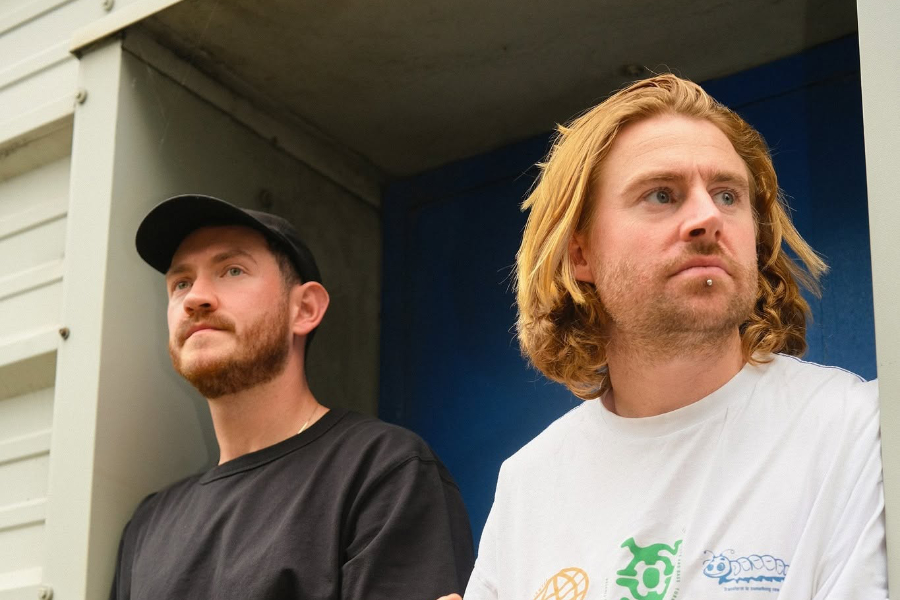
Scottish electronic musician Egebamyasi, aka James MacDonald, has been doing things his way for more than four decades – an early proponent of the Roland TB-303, he began producing what would come to be known as acid house long before the genre took hold, while more recently, he has pioneered a variant of dubstep he likes to call ‘wobblestep’.
Also known as ‘Mr Egg’ or ‘Eggy’ – the name Egebamyasi came from a 1972 album by Krautrockers Can – he also heads up Foxbam records alongside fellow Scotsman Foxtrot, which is now onto its fifth release. Like the man himself, the label is somewhat idiosyncratic: its most recent release, Foxbam 005, meanders from scything breakbeats to underground techno, via a wobblestep remix of New Order’s Blue Monday.
Having played over the years everywhere from Andrew Weatherall’s Sabresonic nights to Bang Face festival, Egebamyasi has upcoming performances in Ghent, Belgium (26 June) and Kosmos Festival in Finland (9-12 July) lined up, while also keep an eye out for launch party for Foxbam 006 – set to be released in November – at The Bongo Club in Edinburgh later this year.
Hi Eggy, great to chat to you. First off, thanks for sending me the Foxbam records. Fantastic stuff – a mix of acid techno and dubstep on there. It’s an interesting label.
Well, the label is a multi-genre label. I’m not disparaging the other artists on the label, but basically, while the music is good, it’s not all my cup of tea.
Basically, Foxy gets people that he likes and I get people that I like, and we’re just bringing it together. He does a track, I do a track. And I’m really kind of expanding away from the acid. That’s why most of the stuff that I’ve done isn’t really acid-based.
I just wanted to do something different, because I really fell out of love with that acid sound. I’ve been doing it for over 40 years. That kind of sound sounds too saturated. You know what I mean? There’s too much of it. So I’ve heard other sounds and just moved in a different direction now.
Are you aware of 909originals? Have you seen it?
No, actually, I wasn’t aware of it until Ben [Willmott] pointed it out. He thought it would be quite a good fit. And I thought, well, basically, if you’re talking about the machine… as soon as you hear 909, 808, 303, 707, 727, they’re all iconic numbers.
Basically, I first came into contact with the 909 in 1985, but never actually played it. It was in the studio at a time when nobody really knew what went with what. I bought my first one — well it’s the only one, I’ve still got it – for 500 quid in 1990. And it’s got [Altern 8’s] Mark Archer’s autograph on it.
Did you buy it from Mark Archer?
No, no. I just got him to sign it at a gig that I did in Glasgow. But the thing is, it’s absolutely mucky. It’s never been cleaned since 1990. It’s got so much patina on it from everywhere — Britain, Europe, clubs with smoke.
I’m based in Dublin, and I used to work in clubs back in the late 90s and early 2000s. And the muck you’d get on your clothes and your hair from the combination of sweat and smoke coming together, you know? It was a glorious time, but it was a bit disgusting as well.
I used to have the 909 and the 808 set up in clubs, and when the smoke was blasting, the oil-based smoke a few times got into the 808 and it didn’t work. It just seized. And obviously the panic constantly set in. The gig had to be stopped, I had to somehow dry the machine up, and then start again.
But going back to the acid thing, I don’t really use the vintage machines anymore. I don’t know if you’re familiar with the Roland TR-8S? Basically, instead of me having five or six drum machines at one time, I’ve just got one drum machine with all the sounds in it. Plus, with old machines, you can’t edit as you’re playing, you know what I mean?

So with Foxbam, in terms of the concept behind the label – so it’s yourself and Foxtrot and a cast of, I would say, rave legends, for want of a better term. Between Mark Archer, and Gez from LFO, and you’ve got Outlander on one of them. I haven’t heard anything by Outlander in a long time.
Aye, well, basically, the one that Outlander’s on was the one that I put out for the 40th anniversary.
I bring in more established artists, like icons or whatever, and Foxy brings some up-and-coming DJs and artists, because he kind of moves in a much more techno side than I do. So basically, he’s bringing the new stuff and I’m bringing the old stuff.
I thought that was quite a good way of getting a good profile for the label, hopefully getting a few established names, because we were going to get more localised Edinburgh people, but that didn’t work. But I think a mixture of the old and new, at the minute, has worked.
Obviously, in electronic music in general, there’s all this kind of cross-generational reference going on anyway. I remember reading somewhere, I think it was an interview you might have done, where you were saying you’re not positioning this to make any money out of it. This is more just to put records out there, to give the newer artists a profile and to give the more established artists an opportunity maybe to do something a bit different.
Listen, the money’s coming in, but we don’t ‘make’ any money, as such. But that hasn’t stopped us doing it. We just hope that the money coming back off the record sales makes each record kind of not as painful financially, if you see what I mean.
So each one is getting cheaper. There’s some return from that point of view, but it’s not a case that we’ve done this to make loads of money. We knew that from the start. That was never going to happen because, obviously, there are a lot fewer DJs these days. If this was maybe about 20 or 30 years ago, it might be different.
As I think I’ve said before, it’s a ‘record-putting-out exercise’, and as long as we’re up for doing it, then we’ll carry on.
I guess it’s a case of Foxbam 005 paying for Foxbam 006, and so on and so forth, as opposed to there being a bank of cash you can draw down from. It’s like, ‘well, this is going to continue as long as people are buying the last one. We’ll do an 006, and if that sells well, we’ll do an 007’. Is it like that?
Aye, well, each one does seem to be selling more. I mean, there’s only 300 being done, and they’re going slowly. I think 005 is probably doing the best at the minute.
And what we don’t have, which would be good, would be to have a press officer. Someone that obviously is in the know and has contacts with people in the industry, like it was years ago. We’ve not really got the time or the list of names that people had back then. And things have changed – with DJ Mag and Mixmag, it’s so difficult to kind of get your foot in the door.
But it’s taken up to number 003, for the label to really start to get noticed, and then 004 and 005 have slowly been getting a bit of recognition. So hopefully this one will just sort of carry on, keep rolling. We’ll be starting the process for 006 a couple of weeks.
I mean, I’ve already started. I’ve more or less got a track. My guest for the track is an absolute f**king stonewall legend of legends. It’s too early to mention any names – the only clue I’ll give you is that he ‘lost his child’ some years ago, and basically he’s still looking for the child.
Well, if it is who I think it is, that’s a hell of a coup… But back to Outlander, has he done anything recently, other than do a track for you?
His name is Marcos Salon. He lives in Brussels. I didn’t actually know that he’d done one of the biggest rave records – The Vamp. I mean, I had heard it, but I didn’t actually put the artist and the music together. I was just basically stuck in acid.
Going back to the early 90s and stuff, I loved a lot of jungle and I loved a lot of garage. But while I liked listening to it, it never inspired me to get into it musically. Because the acid was really fresh then.
But now, I’ve had the mind to do a bit. Obviously, with Ableton, it’s a lot easier to get into stuff like that. Whereas with the hardware, the acid hardware and the drum machines, garage and jungle wouldn’t really work. Or maybe it would work, but I wouldn’t know how to do it.
Some of the tracks on the Foxbam label, like Mandubchester – you described it as ‘wobblestep’. That’s an interesting, wobbly form of two step or garage. Or how would you define that sound? Because that’s something you’ve kind of coined yourself, right?
The ‘wobblestep’ thing came about mainly because of dubstep. With some other tracks that are out there, people might say, “oh, this track has a wobble in it.” And I’m thinking, “that’s not my wobble”. With my tracks, the drums are very dubstep-y drums, but on top of that I go full-on wobble. And the track that I’ll be doing for 006 is as wobble as it comes.
Ok, so you’re segueing away from acid with each release? More towards that dub-heavy wobble? But not that really screechy dubstep, that Skrillex stuff?
It’s interesting that you say that, because basically I think that sort of stuff has kind of given dubstep a bad name. To me, if you’re going to listen to a song, you want to enjoy the song, not have all these horrible, nasty sounds in it. It’s not at all enjoyable to listen to it.
But I think wobblestep is a bit of an acquired taste as well, because it’s obviously much slower than techno. I think it’s one of these genres of music that you have to listen to on a brilliant soundsystem, because there’s so much bottom end and there’s just so much happening.
With techno, house and acid, or whatever, you can get away with listening to it on any old soundsystem. But with jungle, garage and dubstep, you need a quality sound system with plenty of bass on it. Otherwise you’re missing half the entertainment. You’re missing half the sounds that are there. And you’re missing what the music is about.
All the Foxbam releases are on vinyl. Was that a conscious choice? Because sometimes when these tracks are compressed down to MP3, you’re losing a lot of the frequencies.
We’ve got an amazing guy who masters the stuff in Holland, Stefan ZMK. Obviously he does the stuff for vinyl, but also does it specifically for digital. So hopefully the quality should be pretty good.
I’ve not got a record player, just for the record. I’m no DJ. I never have DJed. I’ve no interest in DJing. But if I was to DJ, I would be like no other DJ because I wouldn’t be beat mixing, beat matching, whatever you call it. I’d be playing the record from the start to the end. I would be DJing as if I was playing live.
If I’m playing live, although the music I’m playing is dance music, I’m not playing live specifically for people to dance. I’m playing live from a live electronic point of view, like a live band, but without the instruments other than the hardware.
I don’t know whether an audience takes that into account, because I’ve got a lot of ups and downs, stops and starts and highs and lows.
Alright, so there’s less of a ‘journey’ and maybe more of a kind of up and down experience? As opposed to DJs who craft a ‘two-hour voyage’ kind of thing.
No, I would say that there definitely is a journey there because of what I used to do with the original machines, I would start off with the 707 and the 303, and it would be quite basic acid. Then I would add a bit of 808 in there and it would start to get a bit more powerful. Then there’d be quite a lot of samples played on top of that.
So as it moved through the half hour from the 707 into the 808, and then we’d move into the harder territory with the 909 and then the 303, by the last 25-odd minutes the distortion would come in. So it would go from quite quiet and it would build up that way.
There would be a bit of a journey there, but as I say, it would still be a case of I wouldn’t be going from one song to the next like a DJ would, to keep the whole thing flowing. At times, maybe I break the beat up, or take the sound right down.
People need to treat me as a live band rather than a DJ because I’m not a DJ. And the amount of people that keep referring to me as a DJ, or saying “you’re on the decks and you’re doing this…” I am a live electronic musician, not a DJ. To be honest, if people want to dance, that’s fine. If they want to stand and watch, that’s fine. I’m playing for an hour or two – and it is dance music – but it’s not done in a DJ style.

That’s interesting, because obviously your name comes from the Can album, right? And Can would have been one of those bands where some people wanted to dance and some people want to just watch and get locked into the groove. Are you almost inheriting that vibe with what you do?
Aye, well, I think Can, a bit like acid house, is a bit of an acquired taste. If you know the ins and outs of Can, it can be quite painful on the ears, because there’s a lot of improvisation and jazzy stuff there.
Obviously, for people that don’t know Can, there’s no musical comparison with Can and what I’m doing. It was all basically because of the album they did, Ege Bamyasi.
‘Bam’ is quite a big word in Scotland, and so is ‘eggy’, so I put them together – I just thought it couldn’t have been a better name for a Scotsman to use.
Ok, it’s got like two or three in-jokes there?
Yeah. It’s hard to describe really what the connection with Can is other than the name, because musically they’re completely different.
Well, is it maybe more about artistic fearlessness, perhaps? That would connect you with a group like Can – that you do things on your own terms and don’t feel the need to conform.
Well, the way I look at it, I’ve said to other people that I do it for myself, and you hope that people are going to come with you. And if they like it, good. And if they don’t like it, then that’s not my problem.
And as you said, you’re kind of parking the acid stuff now, to a certain degree?
I will still be doing it, occasionally. I’ve got a festival in Finland in July and I’ll be taking the hardware there. That’ll be the first time I’ve actually taken the proper hardware out with the computer in quite a few years, so I’m kind of looking forward to that.
And I’ll still be doing acid, but it won’t be the go-to live set. I’m going back to Belgium at the end of June, and I’ll do a wobble set there. So I just take the gigs on the merits of what people might want to hear.
Obviously, as an artist, you have to evolve as well. I mean, classic acid house artists who might still be around today, like Joey Beltram, he still plays Energy Flash quite regularly. He often gets it out of the way early, but he is kind of obliged to play it. Like Jeff Mills with The Bells. But at the same time, you’ve got to keep pushing forward, don’t you? You can’t be hamstrung by the past.
Well, I think a lot of the guys that I used to kind of look up to stopped playing out-and-out acid and actually moved into more housey stuff. I was a bit disappointed at the time, but can understand that if you’ve been doing something long enough, you just find other motivations and other sounds that kind of take you.
The dubstep thing had the same effect on me as hearing the 303 for the first time. It was a bit like, “Oh yeah, f**k, this is something.” At the same time, I’ve got into it late. When I YouTube some of the dubstep artists, I’m going, “f**king hell, that record was 15 or 16 years ago. I’ve just heard it.”
What I’m adding to the genre will be up to others to decide, but I suppose you could describe it as ‘McWobble’, the stuff that I’m doing up here. I actually don’t know if there’s any sort of dubstep scene in Scotland, because you never hear it.
Or if there is, it might have been and gone already, right? Because as you say, you’re out of the context now that you’re doing it.
Well, I hope I’m not jumping on the dubstep bandwagon. But most of the places I would go if I was clubbing would all be techno clubs or drum ’n’ bass clubs. It seems as though techno is the go-to – it’s almost like the ‘safe pair of hands’ music.
And very fast techno these days. It seems to have upped the BPMs in the last few years.
I’m not saying techno’s no good. I just think that, for me, the four-by-four is a bit boring and mindless. That doesn’t mean to say it’s no good, because there was one techno track I heard recently, by accident. It’s called Break Through, by AiKAi. This song was just f**king… you know, if an alien came down from space and said, “play me a techno song that sums up the genre,” this would be one of the tracks.
I’ve no idea how old or how new it is, but I heard it by accident and it is a belter, honestly. It almost makes you want to get into techno.
It’s the gateway drug… it’s like, “welcome.”
It was one of those tracks, yeah. And I think if I was a techno DJ, it would definitely be in my set. There’s not a lot of music that does that to me, other than stuff that I would much more be into.
But as I said, if I was going to be doing a dubstep thing live, it would probably be mixed into a techno night. I’ve no idea how it would go down, because you might be playing after somebody who’s quite fast, and then the dubstep would go down to 140 BPM.
But what you lose in speed, you should be gaining in quality of sound. As a musician, I would notice that. Other people on the dance floor might just go, “Oh f**k, this is too slow for me.” But I think you just need to get into the power of the sounds, and the bass.
A lot of dubstep broke through probably 20 years ago now. And to kind of discover it out of context echoes, at least, in terms of what I read about you, with when you were messing around with the 303 back in the 1980s .You didn’t know there were other people out there in Chicago or wherever also making similar music. You had no idea this was going on, and you’re in your own out-of-context scenario, coming up with something that’s your take on what turned out to be a movement, right?
I think it would have been the mid-80s. The first TB-303 that I saw was in Dunblane, which is just outside Stirling – this would have been maybe late ’83 or ’84. How one of these machines actually ended up there I have no idea. There ended up being two, actually – there was another one in a studio in Stirling.
But I found the machine by accident. We were rehearsing in this complex with other bands, and this silver box was there. And it was just like, “Whoa, what’s that?” And that was how it kind of kicked off.
But as you say, I had no idea. It took a few years before I realised that that box was producing the sounds that I was hearing on John Peel. It was probably near the early 90s before I put two and two together.
Because when I was using the machine, I was using it more or less the way it was made to be used, because I am a bass player. So the basslines I was doing were a lot straighter than your blippy, f**ked-up acid basslines.
Those sort of basslines came about because somebody, somewhere, programmed the machine, and then the batteries failed, and it completely transformed the basslines. To me, that is how the proper f**ked-up acid basslines came about.
So the machine was kind of resetting, in other words?
Well, it was an old analogue machine, so obviously the batteries didn’t last forever. You had to write the patterns down because you couldn’t rely on the machine keeping the patterns. The new machines are digital, so they’ve got circuits and chips and stuff, and they can keep the memory in there.
So basically, I deliberately used to take the batteries out to f**k up the basslines. Because I thought, “well, this sounds quite good”. So I’d write a few basslines, take the batteries out, leave it for a couple of hours and just see what happens. And that was how a lot of the basslines came about.
But first of all, I was just writing them as straight basslines. Obviously the machine never caught on because the sound wasn’t like a real bass guitar. It was too clicky and trebly. But to me, it did something, because it was so radically different from a bass.
There was just something about hearing it, and other drum machines, that took me away in a different direction.
It’s the same with the 808, isn’t it? It’s supposed to sound like a drum kit and it just doesn’t, and that’s what makes it. And because of that, it creates a whole new instrument, a whole new movement. So, what you’re saying about the 303 — that kind of imperfection in the machine, that unpredictability, was really the green light for you then? Actually using it for what it was supposed to be used for was only half the battle, or only chapter one of the novel. It was the mistakes in the machine that kind of made it.
Everything was a learning curve. You didn’t have any clues.
Stirling was a backwater musically, certainly for dance music. Obviously, if you talk about London, Chicago, Rome, New York… Stirling doesn’t really have that glamorous ring to it, you know what I mean?
Obviously there were guys in America doing stuff. There was A Guy Called Gerald in Manchester. But nobody was coming to Scotland to hear stuff like that. It was all London, Manchester.
Myself and Gerald actually had the same manager. I went down and spent a weekend with him and we had a bit of a jam one summer. Probably about 1991, I think it was. Unfortunately I’ve lost the tapes.
It was a bit of an experiment – some stuff was good. There were a couple of difficult moments, but it was quite a good experience. He had a room with an attic full of equipment, and it was roasting – I remember the weather in Manchester was sweltering.
I interviewed Gerald a while ago, and he was talking about when he was building his studio, he’d get speakers from burnt-out cars and old TVs and build this crazy soundsystem by wiring it all together.
One of the things I wish I’d had the opportunity to do was actually come and play in Ireland because of what happened with Bubble [on the Acid Indigestion #2 EP] and the guys from Abbey Discs putting it out, a few years later.
I had heard that Bubble was doing quite well in Ireland, it was really well recognised. I just wish I’d known about it at the time because I’d have loved to have come across. I’m probably disappointed that I didn’t.
Abbey Discs was the cornerstone of so much of the scene in Dublin. For so many years, Billy, the guy who ran it, would be pushing obscure stuff.
Bubble first came out on a subsidiary of Play It Again Sam, called Groove Kissing, That was a label run by two Dutch guys from a band called Sequential. It was kind of techno-ish, early techno-ish rave stuff.
I played in the Melkweg in Amsterdam, met them, and they said, “Send me a demo.” So I sent them this cassette, and the cassette was shit. I knew before they got it that it was shit. Why they decided to go with it, I’ve no idea. But the rest is history.
Was there even one track on it that was good?
I don’t remember anything on it that turned into Acid Indigestion #1 or #2. I just remember that I had done a lot better cassettes before that, which I thought would have worked with people, and they hadn’t happened. So it just goes to show that you don’t have to be brilliant when you’re sending out stuff. It’s just pure luck.
Well, sometimes you can capture the zeitgeist with something.
I ended up being a bit disappointed with them, actually, because I found out via the internet and Discogs that a few years later, after I finished working with them, they were licensing my tracks to labels that I never knew about. It was only because of Discogs that I discovered that.
So they were putting them out as their own?
No, they were putting them out as mine, as Egebamyasi. The tracks were mine, but they must have been taking the money for the licensing.
Oh shit. The same thing happened to A Guy Called Gerald, right? He was ripped off big time by his label.
Well, as I say, I only discovered that because of the internet. At worst, I would quite like to have had copies of them. Obviously some kind of financial reward would have been alright, too. Whatever money they were getting was obviously split between two people rather than three, so that was a bit disappointing.
That was kind of the Wild West nature of it, back then.
Well, I’m not the first person that’s obviously been ripped off by labels by being naive.
I think as well, though, I mean, I’ve never really chased the money. The whole music thing for me wasn’t about making money. It was just about playing live.
When I started off, it wasn’t a case of, “Oh, I’m going to play live this way.” The machines were found, the sounds were listened to, you’ve learned as you went along… and one thing just led to another and you ended up doing it live. I’d played live with guitar bands and stuff, so it was a natural progression to move from a live band into electronics.
It was weird playing some of the first gigs with just the drum machines, because people are looking about going, “Where’s the drummer? Where’s the guitarist?” You know what I mean? This was in 1984. There was nobody else in Scotland that I was aware of who was doing anything so outside the box.
Well, this is kind of the tail end of post-punk really, isn’t it? So there’s almost that “rip it up and start again” mentality. Why should you need a drummer and a guitarist and a bassist? F**k it, we’ve got the machines….
Another thing about some of these early machines, if people got to hear them, one of the things you always heard was, “Oh, it doesn’t sound like a real drummer.” Well, that’s the whole f**king point of using a drum machine, because it’s not meant to sound like a real drummer. It’s meant to sound like a f**king machine.
And then you’ve got that shuffle on the 909, where the real garage groove comes in. To me, there’s nothing better than garage hi-hats, the groove and the swing. I’m not a dancer, but as I say to people, garage almost makes me want to dance. Because I think it’s some of the sexiest music you’re likely to hear.
I’m not a drummer, either. I’ve learned to get grooves out of drums by playing around with the machines over the years. I’ve still got loads to learn when it comes to various grooves. You do it your way and you try to pick up bits and pieces from other people – “how the f**k have they done that?” – and try to work it into what you’re producing while still keeping your own style.
You’ve worked in the past with Andrew Weatherall and Vince Clarke. Obviously these are very influential artists. Would they have kind of rubbed off on you, sonically, or guided you? Or maybe they were just in your universe or whatever?
Well, probably more just in the universe.
Actually, the studio that I worked in in Amsterdam was owned by Vince Clarke. He had a studio on the floor below. I was working upstairs with the guys from Sequential and I went to the kitchen one day and he happened to be there.
I was married at that time, and I said to him, “Look, this is a bit uncool, but can you give me your autograph for my wife?” And he said, “I’ll do better than that.” He went away and wrote a bit of Erasure sheet music and signed it.
Basically one thing led to another – Erasure came to Edinburgh and we spent a week with them. What a week that was. This would have been 1992.
People go on about big stars being untouchable. Vince Clarke and Andy Bell were honestly, two of the most down-to-earth people I’ve ever met. I’ve met people who are a lot less important than them who acted way more above their station. Andy and Vince were just two amazing guys to spend time with because they liked to party and they were genuine. They weren’t bullshitters.
In terms of Andy Weatherall, there was a song that I did that was completely unrelated to dance music – Remont (Allegro Con Brio) – which he was going to remix. It was recorded in Youth’s studio in Brixton and it was on 24-track. Andy got the 24-track, but didn’t like the song, and wouldn’t give me the 24-track back – even though Vince’s remix was on the same 24-track.
I reproduced the track somewhere else, and we had a cassette of the remix that Vince did, and basically that cassette got mastered and that’s what got put out. It came straight off a cassette because I just thought, “f**k it.”
I think if Andy had done a remix, I think he could have done a f**king amazing version. I don’t know if he thought Vince’s version was a bit commercial, because it was very Erasure-ish. He took the song and transferred the melodies from semi-normal instruments into analogue sounds.
When you hear the original and then hear his remix, there obviously is a connection. It’s not one of these remixes where somebody has taken the track and completely f**ked it up. He’s kept the essence of the track, but transformed it into his style, and I think it really works.
It was a very summery piece of music, and I think if the drums had been a bit better, it could have gone down a storm in Europe. But as I say, it was lack of exposure and lack of the right people getting it.
Just talking to you, it sounds like you’ve got a lot of tracks from your portfolio over the years that maybe warrant rediscovery or kind of reconfiguring a little bit. Do you still have the DATs of the tracks you made back then?
There’s no DATs, there’s no tapes. Unfortunately, what you’d probably need to do would be to rip the vocals off the track, rewrite the track, and then somehow match the vocals back up to the new track, which probably could be done, but it would take a bit of time.
But what I’m looking for is someone who can play the piano more melodically. Somebody whose fingers can flow up and down the keyboard. Mine are too big, clangy, bashing all the time. At some point before I depart this earth, I’ve got to find someone who can play this song properly, so that if it was done again, so there could be a proper piano version on the vinyl.
One thing the Atari ST – the amazing machine that everything was done on in the early 90s – had was an editing grid that actually wrote the score when you played the keyboard. It would be great to be able to do that, get it off some musical program and pass it on to somebody. That’s probably as good as it gets if you’re not in the same room.
Although one thing that grinds my gears is these ‘classical techno’ gigs, right? “Oh, so-and-so is playing all the hits of…” No, no, no, leave it. Let it go. You’re ruining classical music and you’re ruining techno.
My go-to music – I’ve got a big sound system in the car – is Radio 3, like hardcore classical music. Not Classic FM, where it’s all the popular stuff. I’m going for the heavy-duty stuff.
It’s interesting also what you were saying earlier about when you play live with some of the newer Roland machines, you’re literally doing the drums on the fly. Maybe you’ll come up with an incredible drum loop in a live environment, but then it’ll be gone, because it was literally on the fly. I guess that kind of reflects your career to a certain degree, as well – always doing your own thing, in a way.
Well, the thing is, I don’t actually spend that much time writing drums anymore. Years ago I used to spend days and hours and weeks and months writing drums and changing drums. Now I just concentrate way more on the bassline because I’ll be writing the drums as I’m playing live.
Actually, one other piece of evolution – with one of the proper original setups that I had in 1990, when things moved into a bit more serious and professional. Let’s say I had a 808, 909 and 303. Because there wasn’t a singer, and because I’d been into samples and stuff even before making acid, the samples were played from a cassette – a wee shitty cassette player from a stereo system.
Then, as we moved on and got more serious about what we were doing, we started making up samples on a CD player. The CD player was a level up from the cassette. And now, to come full circle in 2026, I’m using an iPad to launch the samples.
Obviously because the cassette, the CD player and the iPad are not MIDI’d up, and they’re not synced up, the samples are not completely in time. If you do it in the computer, you can stretch things and pull them about and throw them up and kick them about and get them to work a lot more in time with the music.
But when you’re using these external machines that are not connected, even though the machines are out of time, they kind of sound like they are in time because they catch up with the music. So there are some bits that don’t quite fit, but that’s just the way it works live. That’s just a wee quirk of the live thing.
I might use some Motörhead acapella tracks, or even David Bowie acapellas. Basically, I would be trying to manipulate the music to their lyrics. So when they’ve got gaps in the singing, I would have gaps and try to bring drums in and bring basslines in on certain bits of their vocals to make it sound as if I’m supplying the music for their lyrics.
There’s a wee bit of fun involved in that, because there aren’t that many people doing that kind of thing with this sort of music. A lot of samples are sexy girls singing or something fairly standard. It’s not that unusual.
I’m not saying I’m unique in this, but using a lot of heavy metal samples, especially Motörhead, just adds a wee bit of a different atmosphere to the music. People come up to you after and say, “That was different. That was really good. I wasn’t expecting that.”
You mentioned Youth earlier on, and I remember speaking to Alex Paterson about when he was starting The Orb. There was kind of a plan, but the fact that there wasn’t a plan was also the plan. The fact that you could literally f**k around with people’s heads and get away with it made it really interesting. It became part of the project.
Well, as I say, it was purely a hit-or-miss learning curve. I didn’t have any kind of crystal ball. I never said to myself, “I’m going to be an acid house artist.”
In fact, I was doing the acid stuff before anybody coined the term ‘acid house’. You had all this acid culture back then — I never knew what the f**k it was. That completely bypassed me. I knew nothing about any of that.
Which gave you the freedom to create something out of context. There was an Indian guy in the early 80s – Charanjit Singh – and people have rediscovered his album, Ten Ragas to A Disco Beat. People have realised it’s basically like an acid house album made out of context by this guy who was trying to do an Indian raga with a 303.
I’ve heard something about that, that acid house was invented in India.
Well, considering there were allegedly only 10,000 303s made – and I think half of those 10,000 are in f**king Belgium with the amount of machines I’ve seen while I’ve been there – Roland didn’t really know what they had, they didn’t know what was going to explode. Whereas, they’ve obviously done some shit as well.
Nowadays, the fact that they’ve made all these machines much more accessible money-wise has also kind of ruined the genre as well.
It’s too accessible, would you say?
Well, obviously it’s good that they’ve been able to make machines for people that can’t afford the originals, but they’ve taken away the fascination about acid. They’ve taken away the proper underground mystique.
The new machines work properly, for one thing. They don’t drift and things like that.
Well, I suppose that’s the thing. MIDI cables are a lot more reliable than sync cables. I can remember having to prop up the sync cable into the 303 with a match just to get the pins to connect.
I remember playing in Dundee, it must have been 1990, and the power supply I had for the 303 wasn’t the original power supply. It was one of these generic power supplies you might get from Comet or one of those electrical places, one with a kind of multi-pin. Obviously, I was too naive and didn’t know.
So playing the gig, the machine switched off because the power supply didn’t suit the 303. The place was f**king rocking, right? Nobody had ever heard this stuff before. This was a completely new sound to Scotland anyway. Anyway, that night taught me a lesson: never use the machines without the proper power supply.
There haven’t been many gigs that have failed – other than when you’re probably high on drugs – but that was one of the major disappointments, technically, over the years.
I guess, in closing, because obviously you’ve been around making music for four decades – and you’re still making music now – how would you describe your legacy? Is it about artistic independence? Is it about technical innovation? What is the artistic legacy of Egebamyasi?
I think it’s really up to other people to decide at the end of the day. I just do it. I couldn’t give a f**k really what people think.
Plus, I don’t think there are many people who’ve started off underground and are still underground. I’ve not moved to London to become more famous, I’ve not chased the money. I’ve just done it the way that I wanted to do it. I didn’t have managers, I didn’t have agents, I’ve not got a machine behind me. I’ve done it myself.
There have been periods over the years when I’ve had a helping hand, but generally all that’s happened for me now is that I’ve got better because I’ve obviously done it for so long and been able to get better machines.
But generally, I’m the same now as I was back in 1990. It’s basic, it’s underground, and that’s the way it’s going to stay.
I’m actually due to retire next year, so who knows what’ll happen? I’ll have way more time for music because at the moment I have to make the most of weekends and stuff.
So yeah, the legacy… I guess I won’t know what the legacy will be because I’ll be dead somewhere, unless I can come back as an ‘acid ghost’ or something.
Actually, what I will say is that when I’m dead, I’ll be happy for people to write on my gravestone. They can spray it, they can graffiti it, they can do what they want.
They can break eggs over it?
That’s an even better idea. Now you’re talking.
Keep up to date with all things Egebamyasi at www.egebamyasi.com.
About Post Author