As artist Máret Ánne Sara’s Turbine Hall tenure at Tate Modern ended, fellow Sámi artist Katarina Barruk saw out the gallery’s showcase with an exclusive Tate Lates performance. Spotlighting the endangered European Arctic culture, as well as harnessing the importance of ecological crises, Rosie Riot discovers more about Sámi culture and the ‘Tate Lates’ featured artist.
It’s early springtime in London, and the monumental façade of the Tate Modern looms into view. I’m here to glimpse a snapshot of Sámi culture.
I’ve been invited by the Norwegian Embassy and NANU – Sámi Arts International – to a special viewing of the Turbine Hall’s exhibition Goavve-Geabbil and see a performance by Swedish Sámi singer and artist Katarina Barruk later in the evening as part of ‘Tate Modern Lates’.
As I enter the chasms of the Hall, I see the first sight of the Hyundai commission: a soaring tower of reindeer hides as part of sensory installations exploring Sámi culture, indigenous reindeer herding, and the environmental impact of climate change on the Arctic European reaches. I spy a lady in multicoloured traditional dress who transpires to be the artist responsible for the Turbine Hall’s pieces.
Máret Ánne Sara is a Sámi artist whose work advocates for ecological justice by centring her community’s knowledge and practices. I learned that the Sámi people are indigenous to the Sápmi region, which spans northern Norway, Sweden, Finland, and the Kola Peninsula in Russia. Reindeer herding is a cornerstone of Sámi culture, shaping the relationship between people, lands, and animals.
Goavvi is pivotal to the exhibition: a snow condition caused by extreme temperature fluctuations due to climate change. Rain and melted snow freeze into layers of ice on the surface of the land. This prevents animals from accessing the food beneath, leading to widespread malnutrition and starvation of reindeer.
Reaching the heights of the Turbine Hall bridge, we realise that reindeer are once again referenced as we glance down at a maze-like structure constructed from wooden poles. The ‘labyrinth’ is in fact modelled on a cross section of a reindeer’s nose.
Sara tells us that the subject of the maze is in part due to it being a feat of natural engineering: “Did you know a reindeer nose can heat air by 80°C in under a second?” I ponder this natural miracle as atmospheric Sámi cries echo around the hall.
My education in Sámi culture continues with an insight into how the language, a family of Uralic dialects that spans the Sápmi region, is becoming progressively rarer. Katarina Barruk, who I am about to see perform with her band, is a prominent singer and songwriter who still sings in the critically endangered Ume Sámi language, a dialect which spans a strip of land across Sweden and once across Norway.
Apparently, there are fewer people who speak Ume Sámi than those who can fit on a city bus, and it is officially on UNESCO’s red list of critically endangered languages.

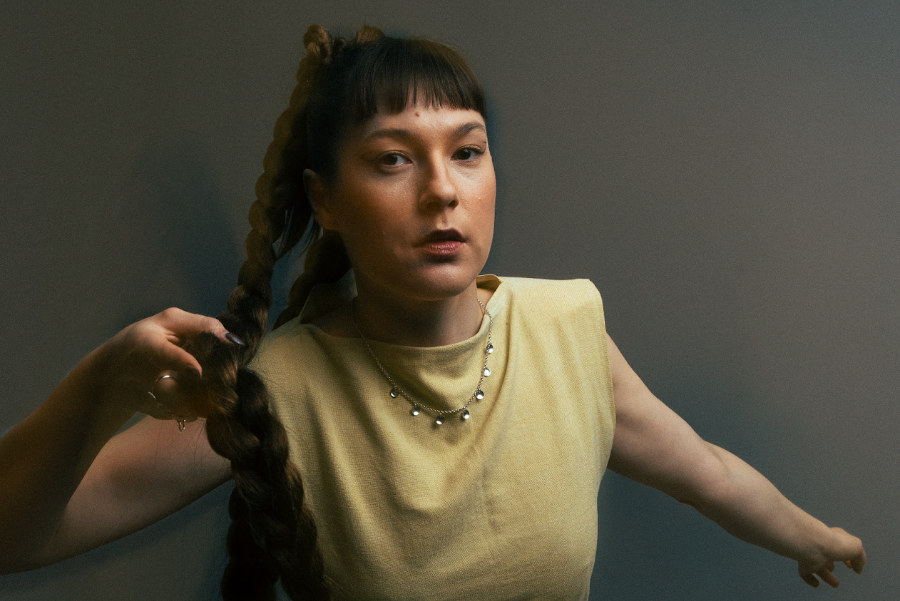
Barruk, known for her powerful voice and evocative storytelling, captivates crowds with songs that reflect her heritage and the deep connection to nature that defines Sámi culture. Her performance follows her powerful contribution Dárbbuo to TAKKUUK, the Arctic-focused compilation curated by electronic pioneers Bicep.
The album, which was released last summer, translates as ‘to be attentive’ and urges people to look closely at the impact of climate change. Singing in the endangered Ume Sámi language, her music bridges ancestral tradition and contemporary sound, bringing Sámi soundscapes into modern cultural dialogue while exploring themes of climate, identity, and belonging.
Barruk has also collaborated with ensembles such as the Norwegian Chamber Orchestra, the Helsinki Philharmonic Orchestra, and even the BBC Proms at the Royal Albert Hall. Her work embodies both artistic innovation and cultural resilience.
“When I perform, I see inner images of places, people and events. I try to take the audience with me to those places and to my emotional state,” Barruk explains. “I believe many have adapted to today’s rapid society, and I want my music to bring freedom, a breathing space where people can rest in what it means to be human.”
This sentiment perhaps doesn’t do the magic of Katarina Barruk justice. As I edged towards the stage on the Turbine Hall bridge, her presence felt magnetic. Dressed in a textured white high-neck top, reminiscent of an arctic creature, she ambled on stage, opening her arms like a butterfly, expressive with movement, and an otherworldly aura.

As the echoes of her melodies filled the expansive hall, the audience was transported into a world where traditional narratives met modern artistic interpretations.
Barruk’s performance included elements of traditional Sámi joik, a form of song that is integral to her cultural identity, as well as contemporary interpretations. Her performances somehow simultaneously channel avant-garde futurism, but with the reflection of ancient times in snowy, tree-lined lands.
As the event concluded, the audience erupted into applause, recognising the importance of such artistic expressions in raising awareness and fostering appreciation for Sámi culture. The performance not only marked the end of an exhibition but also served as a powerful reminder of the resilience and creativity of Indigenous artists in the face of ongoing challenges.
It’s clear the collective Sámi voice is being amplified, and the Indigenous people of the Sápmi region are rippling across the arts and beyond.
Find out more about Katarina Barruk here, and listen to Katarina’s latest acoustic release Dárbasjub Duv here. Words by Rosie Riot.
About Post Author