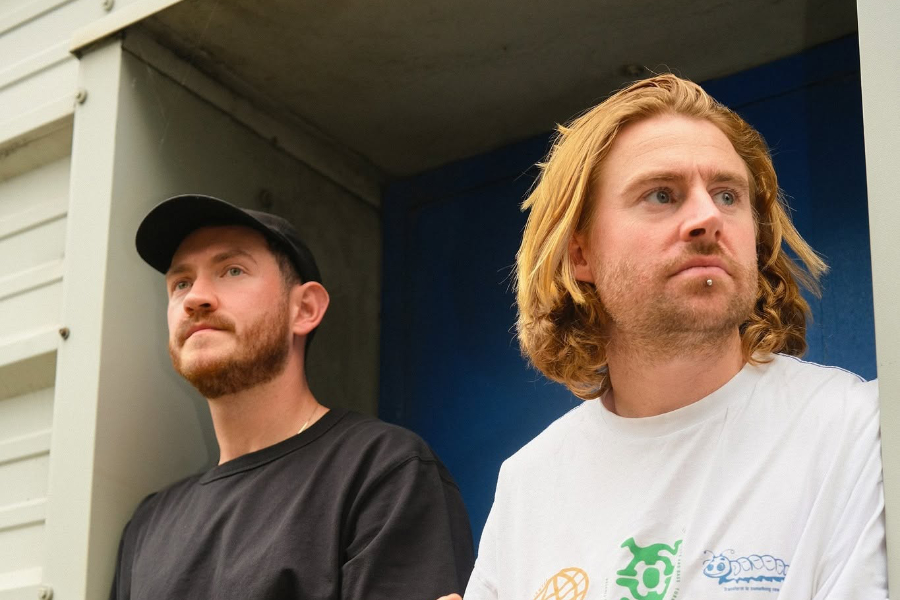
Some three decades have passed since The Sabres of Paradise called it a day, with their two albums, Sabresonic (1993) and Haunted Dancehall (1994) setting a sonic template for countless producers to follow.
Helmed by musical alchemist Andrew Weatherall, the Sabres — as they were affectionately known — emerged from the post–acid house era as a production-focused outfit. Weatherall handled arrangements and sample selections, Jagz Kooner managed programming and effects, and Gary Burns acted as the resident musical maestro, with the group producing commissions, soundtracks, and remixes for artists including Yello, Future Sound of London, and Flowered Up from their Sabresonic studio.
This process would eventually see the trio form a fully-fledged group, attracting the interest of the then-fledgling Warp Records (on which both albums were released) and taking their production talents on the road. Tracks such as Smokebelch II, Wilmot, Tow Truck and Haunted Dancehall helped establish them as a group that played by their own rules – underground champions in a scene that was progressively moving overground.
Following a tour of Japan in 1995, the Sabres wrapped things up, with each member going on to pursue personal projects, but it was the untimely passing of Andrew Weatherall in 2020 – and the reappraisal of his back catalogue that followed – that ultimately led to talks of a reunion.
A 30th anniversary commemoration of Sabresonic, hosted by Weatherall archivists The Flightpath Estate, led to a series of ‘will-we, won’t-we’ conversations, ultimately resulting in the official re-release of both albums, and, earlier this year, a triumphant return to the live arena, backed by a full band, with performances at Fabric London, Primavera Sound, Dekmantel and Sydney Opera House, among other venues.
More tour dates were recently announced for this coming November, and the group have confirmed that 2026 will see them hit the road again – as well as, potentially, release some more gems from the archive.

909originals’ Stephen Wynne-Jones was delighted to catch up with Jagz and Gary to discuss the past, present and future of The Sabres of Paradise.
Thanks for talking to 909originals, guys. First off, an important question. We’re based in Dublin, is Ireland on your to-do list for a forthcoming tour?
Jagz: We need to get over to Ireland. I’m getting it in the neck a bit; quite a few people messaging me, going, “ when are you coming to Ireland?”
We need to get over to Ireland because I love it over there. When we used to play David Holmes’ club, Sugar Sweet in Belfast, the response was amazing. I’ve done a lot of work over in Ireland as well with a few bands and stuff. It’s a great place to go and visit, and I’ve got loads of friends there. So it’s going to happen—hang tight.
When I heard you were coming back, I thought, ‘that’s great’ – a new generation can now discover your music. Was that why you decided to bring Sabres back – to give the music a second life?
Jagz: It’s been a really long road to get to this point. When it fell apart, back in 1995, we had unfinished business to take care of. I mean, we only did about 20 gigs in total.
We played, I think, six gigs with Primal Scream, supporting them on one of their tours, we did our own little tour of about six, seven dates, we went to Japan, did three dates over there, and a couple of others, and that was it really. So it was a fleeting moment first time round.
In total, the Sabres were around from roughly ’93 till the end of ’95, and that was it. So you had two years, which is not a huge amount of time for anyone to actually go and see the band.
Obviously when the Sabres split, we went our separate ways, and we all went on to do other things. Personally, I didn’t really give it a second thought after we finished it because, after we finished Sabres, I went on to work with David Holmes and with Primal Scream. You just move on and start doing stuff with other people. You don’t really think about what you did five years ago, ten years ago, let alone thirty years ago.
How we got back together really stems from Ian Weatherall, Andrew’s brother, suggesting getting the albums re-released, to mark the anniversary.
This was in 2023. I was like, “Oh, bloody hell, has it been 20 years already?” And he said, “No, it’s been 30.” So it was like, “oh f**k, right!”
Even then, I wasn’t totally sure. Andrew always used to come into the studio and tell us, “We need to look forward, we need to move forward, keep doing new stuff, we don’t look back—what we did last week was last week, it doesn’t matter.” We’ve got to try and keep pushing the boundaries and experimenting and trying new things out and see what we can do.
That ethos really stayed with me and still does to this day. So, to revisit something from 30 years ago, well, I was not really sure. And then I spoke to Lizzie, Andrew’s partner, and she told me “Oh, well the thing is, Jagz, there is no more looking forward, because Andrew’s gone now. All we’ve got is what he’s left us.” And I was like, “Yeah, fair enough.”
Then we got asked to do this Q&A to mark the 30th anniversary of Sabersonic, up at the Golden Lion in Todmorden, by the Flightpath Estate guys. They were like, “Would you be interested in coming up to do this Q&A?” And we were like, “Yeah, okay, no problem.” And then they said, “Would you be up for DJing as well?” “Sure.”
When I put the phone down, I was like, “shit, I better go listen to those albums again,” because I hadn’t listened to them since we finished them really. Obviously, when you’re working on music, you are always moving on to the next thing.
So I went through my vinyl collection and dug out all the remixes and productions we did, because I didn’t really have any digital copies of them. When I was doing that – a week of listening to the Sabres stuff, transferring old remixes and productions we did – I was like, “Oh f**k, yeah, this sounds alright, this still stands the test of time.”
And when we did the Q&A, it was great; there was a lot of love in the room. But then people asked us, “Is there gonna be a repress?” “I lost my vinyl moving house 20 years ago, and my CDs have worn out,” blah, blah, blah. There was a lot of interest from that point of view.
So myself and Gary thought, ‘well, maybe we should speak to the band and and see if they’re up for doing this’.
If you’re going to re-release records, you could just go, ‘there you go’, re-release them, and put them out there. And the die-hard fans from 30 years ago will buy the vinyl or CDs or whatever. But you wouldn’t really appeal to anybody new; you’d only have the people who knew what the Sabres of Paradise were buying into it.
So we were like, “Well, if we got the band together and did some shows, it will spread the word much further and hopefully get it out to other people that didn’t experience us first time round.” That’s what was the springboard for getting it all going. It was like, right, “Okay, if we’re going to release these albums, we better promote them. The best way to promote them is to get the live band together.”
That was it. We had an agent put the word out to a few people, and the response has been absolutely amazing. So we’ve got to this point now. It started in 2023, and it’s taken us to May this year to get it from the idea of re-releasing it to getting the vinyl and CD done, and getting the band together.
Also, we’ve had to rebuild all the live songs, because we have been working with files from 30 years ago and a lot of the technology doesn’t work anymore. So you have to sort of recreate all the songs – that happened over the last year and a half.
It all culminated with us getting together and doing the Fabric show in London, and then literally jumping on a plane straight after, and going to play Sydney Opera House as the second ever gig, before jumping on another plane to go play Primavera Sound.
It’s all been a bit of a whirlwind really. There was a lot of work and a lot of thinking about how to make this work. Luckily, it all came together really well.
Very good. I’ll bring Gary in — Jagz mentioned a ‘week of rediscovery’, listening back to the albums and your work with fresh ears after so long. Did you have a similar sort of experience, ahead of the Q&A—reintroducing yourself to what you did three decades ago?
Gary: Yeah, absolutely. Seeing as we were going to be chatting about the Sabersonic album in particular, I listened to it again and was prepared for all sorts of questions, like “how did you do that?” and “what did you do there?”
But just before we did the Q&A, they played a live recording of us. And we were like, “Actually, that sounds really good.” Then afterwards, when Jagz DJ’d and I was listening to all our old tunes, I was like, “Yeah, that still sounds killer.” So to see a load of young people who wouldn’t have necessarily been around back then really getting into the music, it was like, “We’ve still got something here.”
A lot of it still stands the test of time. It was quite an eye-opener, really – “F**king hell. We did some tunes, didn’t we?”
With the Fabric show being the first back, there probably an older crowd, maybe a few tears shed over some tracks. But then you played Primavera, probably to a much younger, mixed crowd. How does the Sabres of Paradise sound land with a modern listener? Take something like Clock Factory, which is 14 minutes long, does it connect?
Jagz: Nowadays the attention span for people who listen to streaming platforms is about two minutes, twenty seconds at most before they go, “Okay, I’m going to move on to the next song.” So putting on a song that’s 15 minutes long is probably asking a bit too much of certain people.
But the thing is, we never really put stuff together to fit into some kind of pigeonhole. We were never like, “let’s do a pop edit of this and make a song that’s three minutes long, and make sure the chorus comes in within the first 15 seconds, and follow that with hook after hook”.
We didn’t follow any of that – that’s why you have some of our tracks that are 10 minutes long, or more. But when you get to that stage, it’s almost hypnotising. If you play something and it’s constantly changing or evolving or something’s happening, the attention span stays because you’re hearing something new. But if you’re hearing something and it’s going over and over again, eventually it becomes a bit subliminal and a bit hypnotic, and it’s a trance-like state.
Yeah, rather than instant gratification. You have to kind of take your time with it.
Jagz: Yeah, exactly. We never compromised on what we were doing. But going back to your question, yes, one of the things that we did do when we got the stuff together was to make the arrangements a bit more concise for live.
Having Clock Factory play for 15 minutes would probably get to a point where everyone would just be like, “I’m just going to go to the bar and get a drink now”. So, we’ve made the songs a bit more concise and shorter time-wise so that we leave people wanting more, rather than leaving them fulfilled.
Having said that though, we do the David Holmes remix of Smokebelch, and that’s like 14 minutes long/ So the end of our set does still go into traditional Sabres’ territory of a double-digit time-limit song.
I would imagine that’s quite a euphoric finale?
Jagz: Yes, and we did a lot of work on it. Gary had to replay all the parts, and we had to rebuild the sounds and find the original samples. It was a huge amount of work.
When it came time to do the show in Fabric, we were all nervous, because it was the first show we’d done in 30 years. Fabric was literally all of our friends and die-hard Sabres fans, so wherever you looked in the crowd, it was somebody you knew, or somebody wearing a Sabres t-shirt or a Sabres tattoo. It was like, “Shit, right, we better step up here.”
So it was a bit nerve-wracking, but the response in the room—the love for the Sabres, for Andrew, and for what we did—was amazing. Fabric was one of the places that Andrew used to DJ as well, so it was almost like we’d come full circle.
It worked out perfectly, and then the band could breathe a sigh of relief. After that I was a lot more confident going off to do the Sydney Opera House. The Sydney Opera House was actually the main gig—Fabric was the warm-up. So it was like, ‘okay, which was the easier one to do: in front of our friends and family at the first show we’d done in 30 years at a nightclub we revered and loved, or the big pressure of the Sydney Opera House?’ But both went amazingly well.
Gary, correct me if I’m wrong. You were really the proper musician in the group, right? And Jagz more the programmer.
Gary: Yeah, that’s fair to say.
So for you, the notes are still the notes, right? Technologically, maybe, there wasn’t as big a leap as there was for Jagz, going from an Atari ST, or something like that, to whatever you’re using now. When you were digging out those old samples and reworking those old melodies, did you find much buried treasure in there?
Gary: There were a few scary moments where when I was listening back to it, I was like, “How did that work? How did I play that? What did I do there?” It took me ages to work some of them out, I had to re-learn them.
But a lot of it was fixed in my memory, like Smokebelch – I don’t think I’d ever find it hard to even hit the wrong notes on Smokebelch, to be honest.
It’s just all been really good fun. I’ve enjoyed every minute of it— recreating all the stuff and trying to make the sounds the same. It was a lot of work, but I’m a bit of a synth nerd—I love all that, really, to be fair.
I like the idea of sticking you in front of a piano at four in the morning and you can still belt out Smokebelch, even though it’s been 30 years.
Jagz: I suppose it’s a bit – not like riding a bike, but once you’ve learned it, it does kind of stay there in your subconscious. But then there’s the challenge of trying to recreate it. It’s easy to remember, but not easy to implement.
With the remastered albums, did you feel the need to update the sounds, or did you just stay true to what you originally did?
Gary: We stayed true, pretty much. I mean, for instance, on Still Fighting, I really wanted to nail that sound, and it took me ages to kind of mess about and get it right. I was trying to recreate the original, really, with the Roland Jupiter X.
A couple of things are slightly newer, I suppose, you’d say—we didn’t have access to a Korg O1W or a Trinity, so I tried to do it all on the Jupiter really.
Actually, listening back to the front-of-house mixes, they sound really good. Even our tour manager at front of house was like, “man, that Jupiter sounds wicked.” You kind of know what the building blocks are.
Jagz: Totally. Take a track like Wilmot—we were like, “We’ve got to rebuild Wilmot. Where did we get that timbale sound? Oh, I remember—it’s off off the RX21L percussion machine.” And the bass drum is from that drum machine, and there’s a bit of 808 in there. And that little bit of tambourine is from the Bobby Bird loop of Hot Pants. It comes back to you.
You have to reverse engineer it. And when you do that, the can of worms starts separating out. It wasn’t as painful a process as I was preparing myself for it to be.
I gave Primal Scream a hand rebuilding Screamadelica for their live show, and when they were doing that, all the technology that we got out of storage — most of it wouldn’t turn on, or it turned on and it just f**king blew up, literally.
So I had to be prepared. mentally, for that happening again. Gary came over to my studio, and we started to dig out the old samplers and the old sequencers. I had one of those Alesis sequencers that Orbital used to use and The Prodigy used to use, sitting there, in a box for 30 years doing nothing. I took it out, plugged the power lead into it really gently, and prayed to the gods of MIDI to make sure this machine turned on. And it turned on.
Then it was a case of, “Oh, I wonder if the songs are still in there or if the internal batteries died.” Flip through—sure enough, there was Smokebelch, there was Tow Truck, and then it was the case of, “right, I’m going to just connect the old sampler that we used for sampling all the songs, connect that to the sequencer, and let’s just see what it does”. I found the discs, loaded them up, pressed play, and boom— the bare bones of what we used to do live was coming through the speakers.
So then we were like, “Okay, back it up quickly, because we’re only going to get a few minutes of this before it dies!” But we got it all down, and then myself and Gary spent about two, three months of solid work rebuilding all the songs.
The thing is, when we played live before, we never did half of the songs that we’re doing this time around now. We never did Clock Factory live before. We never did Still Fighting live. We never did Ballad of Nikki McGuire live. So in some cases, we were like, “Well, what the f**k are we going to do here?” because we never even had a blueprint to listen back to. But they’ve all come out really well.
So it’s been a long, hard slog, but really enjoyable, and it’s all been worth it by the response and reactions we’re getting.
I know that when Sabres was in its prime, you had long, intense days—making music, doing remixes, commissions, and then performing live. Looking back, how did you keep each other focused and inspired through such an intense period?
Jagz: We were a f**king conveyor belt. We were in the studio every f**king day from midday till two, three in the morning. We lived in the studio, we slept in the studio, we spent all our time there. All we used to do was leave, go home to sleep, and then get up and go straight back there again. It was intense.
We were doing remixes for other people, we were writing our own stuff, we were doing commissions and productions for One Dove and others. I mean, you have to bear in mind as well that back then Andrew also had a lot going on, so we were doing all these productions, we were doing the music, we were doing the remixing and writing. And we were doing all of that in our studio, Sabersonic.
But as well as the Sabersonic studio, there was the club called Sabersonic, which was great fun as well. It was a great f**king club – it was brilliant.
So it was a little mini-corporation. When I say a conveyor belt, it was more a well-oiled machine. We had our own studio to write, produce, and make music. We had the label to release the music. We had the club to road-test the music and see how it was doing. We had the live band that could play out the music.
That’s interesting, because with that kind of intense workload, many people might feel constrained – it could stifle creativity or experimentation. But for you, it seemed to have the opposite effect.
Jagz: Well, we had a brilliant person in charge of everything called Andrew Weatherall. So that really helped. He’d turn up at the studio, bring a bag of records, and we could be working on something and—bang—it’d all fall into place really well.
We’d finish in the studio, then go to the club, hear something in there, and go, “F**k, that’s great. Let’s do something like that when we get back into the studio on Monday.”
We immersed ourselves in the creativity of it all because with Andrew we had not only one of the greatest DJs that ever lived, but possibly one of the greatest producers too—plus he was just great fun to be around in the studio.
It wasn’t like we got into the studio and it was all heads down, really serious. We used to have a proper laugh in there.
So it was like a constant creative flow. You were in the zone.
Gary: It didn’t feel like work. You went in every day to make something exciting. I used to look forward to Mondays. Not many people do, but I think we all did.
Jagz: As a caveat to that though, when it came to a bank holiday weekend, we convinced ourselves not to go into the studio on the Tuesday. We learned that lesson.
But yeah, even when we weren’t working, or we’d finished and gone out somewhere, sometimes we’d all just end up back at the studio anyway, hanging out. It was just a great place to be. There was never that feeling of, “Oh shit, gotta face the hard slog to the office on Monday morning.” It was always, “Right, let’s f**king go—this is going to be another interesting day.”
Was it easy to transition from Sabres of Paradise as a production outfit to Sabres of Paradise as a live band?
Gary: I’d done hundreds of gigs by that point, and Jagz had done loads of stuff with bands, so we knew how to put live stuff together. For some parts, we put them on the sequencer, and everything else we played live.
It wasn’t too tricky because we kind of knew what worked really well.
So, did performing live give Sabres an edge in the early ’90s electronic scene? There were plenty of studio producers, but only a few live acts.
Jagz: Yes, and we still get that now. We played Primavera and Dekmantel, and we had the promoters and various people there going, “Wow, you’re an actual live band. We were kind of half expecting you to turn up with a laptop and Ableton and just stand there, and wave your hands in the air.”
The reception has been amazing, and people have loved it. Nowadays, many artists might stick it all in a computer, have a little Ableton push controller, and then fire off a confetti cannon during big sections of the song. We’ve never done that. We’re a live band. This is what we do.
Gary has played in bands his whole life. I think he was 12 when he played his first gigs. Rich Thair, who’s our drummer, is also in Red Snapper, so he’s a gigging, touring professional, consummate musician. Nick Abnett, the bass player, after the Sabres split, went on to be in Death in Vegas and a whole load of other bands. Phil Mossman moved to New York and joined LCD Soundsystem.
So in actual fact, when we got this going this time around, with the original lineup, it was reassuring to be surrounded by so many talented, spot-on musicians who knew what they were doing. But it also meant that I had to up my game as well… [Laughs].
In terms of the two albums – to me, Sabersonic always seemed like more a collection of ideas, a ‘story so far’, while Haunted Dancehall feels like the first proper Sabres album. In a way, the third album could have defined you, but you never got that far.
Jagz: It’s exactly that. The first album is a collection of ideas and bits we’d had sitting on the shelf from when we had our own studio or when we did remixes with other people. We’d be like, “Oh well, we’ve got a day spare, what should we do? Let’s put an idea down, stick it on the shelf, maybe come back to it,” or whatever. And that was the first album.
The second album, that was a case of, “Right, now we’re signed to Warp, we really need to deliver them an actual f**king album.” So that’s what we did.
But we never regretted not making a third album. At that time, we didn’t take it too seriously. We’d go in the studio with Andrew, have a great time, do a remix, do a production, send it out, and it was job done. Then you just carried on.
Then, of course, the live band started to form, and the interest in the live band was pretty f**king epic as well. At one point Noel Gallagher told us, “Oh, we really want the Sabres to come and support Oasis on tour” – this was after Some Might Say went to number one. And we were like, “Sorry mate, we’re on tour with Primal Scream at the moment.”
So, there was this natural evolution to the project. But personally, for me, I never thought, “This is really special, I’ve got to do everything in my power to protect it.” It was just a brilliant time to be making music. We were young, probably a bit naïve, and a little bit stupid in certain ways. And then one day, it’s not there anymore.
We maybe just didn’t take it as seriously as we should have, and if we had, maybe we would have gone on to do that third album.
For Andrew, it was kind of a case that he did Screamadelica and that really blew up, and he was like, “Shit, right, I’m going to retreat and do this thing called Sabres of Paradise.” Then that really started to blow up, and he was like, “Shit, I’d better retreat from this as well.” So he did Two Lone Swordsmen.
But it was never a case that we looked back on it with regret. This time around, looking back, it’s not regret from the point of view of, “We should have done more,” it’s looking back going, “Well, we have unfinished business.”
For you, Gary, in terms of the breakup of Sabres, did it make sense at the time? And looking back, do you wish you could have kept it going?
Gary: It’s like everything really—if ifs and ands were pots and pans, you know? Obviously it was a bit of a wrench when it finished, but then it was like, right, we’ve still got loads of other things going on.
So it just became one thing that wasn’t happening anymore. It wasn’t a big deal. It was like, move on, move on, let’s do new stuff.
Jagz: I think with hindsight you can always look back and go, “Well, maybe we should’ve done that differently, maybe we should’ve handled this another way.” But that’s the beauty of hindsight.
The upside now is that this time around, we can actually fulfill some of the obligations we never quite got to the first time.
Could that include a new album? Or, would it be right to do a new Sabres album without Andrew, I guess?
Jagz: Well, there won’t be any new music, simply from the point of view that Andrew’s gone. But the thing is, after Haunted Dancehall, we did start writing the third album. We did start putting songs together, and we did find a few old tapes as well—a few old DATs. One of them’s got Little Annie from On-U-Sound singing on it, and one of them’s got Bobby Gillespie from Primal Scream.
The third album would have marked an evolution of our sound, we would have had proper songs on there. We would have kind of cemented our production sounds and styles, and that whole metallic edge we were applying would have gone on to the next album. But it was never fully realised, and then we imploded.
So the music is there.
Jagz: There are a few things—almost an album’s worth. Maybe, who knows.
But the thing is, this time around we’ve set ourselves a cutoff point: we want everything done and dusted by the end of 2026. We don’t want to become a heritage act and just do the ‘reminisce-about-the-’90s-weekender’ kind of things. So we’ve got about a year and a few months left to do what we need to do before we call time on it forever.
And then we can all sail off into the sunset, and leave everyone content.
When preparing for this, I reached out on social media for a few questions. I want to start with one of my own though, related to Smokebelch II and Lamont Booker, who wrote the original piece of music that it was based on, The New Age Of Faith. He gave an interview many years after Smokebelch came out, saying that essentially he felt ripped off—that he didn’t get the love, attention, or financial compensation for what was essentially the foundation of Smokebelch. Was Smokebelch originally a cover version, and do you think Lamont Booker was recognised sufficiently, given how big the track became?
Jagz: Yeah, it is a cover version, and we’ve said that all along. As a matter of fact, the credits—if you go to PRS or any of the registration societies for music and do a search for Smokebelch II —it’s not written by Sabres of Paradise, it’s not written by Gary Burns, myself, or Andrew Weatherall, it says Lamont Booker on there.
I felt really sorry for him because I’ve seen a few things where he said he’s not being fully credited or whatever. He has been fully credited. The only time there was a bit of a f**k-up was with the original Sabersonic album: when it was released, it wasn’t mentioned on the album because Smokebelch II came as a separate 7-inch single, so it wasn’t actually on the album. This time round, when we had to do the repress, it was like, “F**k, don’t forget to put Lamont Booker on there!”
But I do feel really sorry for him, because he has now passed away. From our point of view, we credited the right people; I don’t know where the money went. It didn’t come to us. I really hope it went somewhere, but I have a feeling that he might have done a deal with somebody and they didn’t ever really pay him.
But I tell you what, whoever has got that has got a f**king shit tonne of money. That song was used everywhere.
I remember it being on the first Café del Mar compilation, mixed into Penguin Cafe Orchestra, I think, which is a great segue…
Jagz: I think it might be a case of the age-old story of the music industry f**king people over. It’s happened to friends of mine as well—you sign this dodgy little publishing deal or you sign to a label and they keep everything and don’t give you anything. And it’s a really unjust and unfair world.
In Lamont Booker’s case, it’s a real shame, because it was an amazing piece of music that he wrote.
Next question, any good memories you have of the last Sabres gigs – first time round, that is – in Japan?
Jagz: We had a great time. We played Osaka for one night, and then we went to Tokyo, and played the Liquid Rooms twice. Two nights on the trot.
I’ve got a lot of memories of that tour, but one of the lasting memories I have is that it was really intense. When we came back we were pretty fried, to say the least. One lasting memory was that our tour manager came back and had such a bad comedown that he went home and broke his wrist in the process of smashing up his flat. [Laughs]
But for me, there was a bit of “this is coming to an end”. You could sense it, and there was a bit of resignation from that point of view. But the tour was brilliant, the Japanese crowd were amazing, and the people over there are just die-hard fans. So there is no way we’re going to finish Sabres at the end of 2026 without having gone back there.
Did it feel like the last gig for you, Gary, like Jagz was saying?
Gary: I just remember it being very messy. There was a lot of Jack Daniels drinking going on in them days… and everything else. I can still remember almost all of it, apart from the bits where we weren’t awake.
Anther question – where did you get the idea for the video for Wilmot. That’s the one with the brass bands, right?
Gary: I think Andrew organised that with somebody who was going to do us a bit of a deal.
Jagz: It was all filmed over by London Bridge as well, and featured a lot of Andrew’s friends and family. The whole brass band thing was obviously to do with the sample from Black but Sweet by Wilmoth Houdini—also the fact that it’s got that kind of New Orleans, Cajun blues vibe.
Me and Gary weren’t in the video. Truth be told, at that time, I’d prefer just being in the studio and kind of left to my own devices. I just wanted to be in the studio making a racket – somebody else can be in the video, somebody else can do all the interviews, somebody else can be there for the photo shoots and shit like that.
When you see photoshoots of Sabres from that time, it’s always Andrew at the front and then the two lads.
Jagz: As much as he’d want to be a recluse and hide out in the background, he was too much of a public figure for him to have the anonymity.
You mentioned the remixes earlier— is there a compilation of remixes on the horizon? Because that would be great to hear.
Jagz: It would be a really difficult thing to do. And coupled with that, with half of the songs that we did then, 30 years ago, I’d be f**king amazed if any of these labels still have copies of them.
When we talked to Warp about stuff that we did 30 years ago, with a couple of them we had to actually remaster from already-mastered songs that they had in storage, rather than going back to the original mixes.
And that was just our own label. Let alone doing remixes for other labels – yeah, you’re talking the biggest can of worms imaginable to try and get that done.
Last question, in terms of the live gigs—other than Smokebelch, is there any track that really stands out or almost gets a new appreciation when it’s played live that you didn’t get before?
Jagz: For me, I think the whole band has their own favourites they enjoy playing live. As a musician, you do that anyway—there are certain songs that feel good to play, and also appeal to the crowd. Depending on what’s going on, some people will enjoy playing certain songs more than others. Everybody has their own favourites.
For me, the one I really love doing now, because it’s got a good vibe to it, is the live version of Still Fighting.
Gary: I was going to say that, I really enjoy playing that.
Jagz: Also The Ballad of Nicky McGuire, just because we didn’t play it before. Maybe that’s it—I’m enjoying playing songs we never did before.
I also love doing the David Holmes Smokebelch remix live. It’s a good, epic end-of-night tune and it really gets everyone going. It’s hard, because of course sometimes I might f**k up in a song, and then I might not enjoy it as much. But at the moment, I’m personally enjoying playing the songs we never did the first time around.
Thanks to Jagz and Gary for talking to us. Main photo by Steve Double. Keep up to date with The Sabres of Paradise’s latest live dates here.
About Post Author