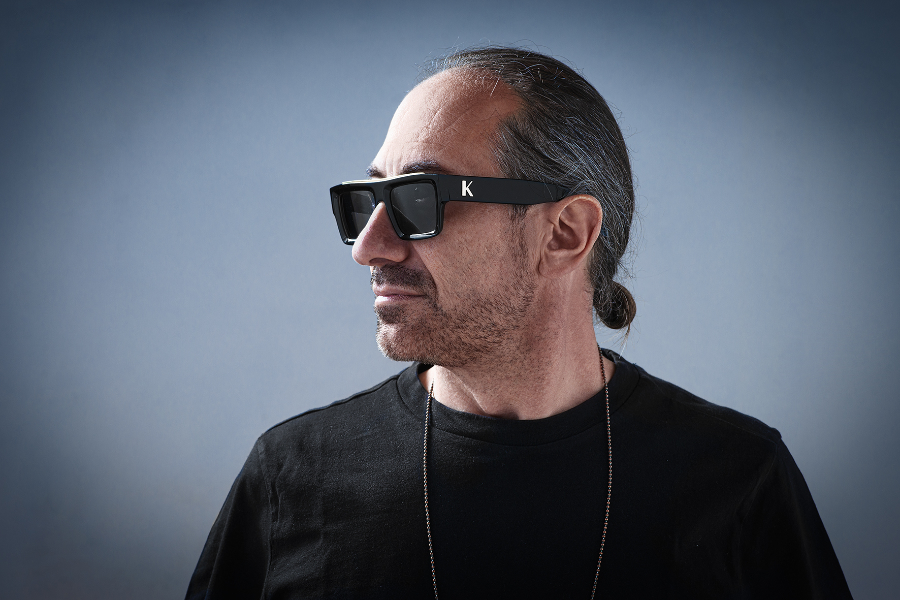
Hailing from Venice, Italy, Marco Lys has been a mainstay on the house circuit for around two decades now, releasing on labels such as Toolroom, Saved, and Relief, and collaborating with the likes of Mark Knight and Green Velvet.
Known for his percussive and groove-focused sound, his latest release is a rework of Sharam Jey’s Shake Your, originally released more than 20 years ago, and a bona-fide dancefloor weapon. 909originals caught up with him.
Hi Marco, thanks for talking to us. Let’s start by talking about your latest release, Shake Your. What prompted you to revisit this track?
Hi guys, and thank you so much for having me! I’ve had a long-standing friendship with Mark Knight and the Toolroom team, and a few months ago Mark reached out asking if I’d be up for reworking a track for a 2025 version.
I had no idea what track it was until I received the email and saw it was the classic Shake Your by Sharam Jey. It was an absolute pleasure to work on such an iconic tune!
What elements of the track did you seek to bring to the forefront as part of your rework?
The original track had some fundamental elements, and the most iconic one was definitely the main riff with that unmistakable M1 organ sound. I knew right away I wanted to keep that—it was important for me to respect the original vibe.
At the same time, I wanted to inject that groovy feel that defines my sound, so everything I added was carefully built around that riff to enhance it without losing the essence of the original.
What has the response been like to date? We would imagine it was quite popular at the recent Miami Music Week?
The crowd response to the track has been truly euphoric. I road-tested it for several months leading up to the release, and every time, the reaction was massive. Testing it out also really helped me fine-tune the details. I wanted to get the maximum impact on the dancefloor.
Unfortunately, I couldn’t make it to Miami this year due to other commitments, but the feedback I got from the Toolroom team, who were there in full force, was incredibly positive!
How has your approach to production changed since you first broke onto the scene, about two decades ago?
Creatively, my approach hasn’t changed that much. I still get inspired by listening to a lot of music from the past as well as from current producers I admire. On the technical side, though, I’ve evolved a lot. Over the years, I’ve learned many techniques and production tricks, and I’ve found the setup that truly defines my sound.
I’ve always worked on Cubase, and with time, I’ve built a few custom templates that I use to start every project or remix. These templates give me a solid foundation with buses, effects, compressors, and a mastering chain already in place – everything I need to get that final sound I’m after.
You have a number of high profile collaborations under your belt, with the likes of Mark Knight, Chris Lake, Steve Lawler and Cajmere/Green Velvet. What do you look for in a collaborator, and how do these partnerships shape your sound?
That’s a really interesting question. I believe a collaboration should be a mutual exchange of perspectives, ideas, and workflows – something that helps both artists grow professionally. Personally, when I collaborate, I look for someone I deeply respect, someone I feel I can learn from.
And it’s not necessarily about technical skills; it’s more about discovering a different creative approach or a new way of thinking about production that I might not have considered before.
Your rework of Cajmere and Dajae’s Brighter Days was a stand-out track from a couple of years ago. Obviously that’s a very well-known classic – when reworking tracks, what care do you take to retain the essence of the original, while also putting your own stamp on them?
For me, it’s really important to respect the original track. First of all, I need to truly like the song. If it already sounds too close to something I’d normally do, then I usually pass. Once I decide to work on it, I identify the key elements that define the original and build my remix around them.
For Brighter Days, I played a lot with the vocal and created a groove with a bit of an old-school feel, but using modern and very percussive sounds.
For another iconic ’90s track I reworked, 20Hz by Capricorn, the essential parts I kept untouched were the Brazilian drum fills and the signature bells. I built a whole groove around those, infusing it with a Brazilian-inspired rhythm and added two huge breakdowns and drops designed to bring the house down!
Your productions are known for their tight percussion and groove-driven sound. What are essential pieces of equipment in your production process?
I’ve been working fully in the box for many years now. One thing I absolutely couldn’t live without is my “eyes” – in other words, my spectrum analyzer. I use the Penguin Audio Meter, and although I’ve tried many others over the years, it’s still the best for me.
Over time, I’ve also built my own personal kick drum library. I know the key of each one, and I know they sound great in the mix.
As for essential plugins, I rely a lot on the FabFilter suite, a few Waves plugins, SubBoomBass, Sylenth1, and Rob Papen’s Blue, which I use for arpeggios or sequenced parts. And of course, I’ve always been a Cubase user – it’s the core of my workflow.
What up and coming producers particularly impress you, and what advice would you give for young producers trying to break through?
There are so many talented young producers out there whose work I really admire; the quality of their productions is incredibly high. I’m also impressed by how prolific some of them are in releasing music consistently.
If I had to give one piece of advice, it would be to focus on developing your own sonic identity. Find your style and make it recognisable. Standing out is more important than ever, especially now that breaking through has become increasingly difficult. But don’t give up. And if you’re lucky enough to have one of your tracks played by a big-name artist, reach out, thank them, and send them your upcoming music in advance. It can open doors.
Is dance music in a healthy place in 2025? What would you like to see more/less of?
I think we’re in a period where, on average, there’s more quality music being released compared to a few years ago (any reference to the EDM era is purely coincidental…?).
What I’d love to keep seeing is a focus on originality and musical quality, and a bit less of that festival-style, cheesy ‘village fair’ sound. Let’s keep pushing things forward with creativity and substance.
What’s next for Marco Lys over the coming months?
I’ve got a lot of exciting stuff in the pipeline at the moment – some big collaborations and solo tracks that I’m really proud of. I’d love to share more, but I’m keeping the details under wraps for now… let’s just say I’m a bit superstitious.
As discussed, my latest release is the 2025 rework of Shake Your by Sharam Jey. We teamed up for this one under the name Sharam Jey vs Marco Lys, and it has just dropped on Toolroom Records.
At the end of April, I’ve got another release coming, this time my second collaboration with my Aussie buddy Ben Miller on Club Sweat. We’ve been testing it out in our sets, and the energy on the dancefloor has been next-level. Super excited for everyone to hear it!
And then there’s summer, which is already looking wild. I’ve got tours coming up in the US, Brazil, Australia, and all across Europe. I’ll be hitting up some amazing spots, including Ibiza at UNVRS with Fisher and Ministry of Sound in London. It’s going to be a busy one!
Thanks to Marco Lys for the chat. Check out Sharam Jey vs Marco Lys – Shake Your here.
Check out the top tracks that the 909originals team has recently discovered through Musosoup here. To feature your music on 909originals, click here. 🙂
About Post Author