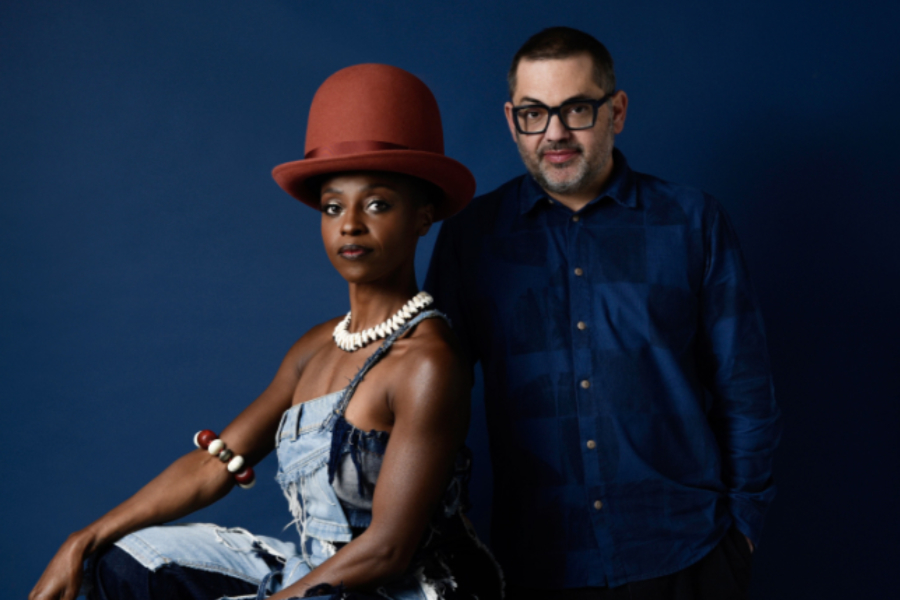
Aderacid, aka French producer Adrien Delaye, is set to release his ‘most accomplished’ work to date, Frequency Colors – a 22-track album that blends IDM, glitch and experimental electronica – on EC Underground on 19 December.
Recorded over a two-year period, Frequency Colors sees Aderacid, who also records under the aliases Waves Explorer and Bob Delay, team up with collaborators including TcomC, animator Emma Catnip and visual artist Lionel Rolineau – in fact, the initial release featuring a ‘jigsaw puzzle edition’, so you can literally piece together the album’s themes while you jam out.
Described as a ‘musical diary’ and an ‘immersive exploration where music intersects with visual and sonic poetry’, Frequency Colors offers a deep-dive into Aderacid’s creative process, and is an exploration of the unconventional paths of electronic music. You can pre-save the album here.
Ahead of the album’s release, 909originals spoke to Aderacid about how the project came together.
For those that might be unfamiliar with your work, how would you describe the ‘Aderacid’ project?
This project is meant to be broad and without boundaries, always searching for new and eclectic influences. It’s a mix of organic elements that can take many different forms. A lot of my tracks are what you might call experiments or tests – there are really no rules.
As for my DJ sets, their direction depends on the place and the theme of each event where I play. Something that’s very important to me is being able to move between genres, whether it’s IDM, ambient, or more dancefloor-focused sounds. I like to explore and offer a wide range of variations within these different worlds.
In the end, if there’s a purpose behind all of this, it’s that my music tells stories – and, like any DJ, one of the things that matters most to me is sharing musical culture.
Aderacid has been around since the early part of the 2000s. How has your sound evolved over that time?
I started DJing back in 2001. Right from the beginning, eclecticism was the core around which my music developed. I actually started composing a bit later, almost by necessity, during a long trip.
I didn’t have my decks with me – just Traktor, a computer, and some headphones, so the possibilities for having fun were pretty limited. That’s when I got Ableton Live. I don’t have any formal music training, and my temperament isn’t very academic, so I never learned music theory.
Sometimes that holds me back, but other times I feel like it actually works in my favour. Over time, you develop your own habits, and then you break them as you keep learning, experimenting, and hopefully evolving.
By choice, up until now, I haven’t used the ‘scale’ function that comes with many sequencers – the one that gives you ready-made scales and chords so anyone can play without hitting ‘wrong’ notes.
In a way, I haven’t made things easy for myself – it’s a slower process, but it’s been a conscious way to learn. But that time has passed, and I’m seriously considering taking advantage of that option in my next compositions. I’ve actually already started experimenting with this approach on some sequencers.
Frequency Colors isn’t my first album, but it’s the most accomplished so far – and, hopefully, the least accomplished compared to what’s still to come. I’m still learning, and even though everything isn’t ‘perfect’, I hope that what I’m offering here will resonate with some people.

What artists have been particularly influential on your Aderacid project, and how does it differ from your other identities, Waves Explorer, and Bob Delay?
I listen to a huge range of different styles, and when I compose, I don’t really think about fitting into any particular genre – I just focus on what I’m creating in the moment.
Most of the time, my thoughts simply drift along with the present, almost like a meditation, leaving little room for that kind of categorisation. What comes out is probably a mix of everything I’ve listened to, from music I discovered recently to sounds from long before I was even born – or at least, what I can remember.
To put it another way, I love listening to songs and music from different cultures around the world, from birdsong to underwater animal sounds… and much more.
Alongside all of that, I enjoy ambient, downtempo, big beat, breakbeat, drum & bass, techno – music by artists like Aphex Twin, Axel Boman, Cylob, Apparat, State Azure, Moby, Chemical Brothers, Ceephax…
There’s also hip-hop and trip-hop, especially from the ’90s and early 2000s (but not only that), with projects like Roudoudou, Hint, Cocorosie, Luke Vibert & Jean-Jacques Perret…
I’m also drawn to reggae, rock, funk, pop, disco, musique concrète, palanque, raï, classical, Afro, indie… all of this, in one way or another, must have an impact on what I do, of course.
The difference between Aderacid, Bob Delay, and Waves Explorer is really just about musical direction. Waves Explorer was created for anything with a tribal sound, but I also use it whenever I feel like making breakbeat tracks, or, for example, when I don’t want to repeat the same name on a compilation.
Bob Delay is sort of a running joke – it’s like the hidden son of Bob Dylan and Bob Marley, something that started with friends. Delay is also an effect I can’t do without, and it’s just one letter away from my own name. In short, it’s a playful alias I use for sets where disco can blend with breaks, house, electro, hip-hop, or world electronic music. Basically, it’s when funkier sounds all come together in a big musical mix.
The tracks on the album have been described as a ‘musical diary’ – how does the album reflect your own creative journey over 22 tracks?
The album simply reflects these past two years –a mix of feelings and sensations expressed with whatever tools were at hand. That being said, Test tehporp 3 & 1 are little ambient live recordings I made back in 2021 or 2022. I find them interesting; I like their form and texture, which, in this case, is 100% analog, both mixing and mastering.
Our favourite track on the album is probably Au bal(…), which we believe was the ‘creative spark’ for the overall project. Do you have a particular favourite, or stand-out tracks?
Who can really say, publicly, which of their creations is their favourite – if such a thing even exists? To be honest, I find it difficult to listen to my own work these days, because I feel I am always progressing, and so my earlier pieces no longer truly reflect where I am now.
How does the visual collaboration with Lionel Rolineau complement or enhance the experimental nature of the album?
This visual wasn’t originally created for the album. I’ve known Lionel for many years and have always admired his work. In this particular piece, I found a connection with my own music – it shares a certain naivety, being simple and complex at the same time.
When I reached out to him, he asked me why I wanted to use one of his works. I explained my feelings, and it turned out we were very much in sync, as he told me those are the same words he uses to describe this piece.
Lionel transports us into a world that is uniquely his own, and I hope to achieve something similar with my music. I’m truly grateful he agreed to this collaboration, which makes me especially happy.
How does the decision to release a jigsaw puzzle to complement the album reflect the thematic idea of a series of interconnected pieces?
It was Florence [EC Underground] who suggested the idea of turning it into a puzzle. She immediately saw the potential of this artwork in that form, and I truly believe she was absolutely right.
On top of that, Lionel told me it was something he had thought about in the past but had never actually brought to life. Now, it’s finally happened, and the result is beautiful. Honestly, I really love this infinite and wonderfully crazy world that he draws us into.

You also worked with Emma Catnip on the project..?
Emma, whose music I invite you to discover and whom I would also like to thank, truly elevated this dream by bringing it to life. You could say it’s the cherry on top of a big cake, floating on a seemingly calm sea that, I’m told, may be deceptively so.
What potential does the album hold for live performances?
It’s a studio album, so it doesn’t really offer any potential in that sense, except that one of these days I will probably play a few sequences from it during live performances. Up until now, I haven’t played much live.
Making it a more regular thing is definitely on my to-do list. The goal is to go out with one, two, or three machines, an 8-track, and two effects pedals. The idea is for it to be portable, simple, and effective.
What’s next for Aderacid in 2026?
The project that is closest to my heart is to release the Aderacid & TcomC project – TcomC is my brother – in the coming months. It will be a small EP with five tracks, featuring original lyrics written and performed by TcomC, over which I will create different atmospheres.
There’s also a collaboration on several tracks that is taking its time, but I hope it will eventually come to fruition. Of course, there are original compositions as well, which I still need to record, and another ambient project that means a lot to me, based on compositions I created for a show a few years ago, for which I invited a friend to join me – though nothing has been finalised yet.
While waiting for all of that, there is, of course, the album coming out on EC Underground on 19 December, and also the release of an EP consisting of an original track by the artist Noise Control and four remixes, including one I produced under the name Waves Explorer, which will be released on 16 December by Magna Terra Records.
Check out Aderacid – Frequency Colors at www.aderacid.bandcamp/album/frequency-colors. Main photo by Samantha Salvy.
About Post Author