

Celebrating 25 years since the birth of electroclash, Demon Music Group/Edsel has just released a new compilation, When The 2000s Clashed – Machine Music For A New Millennium – an 81-track odyssey that explores the scene’s roots, evolution, and influence on later electronic movements.
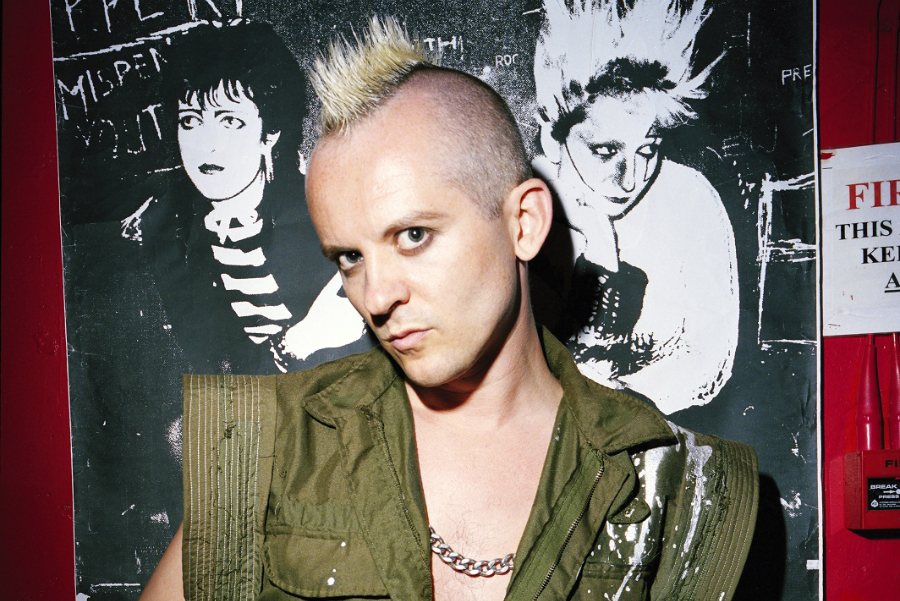
Blending punk attitude with electronic experimentation, electroclash found its spiritual home in a number of underground venues and club nights in locations such as Berlin, Munich, Paris, London, and the Williamsburg district of New York. One such night was Nag Nag Nag in Soho, named after a Cabaret Voltaire classic, which was founded by Jonny Slut, former keyboardist with post-punk outfit Specimen.
Nag Nag Nag was a midweek gathering that defined the era’s underground aesthetic and DIY response to mainstream club culture – established due to music ‘becoming more interesting again’, as its founder noted in 2005 – with a strict no-guestlist policy and a pumping synth-soaked soundtrack.
909originals caught up with Jonny Slut, to chat about the new compilation (which he curated), the rise and fall of the electroclash scene, and the hedonists’ hotspot that was Nag Nag Nag.
Thanks Jonny for talking to us. I have to say, listening to Where the 2000s Clashed really sent me down a rabbit hole. I’m sure everyone who’s spoken to you has said the same – it rekindles all these memories. We used to have a great night on a Thursday in Dublin, Electric City…
Thanks for having me. We came to Dublin a couple of times, actually. Maybe they’re the guys that brought us there. We came once for a Gigolo night and then we came to a more sort of Nag-type smaller place. The name rings a bell.
Yeah – they’d put on some incredible line-ups. One week it’d be T. Raumschmiere, the next Alexander Robotnick, then maybe The Hacker. All this music was just pouring out at the time – it felt like something new every week. For me, I can’t even remember who recommended it or how I first came across it, but I remember buying International Deejay Gigolo CD Compilation 5, and just thinking — ‘f**k me’, this is amazing. It completely blew my mind.
I was kind of the same. It was just an overall sound, wasn’t it? It was really exciting and something I’d never heard before, because it was an amalgamation of all my favourite things as well. It was a bit glam and it was pretty punky, and it was kind of Giorgio Moroder. It was just all the good stuff.
For yourself, was there a kind of ‘year zero’ for electroclash? Was there a starting point where you thought, ‘Okay, this is something new’?
Yeah, there was. I’d heard Adult – Hand to Phone and Fischerspooner – Emerge on Pete Tong’s show on a Friday night – maybe even back-to-back – and I was just like, ‘f**k, what is this?’ It was a real lightbulb moment for me. It made me feel validated.
I had never really embraced the mainstream house stuff. I always liked punky dance music, and that’s what it sounded like to me. I thought, ‘oh my God, maybe I’ve been right all along’.
When I was in Specimen, we ran a club at the same time – the Batcave [an infamous Soho club that opened in 1982]. I’ve always liked stuff that could set the dance floor on fire, you know?
Electroclash was so DIY as well. Dance and electronic music at the time had gone so commercial. You had all those overproduced trance anthems, big synths, huge breakdowns.
And all made for massive venues. I’ve never liked big venues. I’ve always preferred sweaty, unhygienic basements and stuff like that. Electroclash worked perfectly in that sort of environment. When Nag became big and I started getting bookings for all those larger places, I never really liked playing them. It never appealed to me.
How and why did you decide to set up Nag Nag Nag?
I was DJing anyway – I had a longstanding night in Brixton called Marvellous, which was on a Sunday, kind of proto-electrclash in a way. It was a real mish-mash of music. That gave me the confidence to do something by myself.
But there was also a real sense of urgency – I knew that if I didn’t do it within a few weeks, someone else would.
Okay. So the venue fell into place easily enough?
Yeah, I got myself down to the West End and found a little venue, Ghetto.
When people talk about the scene in London at the time, they talk about Nag Nag Nag and they talk about [Erol Alkan’s night] Trash. Was there a healthy relationship between the two, or was there a bit of competition?
To be honest, I never went to Trash because it was on a Monday – Marvellous was on a Sunday night and didn’t finish till 6am. But I’d bump into Erol in the record shops, and he was always really friendly, he might even give me a few tips.
You could draw a parallel and say that acid house was all about Shoom and Spectrum, while for electroclash, there was Nag and Trash, the two standard bearers of the time?
The vibes might have been a bit different. Nag was a gay club and a gay venue. It wasn’t exclusively gay, obviously, but I think there was a bit more of a sense of abandon with Nag. But I never went to Trash, so I can’t really say. Erol came to Nag a couple of times, I remember him coming down.
But you were very adamant from the start to ditch exclusivity – to make it open, no strict door policy.
Yeah, that was never on the cards at all. I didn’t want that. I’ve always disliked exclusivity – it was about everyone being welcome.
By doing that, and by it becoming so popular, you ended up with a real jewel in your hands – a place that was both frequented and sought out by celebrities, but still without the trappings of that celebrity environment. I mean, we’re talking about a time pre-social media.
Yeah, exactly. There was nowhere for them to run, you know? It was a small, sweaty basement — no green room, no VIP area. And I think they really enjoyed that. To be honest, no one gave a f**k when the celebrities were down there. I certainly didn’t.
A lot of the time, I didn’t even realise who’d been down until I’d hear later, “Oh, Gwen Stefani was there,” or something like that.
I guess there was a kind of democratisation of pop culture in that too. The music went back to basics – simple synths, drum machines – and the whole glossy, high-pop aesthetic was reduced down to a sweaty basement. There were barriers being broken – musically, socially. And obviously, gender fluidity too – that whole conversation was really starting to emerge. It was an interesting time, culturally.
Yeah, I think so. I mean, the whole gender fluidity thing – now it’s part of the main narrative, isn’t it? But it really wasn’t back then. And same with sex positivity – I’d never even heard that phrase in the early 2000s. But there was a lot of that energy around Nag and the whole electroclash scene.
It was in the music too. The first track on the compilation is Add (N) to (X), right?
Yeah. They were quite saucy.
I remember Metal Fingers in My Body, the video with the cartoon robot. They used to show that on MTV late at night.
There was a lot of humour in it, you know – metallic tongues in cheeks, as well as metal fingers elsewhere.
And yeah, you mentioned earlier about the amateurism of it – which I’ve always loved. I’ve always liked pop stars who maybe shouldn’t be pop stars – people like Marc Almond, John Lydon, Mark E. Smith. They couldn’t really do anything else but be pop stars. I think that’s quite a British tradition – we’ve always embraced outsiders and sometimes elevated them.
It was also a genre that arrived at the same time as Napster, and at the beginning of the digitisation of music. I think the first time I heard Emerge, I was sent an MP3 of it, and I was like, “What the f**k is an MP3?” This was around 2000 or 2001. So, if you throw that into the cultural mix, it was almost round one of what we now know as the online, Spotify-type behemoth.
When I did a bit of research for the album, I came across a term, which I’d never heard before: ‘blog house’. That was from about 2006 onwards, around the time of the MySpace generation. People were putting out MP3s – we used to call them ‘MP-frees’ – of Justice, Simian Mobile Disco, Crookers, Bloody Beetroots, all that kind of thing.
And that’s kind of how the musical development of Nag went a bit as well, We were just playing the zeitgeist, essentially. Those were the bands that were bubbling up over the years.
You also recorded an album or two as Atomizer.
Yeah, we did three albums actually. I was doing Atomizer for over 10 years – the longest I’ve ever done a project. We were active from 2001, maybe 2002, until 2012. Hooked on Radiation started with me and Jimmy Cauty – one half of the KLF. I knew him a bit from the KLF times, I had been involved in a few of their shenanigans.
He suggested – and I’m not making this up – on January 1st, 2000, that we do a track. He told me on New Year’s Eve that he was going to come around to my studio the next day and that we would start a track. Typical KLF fashion. It had to be January 1st.
Yeah, they had their Y2K thing, around that time, right? F**k the Millennium?
Yeah, that’s how Hooked on Radiation started. He gave me this little riff, and I went away and got my scrapbooks out. We did the track, it took us a while to do, and then he was like, ‘Okay, go and do something with it.’ I didn’t want to do Atomizer as a solo project; I wanted a synth duo. I found Fil [Jones], my partner in crime, who was working on the coat check at the Marvellous Club I was doing on Sunday evenings.
That’s interesting, because obviously then you were not only running Nag, you were also immersed in the scene as a musician.
It was very similar to my experience with the Batcave and Specimen as well. In both cases, I think the clubs were maybe bigger than the band.
Yeah, actually, if you Google your name, the Batcave comes up more than Specimen. With regard to Nag Nag Nag, would you say that it came along at the crest of the electroclash wave?
Yeah, I think so. Trash started before that, late ’90s. There was also a club called Computer Blue, and then 21st Century Bodyrockers. I think maybe we were just before the crest.
I think it mattered that we were midweek, on a Wednesday. A lot of iconic clubs – Blitz, Taboo, Kinky-Gerlinky – were mid-weekers too, where all the freaks would go. That’s important, because you kind of have to mean it.
Obviously, Nag closed down in 2008. Around that time, electroclash had kind of been absorbed into popular culture. It certainly influenced pop – Roisin Murphy and artists like that. For you, Jonny, had the excitement gone?
I think by 2004, the first wave of electroclash was kind of over. The music started morphing into different directions.
We’d been doing it six years, and it was never meant to be a ‘career’ – it was more about idealistic intentions, trying to make the world a bit better, ha ha. It lost its allure over time, and also the venue was about to be demolished for the Crossrail project – Nag and the Astoria were no more. It was the right time to bow out.
The reverberations lingered, though. You’d still hear acts like Fischerspooner in ads during the 2010s. It never really went mainstream; it started underground, and a lot of these acts never reached the commercial success of other genres. But as an instigator of a movement, there are definitely echoes now of what happened back in the early 2000s. It’s great that you included an ‘origins’ CD, so you can trace the story chronologically and see where it all came from.
Yeah, I was thrilled we could include an influences CD as well, because that’s really the genre I love – that post-punk stuff. Listen to something like Warm Leatherette. It has never been bettered – such an iconic track.
Wrapping up, Jonny, why was the time right for you to pay tribute to the scene, obviously 20-odd years have passed?
Well, it was kind of the 25-year anniversary of electroclash. I had done a Batcave one three years ago for its 40th anniversary with Mark Wood. We always had it in mind that we could do one centred on electroclash and Nag. Mark came up with a brilliant title, so we had to do it.
It took a couple of years to source all the tracks – figuring out who owned what was tricky. Also, compared to the Batcave compilation, it felt like it was only yesterday, but of course, it was 20 years ago.
I guess to close – there are so many tracks on the compilation. In terms of the sure-fire stompers at Nag, what are your go-tos?
It has to be Vitalic.
Ha ha. the entire Poney EP, right?
Yeah, the entire EP. You can’t pick just one. Hand to Phone was always special to me as well. There were so many tracks, though, to be honest.
When The 2000s Clashed – Machine Music For A New Millennium is out now on Demon Music/Edsel. Check it out here.
About Post Author


