

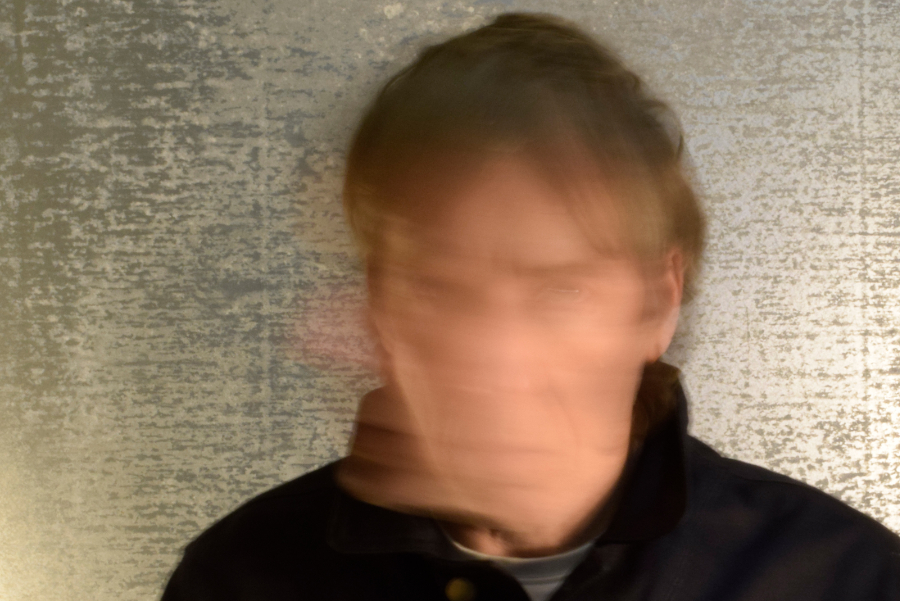
While Death In Vegas may have burst onto the scene at the height of the Britpop/Big Beat era, you could tell from early singles such as Dirt, Aisha, Dirge, Scorpio Rising and Neptune City that this was a group that didn’t want to be pigeonholed into one particular genre.
Death In Vegas has gone through many incarnations over the years, but the one constant has been founding member Richard Fearless (aka Richard Maguire), who has overseen the evolution of the project from scuzzed-up debut Dead Elvis to the hazy electronica of 2016’s Transmission, the group’s most recent long player until Death Mask arrived in June of this year.
Recorded over a difficult two-year period – including the death of his father – Death Mask is a deeply personal album, but is also, sonically, one of Death In Vegas’ grittiest, like ‘light refracting through a filthy, cracked stained-glass-window’, as a press release put it.
Fearless, who recently released two solo albums, Future Rave Memory and Deep Rave Memory, before returning to the Death In Vegas project, admits to being influenced by artists such as Ramleh, Ø, Terrence Dixon, Jamal Moss, TM 404, King Tubby and Scientist on the new record, while also absorbing the industrial aesthetics of his Thameside Metal Box studio – which he is in the process of moving from.
The return of Death In Vegas also marks a return to the live circuit, with appearances at Deleste Festival in Spain and Beyond The Pale in Ireland already under their belt, and upcoming shows planned for the summer.
909originals caught up with Richard Fearless a couple of days after Death In Vegas’ stellar Beyond The Pale performance, and we started by asking him how it went.
Well, we had a few technical difficulties, which was a little off-putting, but two shows in there’s always going to be a couple of things.
It’s good to be out on the road. And you always need a few shows under the belt to get into the ease of it. Back in the day you’d do some warm-up shows, but this time we went straight into a festival in Valencia and Beyond the Pale as our first two performances in a long time. But yeah, it’s been good to take it out of the studio, because there’s been a lot of pre-production.
To be honest, the last time I saw Death in Vegas live was about 25 years ago. If I recall, you had elements of a band back then—you had a live drummer and all that. So, what’s the live setup like now? Who’s in the current Death in Vegas setup?
There are three of us in this incarnation. There’s Sinead, the synth player – she records under the name of Surgeon’s Girl. Her stuff’s fantastic. She’s done a string of releases on Liberty Sounds, a great Bristol label, and I’ve been into her material for a long time. I curated a night at MOT in South London a while back, and she was one of the first people on my list. She’s classically trained.
And there’s also Nick Powell – the engineer I’ve been working with for the last three or four albums. He’s a fantastic engineer. So Nick’s on the drums side of the show, and Sinead’s doing all the synthesisers live. And I’m doing the effects and a few other things, like the 303.
Over the years it’s been many different things—we did a Glastonbury once with 12 people on stage. It depends on where the band is and what we’re doing. But this is the start of this current setup.
It’s interesting you say that. So it feels like the start of a new chapter for Death in Vegas. I mean, just looking at the setlist for Beyond The Pale – Girls was probably the biggest hit in there, and even that was just a snippet near the start of the gig. There was no Dirt, no Aisha, no Dirge – none of the bigger Death in Vegas tracks. That’s obviously deliberate, right? Are you trying to turn the page, shed Death in Vegas mark one, or even mark two, and move into a new iteration?
Yeah, on some levels. But also, a long time ago I decided I didn’t really want to take a band out on the road. There’s a lot of reasons for that, but the main reason is the tools of my craft aren’t a band. Before I started Death In Vegas, I was a DJ playing Detroit techno.
I’ve done the live band thing – a dance band that crossed over, straddling rock, psychedelia and dance music. Now, I’m doing all my work in my studio, and that’s what I want to Death In Vegas to represent now. The idea of trying to put a four or five piece band together and do old songs, unfortunately, it doesn’t interest me, and the only way I can keep doing the project is if I feel there’s a sense of evolving it and pushing it forward.
When I first formed the band, I wanted to do something a little left of center and exciting. And when I started doing it again, I wanted to keep that mantra of it being not some throwback thing. I’m thinking ‘how can I evolve it and move on from the last record to the next one’?
I want to talk about Death Mask, since it hasn’t been out that long. It’s interesting to me, because you’ve had a couple of major solo projects in recent years, but you haven’t released a Death in Vegas album since 2016. And this one – just in terms of tone, the song titles, the theme – it feels like a very personal album. But you chose to record it as Death in Vegas rather than under Richard Fearless. Is there a reason for that?
Firstly, I decided to do it as Death in Vegas before I started it, so that’s an important reason why it was Death in Vegas. The reason it was a personal record on some level is because during that period, over the two years, I was going through a lot.
That’s when I think I can do my best music – rather than thinking, ‘Well, today I’m going to make a deep house track’, I need to go into the studio and be like, ‘How am I feeling right now, and how can I express this?’
I’d made these two Richard Fearless albums, and I felt I was ready to do another Death in Vegas album. But that comes at a cost – doing Death in Vegas – because I know that if I’m going to do it, I’ll want to release it myself. And that’s pressure. And I know that it has to be done to a certain level; otherwise, it’s a waste of time releasing it because no one will hear it. So that needs X amount of work. And then there’s going to be the live side, and how much pressure I take on mentally to try and deliver that.
So, there’s a lot to negotiate in my brain before I’m ready to take the project on again.
Okay, so you have to be in the right headspace to do a Death in Vegas project.
Yeah, and it just happened that the last couple of years were intense for various different reasons.
Obviously, aside from the personal aspect, there are elements that are reflective of the state of the world as well. I mean, that obviously influences the sound too; the unpolished, aesthetic of it, the rawness of it.
While My Machines Gently Weep was supposed to be a reflection on that. I had this loose idea in my brain, I was thinking about the way I used this equipment in the studio and, conversations going on around about AI and which way things are going.
I was trying to match it by romanticising the despair of all these machines weeping at what’s going on, talking to each other, in a way. So, I was trying to capture the sound of a world falling apart in that song. Which is hard in an instrumental techno track.
With some of the tracks on there, like Lovers and Hazel – that’s probably the hardest stuff you’ve done as Death in Vegas, in terms of the intensity of it. I think Hazel is 140 BPM or something?
Lovers has got that really harsh sound in it. I remember we were getting that sound and it was just like, ‘whoa, what the f**k’s that?’
Is that the scream sound? Oh my God, it ends so abruptly with that scream – you’re just like ‘what the f**k?’
I don’t know if you know an artist called Container. I released one of his tracks on an EP on Drone. I think he’s an absolute genius – he makes this really abrasive sound. He comes from the East Coast American art rock scene – you could put him in a bracket of bands like Lightning Bolt and all those very performance-based acts.
I remember borrowing a four-track cassette player from Jim Finer — he works at the studio where I’m based, but he’s also, more famously, the fiddle player in the Pogues. He’s now a sound artist. He lent me a four-track, and Container uses a four-track. And he has this feedback sound which I’m always fascinated with.
We were just mucking around and managed to get the sound – we were like, ‘f**k, that sounds like Container!’ That’s the scream sound.
But another thing that’s really important: that song’s got two halves. It’s got the beginning, which is supposed to be like a battle cry, a wake-up call. And then there’s this moment – I’m trying to channel a certain moment on the dancefloor that you sometimes hit, that everything’s okay, and joy and love. The unity of the dancefloor. That’s one of the things I was trying to go for on that record – the unity of rave culture.
One of the tracks is called Róisín Dub(h) – obviously there’s a connection with Ireland there. In terms of its origins, I’d imagine it’s based on the folk song or poem, rather than the venue in Galway – or maybe it’s a bit of both? The theme of the original poem is wistful, nostalgic, a bit nationalistic. How did that track come about?
One of my father’s favourite songs was Róisín Dubh. My parents split up when I was quite young. Years later, my mom, my sister, and I got a dog, and we named it Róisín after Róisín Dubh, the little black rose. She was a little black mongrel, but she was a rose to us.
That song actually started as a dance track, a really big dance track. Do you know Mark Ernestus, one of the founders of Hardwax Records in Berlin? He’s one half of Basic Channel with Moritz von Oswald. There’s a dub track he did – Mark Ernestus Meets BBC.
It’s really incredible. It just moved me so much when I heard it. It’s like this distillation of dub down to its various components – that was something that just hit me massively as an inspiration. I think that’s been something I’ve been searching out in my music all the time anyway. The techno I was into, and the dub – I was getting drawn into more of the minimal side, and that includes noise bands.
So I wanted to use that approach of doing a song in the studio – a recording where I have all my separate parts – then start doing dub mixes from my desk with my material, and seeing how far I could push it. In Róisín Dub(h), I’m dubbing out the various stems rather than the original track. So it’s very stripped down.
But also, when I was doing that song, I was definitely having some big waves of grief. It feels like a sad song when I listen back to it. I was very much concentrating on the grief and the feeling I was going through.
Ok, so you’re separating the different parts, then doing dub-style breakdowns and effects on each, and assembling them back together? That layering and heavy use of reverb and delay give it an almost ghostly feeling.
It’s absolutely that, and it’s particularly on songs like Robin’s Ghosts, Roisin Dub(h) and Chingola. With Roisin Dub(h), I went back to it and did the process maybe three times. I would take those stems and distill them again and again – I kept telling Nick that I wanted it to sound like we were listening to it coming from next door.
In the past, I’ve definitely been inspired by the river, which was beside the studio. You used to get a lot of these party boats going up and down the river, with soundsystems on, and depending on the way the wind is, you get hit with these waves of sound – but it drifts, it’s not a constant.
So it has this ghostly quality, like ghosts of the past. These are the things that are going on in my head when I’m working, what inspirations me when I’m doing the mixes.
Correct me if I’m wrong here, you were largely using a lot of analogue equipment on Death Mask, right?
Only analogue.
Do you think you would get the same authenticity if it was digital, doing the same thing? I read an article where you were talking about the voices on the tapes bleeding through, even when they’re recorded over multiple times – that’s something you can’t emulate with digital, maybe?
I think there’s a quality that comes from all that analogue gear; it has its own sound signature. It has added to the record 100%.
At the same time, there are tonnes of records that are in my record box that are all digital, and I love that Central Processing Unit-type electro sound. But I just don’t make that sort of music. Everything I’ve got in the studio, I’ve got there for a reason, for what I think it sonically brings.
Is there a reference in Death Mask as well to the fact that your studio – the famous Metal Box – is moving? Certainly it seems like the location, the setting, even just the aesthetics of it, influenced your sound on the last few productions.
Being moved to a new location has actually got other benefits. I’ve always had two studios anyway – I have the container and I have a loft space where I do Drone and the visual side of my work. My new studio is opposite that. So on some levels, it feels like it’s a new chapter. It’s a lot more streamlined.
Also, I need to have help with the label – it’s time to put my big boy’s pants on, and take it to the next level. So, it feels like ia new chapter. I think it’s a very inspiring thing working while looking down a river and following the world go by, sure, but there’s a lot of other things going on in my head that I can channel into music.
In terms of Drone, I guess it would be fair to say that the new album is a reflection, or a template, of Drone as a label. How is the label going?
Well, it’s going [laughs]. This is our 27th release, which is cool, and the next two releases are already lined up. It’s hard doing a label in this day and age, to be honest – but it feels really important. Also, it would have been really hard to have done these last three albums if I was handing them over to someone else.
I feel like being on Drone has been the most creative, the most liberating time in my musical career. I was with BMG Universal when I was 20 years of age. They were the ones asking ‘who’s going to be singing on the new record’ and stuff like that.
It’s been really liberating doing Drone, and a lot of it has been down to the support of my partner, who helps me with the label. We do all the visual work together. It’s great having really supportive people behind you.
But yeah, as far as Drone goes, it feels like it’s picking up. This record’s done well – we just got number one dance album in the charts, which is brilliant. So we’ll see – hopefully it’ll carry on for another 27 records.
On the previous Death in Vegas album, there’s a track called Transmission with Sasha Grey, and I feel there’s definitely a continuation from that sound into what you’re doing now. Do you think there is a thread with what you’re doing now that goes back to your earliest work on Dead Elvis or The Contino Sessions? Is there a sonic continuum?
On some level, of course there is, as I was involved in it. We did Rekkit [from Dead Elvis] in the most recent shows – that’s one of the older tracks.
But as far as the link, I’m not really trying to look back and be like, “Well, how can we do those old songs and, you know, make them fit for 2025?” I’m trying to make the live show an experience where people can just get lost in it for 90 minutes. There can be points of reference, but they don’t have to be the main part of the conversation.
In terms of older tracks we did live, we did Savage Love, we did Lightning Bolt – and that’s nice for me, because they were the songs that I’ve always really loved. I guess the live side is quite personal for me, as there are songs that I really like to do.
Also, and this is something I’ve been talking about for ages – there’s a best-of compilation that I really want to do, with lots of live takes, rarities, lost mixes and stuff. Maybe when I do that album, that’ll be a better time to do a different incarnation of the band.
But right now, this live show is a reflection of the record that’s out at the moment. Also, there’s a reason that Death Mask is the last track on the album – that’s where I want to take things going forward.
Keep up to date with Death In Vegas’ current tour dates here. Death Mask is available now via Drone Records. Main photo by Elaine Kin.
Check out the top tracks that the 909originals team has recently discovered through Musosoup here. To feature your music on 909originals, click here. 🙂
About Post Author


