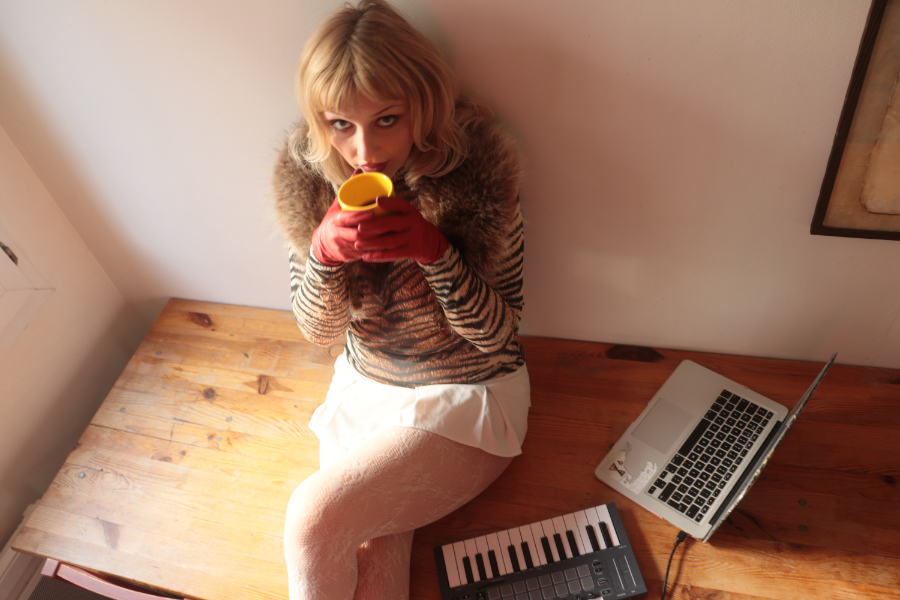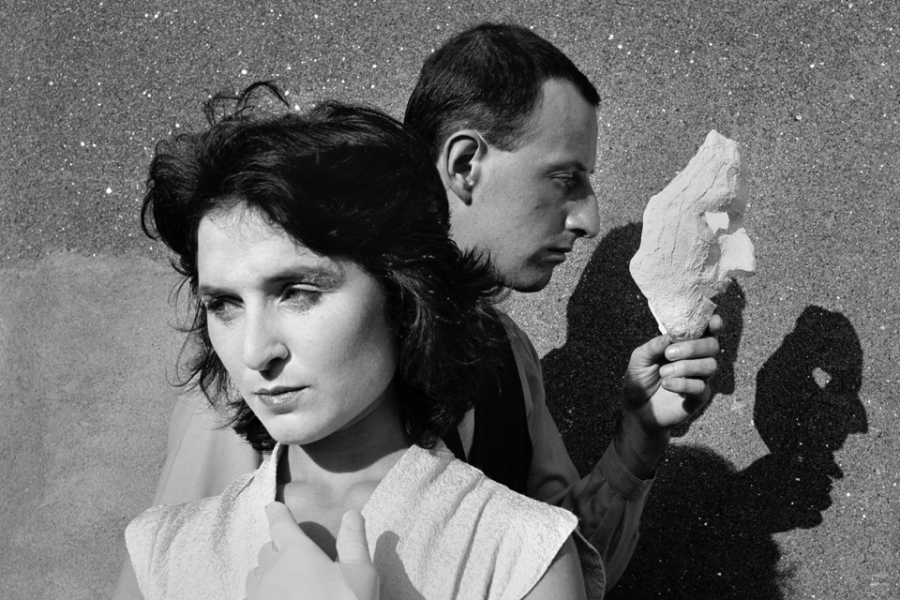
When indie-pop icon Caroline Polacheck – widely described as ‘Gen Z’s Kate Bush’ – released an extended version of her LP Desire, I Want to Turn Into You in early 2024, attention turned to a musical curio buried in the second half of the album.
The track, Spring Is Coming With A Strawberry In The Mouth (which to date has garnered more than 10 million streams on Spotify), is a cover of a near 40-year-old piece by Operating Theatre, an Irish musical/theatre combo founded in late 1980 by electronic composer Roger Doyle and performer and actress Olwen Fouéré – which in recent years has been enjoying a renaissance.
Despite having never officially called it a day, Operating Theatre’s output since its 1980s heyday has been sporadic – theatre productions over the years have included 1984’s The Diamond Body (adapted from a short story by Aidan Matthews), 1987’s The Pentagonal Dream (written by Sebastian Barry), 1999’s Angel/Babel, and the live installation Here Lies.
Outside of Operating Theatre, however, Doyle and Fouéré are among the most prolific artists in their respective fields – Doyle has more than 30 album projects under his belt, while Fouéré has appeared on stage in London, Paris and New York, as well as in countless movies and TV shows.
Musically, Operating Theatre’s last official release was 2008’s Operating Theatre – The Early Years, a compilation tracking the group’s evolution, however in recent years, a new generation has grown to appreciate what may well be 1980s Ireland’s best kept musical secret.
In 2022, Allchival Records, operated by All City Records’ Olan O’Brien’ released Spring Is Coming with A Strawberry in the Mouth as a double vinyl album (selling out rapidly) while the momentum behind the Polachek cover saw her version of Spring Is Coming… – “it launched us into another sphere,” says Doyle – signed up for use in a campaign for fashion house Gucci. Doyle was also approached by Chloé to use the original version for its worldwide campaign.
On 18 June, Operating Theatre play a rare live show at the National Concert Hall, as part of the Musictown festival, curated by Leagues O’Toole and David Connaughton. Tickets are still available, and can be purchased here.
Ahead of that performance, 909originals caught up with Roger Doyle and Olwen Fouéré to discuss the past, present and future of Operating Theatre. We started by asking them about the forthcoming show on 18 June.
ROGER: The rehearsals are going really well. We’re curating our own material. What do you leave out, what do you keep, what do you hope the audience will make of it?
There’s some interesting stuff. One of the things we added in rehearsal was a video of Olwen and me on a programme called the Live Arts Show in 1983, performing Part of My Makeup. We found that video on the RTÉ archive. We’re gonna play the video and perform the work at the same time. So you’ll get this double image of the past and the present all going on at the same time.
OLWEN: Most of the performances we did before were really in a big performance context – a lot of development, several weeks of rehearsals, all that kind of stuff, you know? So, when it came to this thing, we just thought ‘what are we going to do?’
As I said to Roger, “We just have to start working.” When we start working together, things always tend to fall into place.
I would say it’s a kind of experiential journey. I mean, it is fundamentally a concert and the focus is very much on the audio, but there is still a performance element. It’s like a journey through our back catalogue, but not linear.
Roger’s music has skipped two or three generations – the younger generation love his work, which is something I’m really thrilled about because he’s produced so much incredible music.
At the time it was made, I remember some of our contemporaries liked the music, but we had one friend who said that, when listening to one of his albums, “it makes me want to vomit.”
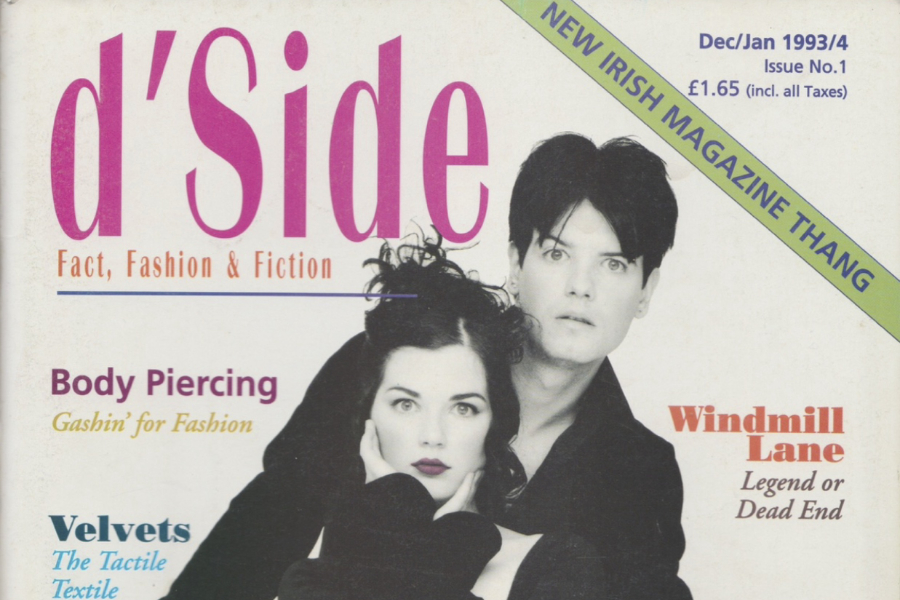
The Dublin in which Operating Theatre emerged was a primordial soup of artistic experimentation, driven by the white heat of punk and a generation of young Irish contemplating their place in a world in which the old norms were being questioned for the first time. It was a hotbed of creativity, and it was therefore somewhat inevitable that Fouéré and Doyle would cross paths.
ROGER: I was one of the crowd of musicians and theatre people who congregated around the Project Arts Centre in the late ’70s, early ’80s, run by Jim and Peter Sheridan. Punk bands used to play there regularly, and I used to give improvisation workshops down there on a weekly basis. There was lots of stuff going on.
I had composed a long piece called Thalia, and it was going to be in the Festival of Music at the Project Arts Centre, in January 1978. I wanted somebody to improvise a dance to it. So I asked Jim Sheridan, “Do you know any dancers? I can’t play a 30-minute piece through a pair of loudspeakers without the public having something to look at.”
So that’s how I met Olwen. He said, “Yeah, I know just the person you should meet.” And she did a fantastic job in the concert that ensued shortly after.
OLWEN: I was orientated towards the visual arts, and I think it was Jim or Peter Sheridan who mentioned to me that Roger was looking for somebody. We were introduced, and we went into a room and he put on the music and I improvised to it. That’s how we started working together.
My own orientation at the time was very much towards non-verbal theatre – although I’ve done lots of verbal theatre since then. It definitely felt when Roger and I started working together, it was like a neighbouring planet coming into our respective orbits.
We felt at the time that there was nobody else doing what we were doing, so we’re going to create a space to do it – the art of necessity of creating that space.
It wasn’t a conscious punk aesthetic, although I suppose in its manifestation it was. But it was highly disciplined as well – there was quite a lot of rigour in the work, and a carving out of a particular type of space, I think, which just wasn’t there at the time.
The pair’s willingness to make music a core element of theatre – coupled with the fervent atmosphere of the Project – led Doyle to take the next logical step, and put together a single, Austrian, which despite having a “low percentage chance of success”, as he puts it, was released on CBS in 1981.
ROGER: I would compose music for various theatre shows they had on in the Project. They had an old piano there, and I would compose music on the fly—live piano on stage with the actors.
Olwen and I worked on a very memorable production of The Fall of the House of Usher around that time, which we spent around three months on. We were working so well together — in the company of actors and other musicians – that I decided to make a pop single.
I hired a studio and made the single, Austrian, at my own expense and asked Olwen to sing on it. It had heavy drumbeats and some nice – but strange – harmonies.
OLWEN: When we got together in musical terms, it was like tapping into the music from the mothership.
From the outset, the group was to have a dual identity – as much about the theatrical as the musical, a two-headed artistic endeavour, under a unifying name, Operating Theatre.
OLWEN: That was always the principle: that it could be both.
ROGER: I remember the moment when a friend of mine said to me, “You know what you should call yourselves? You should call yourselves Operating Theatre.” It was one of those moments when I thought, “F**k yeah. That’s a great name.”
The early 80s was a formative period in popular music, as electronics increasingly became woven into pop’s tapestry. For Doyle, mastery of one particular piece of equipment was essential to give Operating Theatre its sonic identity.
ROGER: In the early 80s, I got very fond of synth pop. I was listening a lot to Thomas Dolby, Kate Bush — and they were working a lot with the Fairlight Computer Music Instrument.
I was on the dole, and one day, I met a drummer friend of mine in the dole office, Sean Devitt. He told me about this studio opening in Bray that was buying a Fairlight. He knew them, so I asked him, “Oh God, tell them about me, will you? Introduce them to me.”
Thanks to Sean – who plays drums on Spring Is Coming, actually – I got to meet them. The studio bought the Fairlight, and I had the use of it.
I actually moved out to Bray to be close to the Fairlight. Any time there was ‘dead time’ in the studio, I was in there, working out how to use it. And it took months to figure out how to make it work, how to compose music on it.
The single Austrian was followed up by Blue Light and Alpha Waves/Rampwalk in 1982, while the following year saw the release of the group’s first album, Miss Mauger – named after Fouéré’s mother – on Kabuki Records. What started as a musical trickle was quickly developing into a surge.
OLWEN: Probably our first public performance of any song was in 1983 with Part Of My Makeup. We were told we were going to appear on RTÉ, and Roger had this track, so I walked around playing it on a Walkman in my ears and wrote the song – that’s basically how that came about.
I’m proud of that one. It’s not the first song I wrote, but it’s definitely the most enduring one.
ROGER: I never thought of myself as doing anything particularly new. At the time, it felt like “Let’s try that. Let’s see if I can get that to work.”
Operating Theatre’s efforts draw attention from U2, who sign the group to their fledging Mother Records label – home to groups such as In Tua Nua and Cactus World News. In 1986, Operating Theatre went into the studio to record a double A-side single, Queen of No Heart/Spring is Coming With a Strawberry in the Mouth, bringing in Elena Lopez as the main vocalist. Bono sat in as executive producer on the recording. On its release however, the ‘U2 machine’ failed to click into gear, and the single underperformed.
ROGER: I used to hang out with U2. I sat in on The Unforgettable Fire recordings. I had dinner with them at the studio and in Bono’s house.
We were in Windmill Lane Studios, which was costing a thousand pounds a day. I remember Paul McGuinness [U2 manager] saying to me “You’re next.” That filled my head with a fantasy of “maybe I can make a breakthrough here – isn’t this exciting”, you know? He shouldn’t have said it really. In the words of Monty Python, “…and then nothing happened.”
The consensus is that somewhere along the line, this was costing them a lot of money and maybe they could use it as a write-off against tax, or something like that. That wasn’t just me – loads of people said that at the time. I don’t know if that’s true. It’s just a theory, but it is a kind of explanation.
Spring Is Coming and Queen of No Heart were really fresh in 1986. They really should have done something with them. Also, I know I’m biased, but to me, they’re still fresh 40 years later.
Bloodied but not unbowed, Doyle set forth to the UK to meet with label representatives there, in a series of meetings arranged by U2.
ROGER: I was sent over to London to meet Zomba Music. I met their rep in his offices and he already had the recordings from Mother Records. I thought that maybe something could happen with them. But he just wasn’t interested.
He said, “We get a lot of people looking to make records, we get a lot of stuff in, and there’s very little that we respond to.”
U2 had set up the meeting, so what I should have said to them at the time was “You invited me over here—I didn’t send you any bloody music. You invited me”. Anyway, it came to nothing.
Also, I played Austrian to Geoff Travis at Rough Trade, but he said, “It’s too commercial, I’m not interested.”
With no record deal emerging, and given the respective workloads of both Doyle and Fouéré, Operating Theatre was put on hiatus – as an Evening Herald article noted in 1987, ‘all it takes is £7,000 to buy a second-hand Fairlight computerised keyboard and [Doyle will] be gone, hidden away somewhere, composing contemporary music’. Doyle set to work on what would become his magnum opus, Babel, which took the best part of the 90s to complete – and prompted a realignment of his and Fouéré’s ‘planets’ as the Millennium approached.
OLWEN: Operating Theatre never ‘ended’. In 1987, we did The Pentagonal Dream. Then we had a gap, and reunited ten years later, when he was bringing out Babel.
As I said to him, “I’ve got this idea, to create this piece called Angel/Babel, which had a lot to do with the millennium as well, and the information superhighway. This is when the internet was taking off.
ROGER: It came together naturally. I met Olwen for coffee and we were like, “Will we, won’t we? What do you think?”
We just thought, “Come on, let’s have another go.” We applied for a grant from the Arts Council, and we were lucky enough to get Arts Council support for a number of years. And then in about 2008, we brought out a book – a hardback book and two CDs in the front and back cover – and then we called it a day. For the time being at least.
Which leads us to the present day, and Operating Theatre’s first performance in over a decade. The world has moved on a lot since Doyle and Fouéré embarked on their sonic/theatrical journey (try explaining social media to a time traveller from the early 1980s) but the ethos from which the group was established remains as prevalent as ever. Shake things up. Be bold. And, where possible, try not to conform.
OLWEN: When we formed in the early 80s, the word ‘career’ never crossed my lips. Nobody was thinking career — everybody was driven by some kind of necessity. And the work happened because it HAD to happen. That’s the only way I can describe it.
ROGER: Theatre is still so dominated by the word. The reason we formed Operating Theatre originally was that we were sick of theatre where actors were just standing around on the stage, talking non stop.
We felt that there was more to theatre – it can’t keep going like this. Music needed to be part of it – as important as the words. Or even get rid of the words completely.
The typical approach to Irish theatre, or all theatre really, was ‘from page to stage’ – that was how it was described. With Operating Theatre, there was hardly ever a page, and there was hardly ever a stage. We did site-specific things, performances in all kinds of places. We broke the mold of ‘page-to-stage’.
Operating Theatre perform at the National Concert Hall, Dublin, on 18 June. Tickets are available here.
Check out the top tracks that the 909originals team has recently discovered through Musosoup here. To feature your music on 909originals, click here. 🙂
About Post Author