

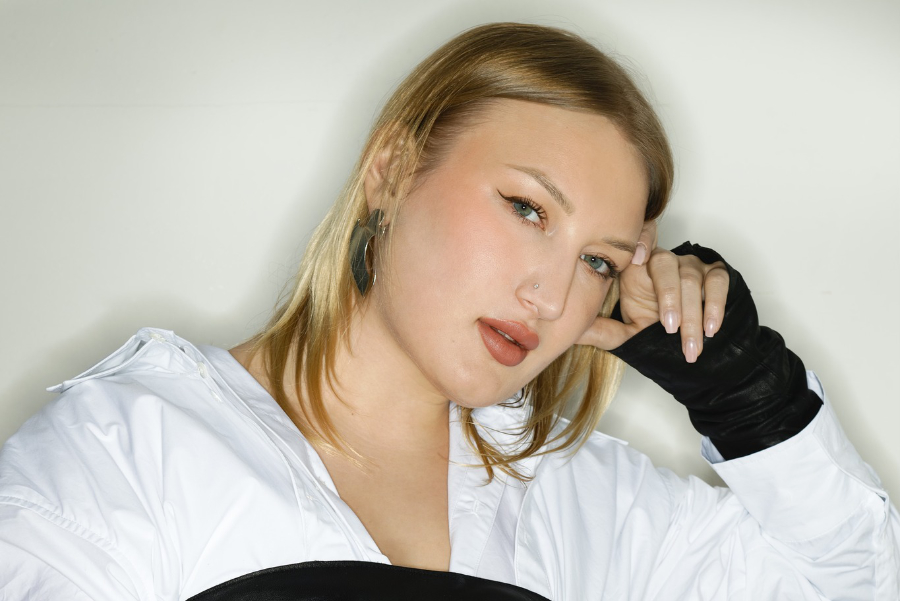
In January of this year, Beatport recognised Grace Dahl as one of its ‘next class’ of up and coming DJs – the latest acknowledgement for the rising techno talent and SDT Recordings label head.
Born in Hungary to a Finnish mother and Hungarian father, and raised in Amsterdam, Dahl was immersed in electronic music at a young age – her parents organised dance events in Budapest in the 90s – and since taking to the decks herself, the Vault Sessions resident has appeared at Berghain, Awakenings, RSO, Intercell, and recently performed a Boiler Room set in Lisbon.
She’s released on labels such as EXHALE, Voxnox, Deestricted, and IMF, as well as her own imprint, has just released a new EP, System Failure, and is currently preparing for her next All Night Long set with Vault Sessions at Radion Amsterdam on 29 March. 909originals caught up with her.
Congratulations on your recent release, System Failure. For those unfamiliar with your productions, how would you describe it?
Thank you! Generally, I love creating tension and release in my productions, so you’ll hear gritty textures, rolling low-end, and unpredictable elements that keep things dynamic. It’s functional for the dancefloor but still carries a bit of personality — something slightly unhinged in a controlled manner.
That said, my music isn’t fixed to one particular style. I thrive on variety, and I think that’s immediately clear when you go through my releases. The first release on my label, for example, is heavily house-inspired and features my own vocals, whereas I Like ‘Em Sexy leans deep into electro influences.
With System Failure, I went for a pretty timeless techno sound. For me, it’s really about creative freedom rather than being boxed into something. I want each release to be a fresh expression of what excites me at the moment.
You launched Serial Disc Touchers (SDT Recordings) in 2024. What is the vision behind the label?
What I’ve been personally missing for many years was the possibility to experiment a bit more publicly. During my decade of being involved in the industry, I’ve sometimes felt a bit pigeonholed into a certain style, feeling like a certain sound was expected from me if I wanted to be ‘successful’.
However, during this journey, I’ve come to find out that I simply love too many different genres and styles to strictly stick to one. I also know I’m not the only one, and I personally know lots of producers who make all types of genres and styles, but these usually never see the light of day because it doesn’t ‘fit’. With my label, it doesn’t need to fit — we create the space for it.
The key message I’d like to convey with the launch of my label and its releases is to have fun! I’m not reinventing the wheel here, and I’m also not trying to rewrite the script… just a few new lines perhaps.
What are the challenges involved in running an independent label in such a competitive market, and how are you seeking to overcome these?
One of the biggest challenges is standing out. With so many labels out there, it’s easy to get lost in the noise, so having a strong identity is key.
Another challenge is the workload — handling A&R, distribution, promotion, and making sure every release gets the attention it deserves. I’m tackling this by keeping things selective, focusing on quality over quantity, and building a community around the label where artists feel encouraged to experiment.
At the end of the day, I want SDT to be a space where both artists and listeners can have fun with music, without overthinking whether it conforms to expectations.
With a Hungarian, Finnish and Dutch background, how does this blend of cultures manifest itself in your music?
I think identity is something fluid rather than fixed, and that reflects in my music. Growing up between different cultures, I never felt fully tied to just one. There was always a sense of movement, of existing between spaces rather than within a singular definition.
That naturally comes through in the way I approach music: I don’t see genres or styles as rigid boundaries but rather as elements that can be blended, manipulated, or reimagined.
Was there a particular club night or event that led you to fall in love with electronic music?
There were actually two phases to my journey into electronic music. Before I fell in love with techno, I was deep into drum ‘n’ bass. I spent years going to events like Major League and 50Hertz at Melkweg in Amsterdam.
But the real turning point for techno was in 2017 when I went to the ‘UK Hard Special’ Awakenings event at Gashouder. The scale of it, the hypnotic power of the music, and the way the crowd moved as one… It felt like a complete immersion into something bigger than just a night out. That was the moment I knew techno was my world.
Funny enough, a decade after first stepping into Melkweg to party, I returned to that same venue to give a SEEDJ Masterclass. It was a surreal full-circle moment, standing on the other side and sharing my own experiences with the next generation of artists.
You started your career at 18 and developed yourself into an established artist quite quickly. Was there a particular moment when everything ‘clicked’ for you?
I don’t think there was a single ‘aha’ moment, but rather an accumulation of breakthroughs step by step. Winning contests to play at Unpolished and Soenda Festival in 2019 gave me my first real taste of what was possible.
Playing for Vault Sessions for the first time in 2020, performing during the Unmute Us demonstration in 2021, and becoming a Vault Sessions resident in 2022 were all key milestones that made me feel like things were falling into place.
And then there was Berghain last October. That one felt like the culmination of everything I had worked toward. It wasn’t just about playing at an iconic venue, but about realising how much I had grown as an artist and how far I had come since those early moments. Each of these steps shaped my journey in a different way, and looking back, they all played a role in things clicking together.
Vault Sessions has been a major part of your journey. How has being a resident shaped your sound and career trajectory?
Vault Sessions has been instrumental in shaping me as an artist. It gave me a playground to experiment, take risks, and truly refine my craft.
Being a resident means more than just playing regularly. It means learning how to read a room on a deeper level, understanding the nuances of different time slots, and developing a strong sense of narrative within a set.
Beyond the technical growth, Vault Sessions has given me a sense of belonging in the scene. It’s a collective that values artistic integrity over trends, and that kind of environment pushes you to stay authentic rather than conform.
The support I’ve received has been invaluable, both in terms of opportunities and the creative freedom to explore my own direction. I make sure to express my gratitude every chance I get because it’s not just a residency — it’s a family that has played a huge role in my journey.
You’ve spoken in the past about drawing inspiration from both old-school and newer artists. What artists or labels have been particularly influential?
DJ Rush has always been a massive inspiration for me, especially in terms of mixing style. The energy, the unpredictability, and the way he builds momentum in a set have heavily influenced how I approach DJing.
Richie Hawtin has also been a big influence for a long time, and recently, I got completely re-inspired after watching a piece about his early days and the Plastikman era. Revisiting that period of his career brought all of it back to the surface. That era represents a level of creative purity that has always resonated with me, truly boundary-pushing.
Among ‘newer’ artists, Quelza is a big inspiration. The way he approaches production and storytelling feels like art in human form. His music has this intricate depth while still carrying a strong physicality that moves people on the dance floor, and I have no doubt that what he has yet to share will continue to push boundaries and inspire.
Blasha & Allatt are another duo I truly admire. Not just for their technical skills but for the sheer energy and authenticity. They have a deep understanding of pacing and movement, building tension in a way that keeps the dancefloor locked in from start to finish. Beyond that, their presence in the scene as artists, curators, and community builders is something I really respect. It’s clear they’re in it for the right reasons, and that passion translates into everything they do.
And then last but definitely not least, Lobster, one of my best friends and, in my opinion, one of the best DJs out there. He has this unmatched ability to read a crowd and get any room moving, no matter the setting. Watching him play and seeing how he navigates energy shifts in a set is always inspiring.
Of course, there are so many others who have shaped me in different ways. Inspiration is everywhere, there’s always more to discover, more to learn, and more to be moved by.
You’re about to play an All Night Long set at Radion. How do you prepare differently for a marathon set compared to a standard slot?
The main difference is thinking about the arc of the night. I want to take people on a proper journey rather than just delivering peak-time energy from start to finish.
To prepare, I dig deeper into my collection, curating a wide spectrum of moods and textures. I don’t just think in terms of tracks but in waves of energy — when to build, when to hold back, when to surprise.
Ultimately, part of the beauty of an All Night Long set is surrendering to the moment. You prepare, but you also allow yourself to be led by the crowd, by the space, by the feeling of the night unfolding in real time.
The techno landscape is constantly evolving. What are the most exciting trends you’re seeing right now?
I keep seeing quite a lot of comments about how ‘groove is making a comeback’, however, I feel like groove never really left. It’s the heartbeat of techno, the element that makes people move instinctively rather than just endure a wall of sound.
What I find exciting is that more artists are embracing it again, prioritising fluidity and movement over sheer intensity. The focus is shifting from relentless, linear energy to something that breathes, something that pulls you in rather than just overwhelms.
I also love seeing techno become more playful and expressive. There’s a resurgence of unexpected elements — cheeky vocal chops, nods to early rave aesthetics, and unconventional sound design that keeps things fresh.
And of course, the high-energy sets are still thriving, but they’re evolving too. DJs are weaving in more nuance, more storytelling, making it less about brute force and more about dynamic flow.
It’s an exciting time because the genre feels more open-ended than ever. Instead of being confined to rigid formulas, techno is embracing its own diversity, which is exactly what keeps it alive in my opinion.
Your Boiler Room set in Lisbon recently gained a lot of traction, and we recognised a few older tracks in there, most notably Underworld’s King of Snake. Did you rob that from your parents’ record collection? 😉
I definitely have my dad to thank for that one! He introduced me to a lot of classic gems that have shaped my taste, and King of Snake is a track I’ve known and loved because of him.
We both share a deep love for Underworld. They’re easily one of my all-time favourites. Their music has this timeless, euphoric quality that just hits differently every time you hear it. So, it felt only right to sneak that one into my Boiler Room set! It’s one of those tracks that never loses its magic.
What’s next up for you, and what are you most looking forward to in the coming year?
This year feels like an important turning point for me. I have some exciting releases lined up both on SDT and on labels I deeply respect, which feels like a natural extension of my journey.
SDT itself is something I’m looking forward to nurturing, shaping it into a space where creative freedom takes priority over expectations. Everything step by step though.
Beyond that, there are some super exciting gigs coming up — ones that feel like big milestones, though I can’t reveal them just yet. But what excites me the most isn’t just playing certain stages; it’s the idea of connecting with new crowds, testing the limits of my sets, and finding new ways to challenge myself as a DJ.
But more than anything, I’m looking forward to evolving. To pushing myself in ways I haven’t before, refining my artistry, and creating moments that stay with people. The most exciting part of this journey is that nothing is ever static.
Thanks to Grace Dahl for the interview. Keep up to date with her latest releases and tour dates here.
Check out the top tracks that the 909originals team has recently discovered through Musosoup here. To feature your music on 909originals, click here. 🙂
About Post Author


