

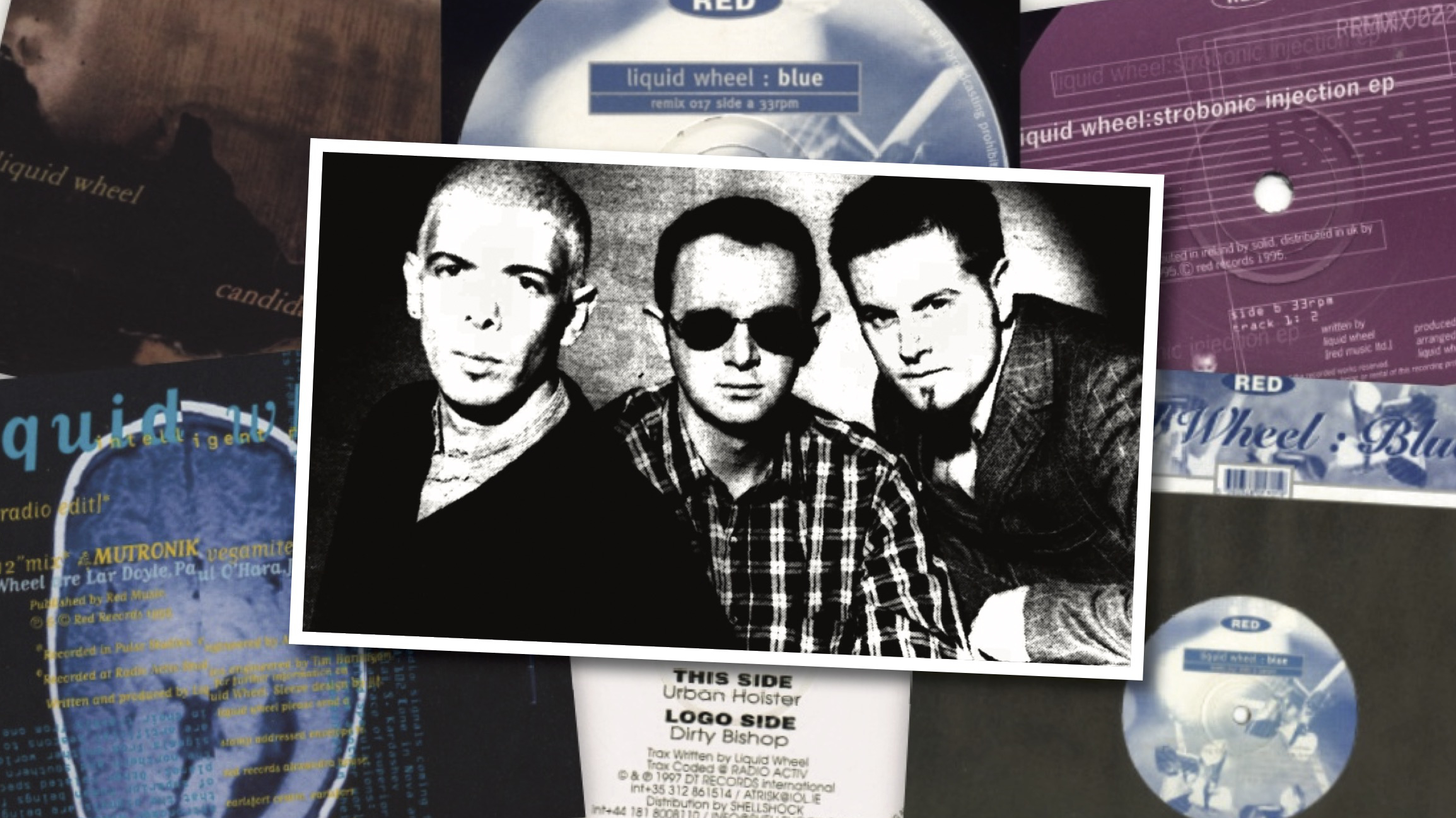
Sometimes, it helps to be in the right place at the right time. For the three members of Liquid Wheel, Paul O’Hara, Lar Doyle and Jay Oglesby – all of whom were trained musicians – the decision to immerse themselves in electronic music during the formative years of Ireland’s dance scene proved a fortuitous move.
What started off as a handful of rudimentary jam sessions led to the release of the trio’s first single, Blue, on Red Records in 1994, which in turn led to Liquid Wheel becoming one of Ireland’s most fêted live acts.
Mutronik, from their second single, Strobonic Injection, reached #17 in the pop charts, while the group’s musicality shone through on tracks like 2 (also from Strobonic Injection), Nova, Bloodclot, Smokie Does Dublin, Dirty Bishop, and more, all produced alongside Sound Crowd’s Tim Hannigan.
“We’ll keep releasing quality stuff,” Oglesby told the Evening Herald in 1995. “Unfortunately the Irish music industry refuses to take dance music seriously. and still insists on seeing it in terms of commercial throwaway pop.”
Performances at the SFX, The Point, The Ormond Multimedia Centre and various festivals helped shape Liquid Wheel’s reputation as solid live performers, earning them a Best Dance Act award from Hot Press, and a contract with booking agency Concorde.
As the 90s wore on, however, other priorities – not to mention the dissolution of Red Records – led to further singles from the group being few and far between, before 2003 saw the release of the trio’s one and only album, Candidates, a more downtempo, hip hop-influenced production, and arguably the record on which their musical capabilities most came to the fore.
While it’s been some time since they last shared a stage together – at 2004’s Oxegen Festival – all members of Liquid Wheel are still involved in music in one way or another. Keyboardist O’Hara (who went on to join Royseven in the early 2000s) is “writing constantly and banging away a few tunes here and there”, Doyle is “still tweaking knobs in the studio”, and professional drummer Oglesby teaches music in BIMM Music Institute and Maynooth University.
909originals caught up with the lads over a few pints to chat about the legacy of Liquid Wheel, and to discuss an upcoming remix of the track – Blue – that cemented their place in Ireland’s dance firmament.
PAUL: It’s 30 years since Blue came out, so we decided we needed to mark it in some way. We thought the easiest way to do it would be a remix, but it’s not an easy tune to remix, I will tell you that. It’s a bit of a head f**k.
JAY: We’re trying to modernise it, and let the core of the tune stay the same. We didn’t like the drums from the original, we wanted them a little beefier and a bit heavier. That was our first single, and over the course of the band, our sound toughened up a little.
So we went down to Tim [Hannigan’s] studio to work on it. And it’s coming out well, we’re happy with how it’s going.
LAR: We had the original DATs, so we can reference the track that was released, but beyond that, we didn’t have anything else apart from the MIDI file. And the MIDI file is just a series of instructions of what synths are referenced, in what patterns.
So it was really a case of going back in time in terms of the technology that we used then and trying to readapt that – getting all the old sounds and all the arrangements, you know? It was an experience to do that, in the room where we created all the tunes. It was certainly a moment of reminiscing.
909originals: That’s in Bray, right?
JAY: Yeah. We were also thinking about maybe getting some other people to do remixes. Beyond that, I don’t know.
LAR: We have no hard-coded plans with it, we just want to see how it evolves and how many mixes we can get out of it.
909originals: Am I right in thinking that with Liquid Wheel, you never actually split up, that you still work together, and write together?
JAY: We do. After 30 years, we’re still together. We’re doing new music all the time. But when we realised it was 30 years since Blue, it was a bit of a frightener, actually. It was good to mark it in some way, even just for ourselves.
909originals: With that in mind, it would be good to get some perspective on how you all got together and your musical upbringing. Correct me if I’m wrong, you were all pretty musical from an early age?
PAUL: Yeah, my first thing was keyboards. I got a keyboard at 14. There was a piano in my music class in school, and I was fond of the teacher, so I took a real interest in that class. There’s no-one musical in my family. No background in any of that – it was just me.
When class was finished, I’d go over and tinkle a few notes. I tried to play stuff, but what I found really beneficial in the class was reading sheet music – things like Stravinsky and Mozart. That was the key, for me, because as the lads will tell you I’m all about harmony and chords, and that’s where my strengths are.
That was the start of it for me, of my music journey. I met Jay and Lar at around the age of 14, through secondary school. All our mates were musicians. Everybody played something, and that was what kind of kept us together. That was the start of our journey.
When we got a bit older, we rented a lock-up in Artane, down the road from where we lived, because we were thinking, it would be a place where we could get a few 2-litres, have a few smokes and play a few tunes. But as it turned out, when the three of us got together, we started cracking on with a bit of music.
We had a sampler, a 4-track with a tape cassette, and a couple of little speakers. The lockup was number 26A. So we called our first tape ‘26A’. It was a vibe. Then, within about four weeks, we’re sitting in Bewley’s, trying to work out the name of the band that we’ve just put together.
909originals: Jay, what about you?
JAY: I joined the Artane Boys Band when I was 7, as a drummer. So I’m a long time doing it at this stage. All our mates were musicians, as Paul said. My dad was a drummer. My two uncles were drummers. So it was in the family.
When we went to 26A, we decided that we needed to learn sound engineering, so we did the sound engineering course in Pulse. It was only a six-month thing, but it was as a result of that that we decided to work on a demo, because we had written some tunes in the lockup that we were quite happy with.
We put a cassette together with two tracks on it: Blue and Yellow. I haven’t heard Yellow since. We sent it to Red Records. I remember getting a message to ring Mark Kavanagh. I was living in Ballybough at the time. I had to go to a phone box out on the street, and I rang Mark. He loved it.
We signed with Red Records, which was a subsidiary of Solid Records, and we started working with Timmy. So that’s how Liquid Wheel started.
909originals: Lar, where did your musical journey start?
LAR: I was in the Artane Boys Band as well. I think I joined when I was about eight or nine.
It gave us a musicality. When you start at a young age, you’re learning an instrument. You’re actually at it five days a week, going for an hour minimum, two hours most of the time. So you get fairly proficient at it.
Also, young musicians develop a bit of an arrogance about the music they listen to. The music we listened to was a lot of rock – the classic rock stuff with blistering guitar solos and keyboard solos, where we would know very note. And we would obsess over the musicality of it.
JAY: We were listening to a lot of prog stuff as well. Mike Oldfield, Jean Michel Jarre, Pink Floyd.
LAR: Through listening to Floyd, you get an appreciation for synths and that kind of soundscape of music.
At 26A, we started using a computer to record, and as soon as you do that, you’re into sequencing music and repetition, which draws you towards dance. So it was a natural evolution – we were drawn towards that early-stage dance music.
909originals: And obviously, you were going clubbing as well, immersing yourself in the scene?
PAUL: Not really. It was only after we got the band together and we had released Blue. That’s when we started going clubbing.
JAY: It was around the same time. It kind of happened simultaneously.
909originals: That’s interesting. So it wasn’t the case that you were getting the energy from the clubs and trying to channel it into creating something?
PAUL: Our energy was from our early gigs. That’s when we experienced the clubs first. We were going out, don’t get me wrong, but not as full-on.
909originals: Ok, so it wasn’t like you went to the Olympic Ballroom and ‘everything changed’ and you thought, ‘we have to make music’?
JAY: No, we were a little later than that. The Olympic and The Asylum, I never went to either of them.
We had a friend who was clubbing just at the start of it, in Sides and places like that. But for us, it kind of all happened at the same time. We wrote Blue, got signed very quickly, and then we started going clubbing.
909originals: Was Blue inspired by anything in particular? Were you trying to emulate a particular sound, or track that you had heard?
LAR: No, it wouldn’t have been that specific.
JAY: My first memory is hearing a friend of ours playing something on the Le Petit Prince label, kind of very trancey. But Blue was just a case of us wanting to do a dance tune. It wasn’t particularly influenced by anything specific.
LAR: We booked some time in the studio to f**k around really. We weren’t quite sure what we were aiming for. We had a rough idea that it was going to be a dance tune.
Now, if you heard what we came out of that original session with, it was laughable compared to what we ended up releasing through Red Records, when we remixed it. But it was a reference point for what we spent the next ten years doing.
909originals: Blue was very accomplished. It was like you had been honing this sound for a while. It didn’t sound like a first single.
LAR: It was just a case of us literally dicking around in the studio, from a production perspective rather than a dancefloor one. A couple of months later, when we remixed it with Tim, we went from conventional studio gear to a studio for dance production. So sonically, we were better equipped when we remixed and released it.
The version that we did ourselves was never actually released. It was literally a demo, an exploratory tape that we chose to send out that got us noticed. And that was where the adventure started. When it was remixed, it came out with the mixes that Tim did as well, all at the same time.
909originals: Red Records was in its infancy at the time too. Did you get a feeling for what they were trying to do with the label? They were just finding their feet – Sound Crowd only had a couple of EPs out by the time you released Blue.
LAR: They had a few singles out. The scene was just coming together all round, to be honest. The fact that people were putting out material was significant.
Prior to that, it was just clubs and DJs playing material from the UK and other countries. There was a sense of it moving from the underground to the mainstream, even though it never truly became mainstream. People were paying attention. It was a whole new movement.
909originals: That’s important, the fact that there were people putting their hand up and making music here, in Ireland. Up to that point, everything was coming in from abroad — Dutch labels, Italian labels, UK labels like Rising High.
LAR: And that was in tandem with changes in technology. One of the big things to happen was the Atari ST computer, which allowed you to sequence your own stuff without needing to be a f***ing professor. A normal dude could sit down in front of the computer, hook up a synth, and make an arrangement. That was phenomenal.
It was all interdependent on what was going on with the technology. When the technology changed, the scene came along. Production changed.
JAY: Yeah, that’s what attracted me. The scene seemed very progressive, very new, almost like the punk of our generation. With punk, you only needed three chords, and you could bash out a tune. With the new technology, when it became more widespread, it was the same. It democratised things, everyone could do it.
909originals: Yeah, but then again, you were also able to bring those musical elements into it – your knowledge of classical music, Paul, as an example. It all came together at the right time.
PAUL: Our age had a big part to play in that. There was the start of this global scene, and we were of the right age to get caught up in it. We were learning as we went along, gigging and releasing records. We were as much in it as the people watching us.
909originals: Yeah, there was an element of making it up as you went along. The promoters, the producers, everyone was figuring it out.
PAUL: Everyone was making it up as they went along. It was nearly week by week. There was no long-term plan. It was just, what can we do next? We were riding the wave.
LAR: There was also a serious dislike towards dance music, especially techno and the harder ends of club culture. Jay mentioned the punk element. So, when there’s a general societal dislike towards what you do, it’s ‘ok, f***ing game on’. It fuels you even more to pursue it.
909originals: Yeah, exactly. And you have that vitality of youth, wanting to grab the world by the bollocks.
LAR: That was a real energising factor. At some of the bigger nights, there was hassle, police involvement, and general societal dislike towards club culture. Everybody was up against it. But that fuelled our momentum.
JAY: As Paul mentioned that we were part of something bigger – there was a kind of connection with the audiences, and us. That’s what I liked about white labels – when tracks got released on white label. It didn’t matter who made it; there were no superstars.
It’s all about superstar DJs now, but at that time, we weren’t really looking to be famous or anything.
909originals: You probably couldn’t believe it when you got signed, then? With that in mind, I thought your second EP – Strobonic Injection – was probably the most accomplished thing that came out in Ireland in terms of dance music at the time. 2 was an incredible track.
JAY: Yeah, it’s Mark Kavanagh’s favourite.
PAUL: I have a good story about that. Mark Kavanagh happened to be picking up Carl Cox from Dublin Airport to bring him to a venue he was playing at, and they were chatting about Strobonic Injection.
Mark played him the record on the way from the airport, and Carl went bananas about it. He absolutely loved the track 2. So he said, ‘That’s going straight into my set.’
909originals: Mutronik, on the same EP, was very different as well – different tempo, different sound.
JAY: A lot of the stuff was accidental, as it happened. Mutronik was one of those tracks that just developed with the use of samples.
LAR: I suppose it was a victim of the sample, in many ways. The Low Rider sample.
909originals: I was wondering actually, was the sample taken from the original Low Rider, or from the Marmite ad that was around that the time.
PAUL: We took it off the original, off the vinyl as well. We had an hour of just going through vinyl records – Tim had a wall of vinyl there.
We started pulling a stack of records, stuck them on, and Low Rider came on, and everyone just started looking at each other going, ‘That’s interesting.’ So we threw it in.
909originals: Mutronik got into the charts – was that the biggest ‘pop’ track you had?
JAY: Yeah, it got to #17; that’s the only one really.
LAR: It was, yeah. I think Blue might have entered the charts as well, at #44 or something.
909originals: And then there was the obligatory ‘video’, where you have the three of you going around in scooters, along with the footage of the Ormond Multimedia Centre.
LAR: You know when you have an idea in your head, and you have a concept, and it doesn’t transfer to celluloid…
909originals: Were you pushed into doing that? Seeing as the track was in the charts?
PAUL: Yeah, it wasn’t our idea to do videos. But we had to do it.
LAR: It makes sense, though. If you’re going to have a chart placing, it will increase the sales.
909originals: Was it the only video you did?
PAUL: I think it was, thank god. I remember we had this car that we were driving around in, in the video, an old Citroën. That was a big deal at the time.
LAR: We actually did other videos, but they never actually made it to release. We did one for Dirty Bishop as well, but it never came to fruition. We spent a day shooting it. God knows where the footage is, or whether it ever actually got assembled into the video.
When you look back on stuff, it seems so intentional. But when you’re going through it, it’s like a pinball machine. You’re just reacting to the sequence of events that happen. Yeah, it can seem clear, and follow an order, in hindsight, but in fact, at the time, it was just complete chaos, you know?
There wasn’t much of a strategy, and we kind of stumbled into it, in terms of the demo we initially made being successful. So then it’s like ‘OK, well, what do you do with this?’
909originals: Your first gig wasn’t long after Blue, right? In the SFX?
LAR: Prior to that, we played a gig in the Harp Bar, on O’Connell Bridge. I remember the stage was made of plywood. There were about five or six nutters there.
909originals: So you weren’t playing live before Blue?
PAUL: No, that was the reason we started playing live. We felt we had to promote it.
LAR: The reaction we got from such a small handful of people was just an insight into the whole kind of scene, and how passionate people were about it, on any given night, about clubbing and going out. As far as I remember, that was the launchpad for the gigs we started doing.
909originals: Was it an easy transition from recording in the studio to playing live? Because a lot of dance acts that went live ended up being shite, you know?
JAY: We’d been in different bands anyway, and we’d been gigging all our lives, so we knew how to do a gig and put a gig together. So that wasn’t hugely difficult for us.
PAUL: We used to analyse music. With any music that we liked, we would be like, ‘Do you hear this? Do you hear that?’ And we’d be deep into it. I think that’s where the creative side came out. Yeah, it was easy to do the gig thing.
909originals: So you never had a rabbit-in-the-headlights sort of experience, where you might press the wrong button and the whole thing shuts down, mid-gig?
PAUL: Now, The Point, for Dance Nation 95, was a little bit like that, I have to say, because we went from clubs to ‘what the f**k? What is this?’ I remember it was absolutely mental.
JAY: After that, we were doing big gigs, festivals. We did a thing in Navan, and there were thousands at it. Ultrasonic was on that bill as well. There must have been 5 or 6,000 people at it.
909originals: The way that Dance Nation 95 was being hyped, was that this was the ‘coming together’ of the scene to date. You had yourselves, you had Sound Crowd, you had 4 Rhythm and you had all these DJs. It was like a celebration. Were you starting to believe the hype at that stage?
PAUL: Not really. Sure, there were all these amazing DJs. We were surrounded by them.
We were in this huge dressing room, with the light bulbs on the mirrors and all that. But we were just chilled, a few mates having a bit of a party, doing our thing. After our gig, we never left the room. We could have networked, we could have connected with everybody.
LAR: No, we didn’t believe the hype in the way like you would get with a ‘normal’ band. It was still niche, you know? We were very successful in Ireland, in our niche. The hype will only go so much.
Obviously it would have been great to make a bit more money from the gigs we were doing. But you still wouldn’t be pushing away from it.
JAY: We were also doing gigs with other people, as musicians. But a lot of the time when you commit to it – to your own band – it gets harder, you know? Financially it does, anyway. There were a good four or five years where Liquid Wheel was all we did. It was our main focus.
The Point was a turning point. We went down really well that night. We realised we could do it on a big stage, and we went down well.
LAR: One of the things that I think we all felt conscious of, coming to a live setup with a dance band, is that most of the time you’re running it off DAT.
So if you’re running a DAT gig, how can you, as a musician, get up there, perform, and feel authentic? You can’t, and miming is just inherently abhorrent to us. As musicians, to mime is like sacrilege. So, we found that we had to bring something else to the stage, and that was an energy.
We felt we needed to bring energy to the stage in terms of pushing the audience, interacting with the audience, and then incorporate some element of live performance, be it congas, live synths, drum kits. We were very conscious of that, as musicians coming to a kind of setup where most people were just doing PAs. That felt like cheating to us.
909originals: That’s obviously why you got kind of renowned as a good live dance act in a world of very average live dance acts.
LAR: We were trying to distinguish ourselves from just giving a half-arsed show, you know?
JAY: I wouldn’t want to go to a gig and just watch two dudes just standing behind a synth.
909originals: I came across this article in the Evening Herald from the mid-’90s. You were saying, ‘We’ve got hundreds of tracks; and we’re going to be trying some of them out in The Point’ So you must have been very prolific then, you were churning out stuff?
PAUL: I had moved to a new house that I was renting with a couple of lads, and in the back bedroom or in the back room downstairs, the larger room, we set up a studio. There was a tabernacle on the wall and an upside-down cross – because it was such a strange place, we ended up naming it ‘The Room of Death’ That’s where all the writing went on.
909originals: OK. Any strange, Satanic happenings in the middle of the night?
LAR: No, but it was a fairly intense period. We were working every day, even more so because the whole music scene was changing so much then. It was just before everything started to get pigeonholed, you know, with the sub-genres that started happening.
909originals: I guess that’s one thing you can say about the early Liquid Wheel stuff, that it certainly wasn’t pigeonholed – Blue was quite different to 2, which was quite different to Mutronik. And then fast forward a couple of years and you’re bringing vocals into the mix.
LAR: It would be a shame for us to have fallen into single category. Plus, we loved all the stuff that was going on at the time.
JAY: That’s just it. There were three of us, and we liked all the different styles of dance music—most of them, anyway. I was into techno, Lar was into trance, Paul liked techno as well and breakbeat stuff, you know? We all had our own little parts of dance music that we were drawn into. I suppose it all blended together, in some way.
909originals: You must have been developing a bit of a fan base at this stage. Were the same heads coming to all the gigs?
JAY: Yeah, there were a lot of the same heads. Every time we played the Ormond, we’d go to The Front Lounge after our sound check, have a few pints, and I remember coming out of there one night – before our gig – and the queue was literally all the way down the quays. We sold it out. That kept happening. It started to grow, and for a while we had a great following.
909originals: We were talking about Dance Nation there – obviously that was one of those ‘uniting the tribes’ sort of events. But then someone died at it, and there was this dark cloud over dance music again.
LAR: Yeah, that really sucked the wind out of it.
One of the big things about that Dance Nation event was that it was supported by the big promoters in Ireland. It was the first time they hugely embraced the culture of dance music in the premier venue of the country, The Point, which technically held eight and a half to 9,000 people. I think there was 11,000 people there.
909originals: Obviously it wasn’t influenced by that, but you didn’t release something for a couple of years after that. There was a couple of years between Dance Nation and the next EP, which would have been Bloodclot.
LAR: Well, I had a kid; that might have had something to do with it.
909originals: Were you still on Red Records by that stage?
LAR: Red had started to dissolve by that stage.
JAY: We released Bloodclot ourselves, on Bleech Records. I suppose, musically, we started to take a change in direction then as well. You know, that EP is a lot heavier than what we had done before.
909originals: Yeah, you mentioned Dirty Bishop, and that’s nothing like Blue or 2 or anything like that.
JAY: As I said before, what attracted us to the scene at the time was that it was progressive, it was rebellious; it was punk, it was DIY. And we felt our music should keep progressing.
Not to get too grand about it, but that was our approach. We didn’t want to just keep putting out the same stuff.
909originals: That’s the case with most of the producers I speak to, they’re always like, ‘You can’t look back; you have to look forward’. Particularly at the time, when you were living it, why would you want to release another Blue?
JAY: It was more about what was turning us on at the time, musically. I suppose that degree of diversity wasn’t great for longevity, and we maybe lost some people when we got a bit harder.
909originals: But you were trying to keep it interesting for yourselves.
JAY: For us, that wasn’t a huge concern – whether the people who liked Blue might not like Bloodclot, for example.
909originals: Were you still playing live then?
PAUL: Yeah, we were, but it was tapering off. We were less active; all gigs faded away as Red Records was fading, so it was all very simultaneous. It was like a family in a way, you know? Whoever was signed to Red, we knew what everybody else was doing.
It was like two years of a full-on 18-wheeler truck, and then the calm after it.
That’s when we decided that it shouldn’t be all about dance music. We thought, let’s go back to our roots regarding what we were listening to and what we liked.
JAY: What started to irritate me, anyway, and I know the lads felt the same to a certain extent, was that what was progressive and fresh in the beginning started to become very repetitive.The music became predictable. That’s when we decided to do Candidates.
909originals: Candidates is so different. You know, it’s still Liquid Wheel, but for those that listened to Blue religiously, less than ten years later, you’re suddenly doing an experimental hip-hop album. It’s a huge jump.
LAR: It was a gamble, in many respects. But it was just an evolution of how we were at the time. I suppose you can resist that or just go with what you’ve been doing for years. Repeat the same equation, or try to let it evolve and tweak it a little bit.
So in many ways, it was about being more experimental with the Candidates album. It more reflective of where we were. We did it with Tim as well, so while sonically, it sounds different, it still has the same sort of palette, you know?
909originals: Going back a few years, it’s like when you started to bring vocals in, around the time of Dirty Bishop. After having three or four years as just an instrumental band, you thought, ‘let’s add some vocals to the mix’.
LAR: As soon as you bring in vocals, even if it’s just a sample of your vocal, the whole dynamic of the tune changes. You feel differently about it; the music has to evolve differently. Again, it’s about widening your sound palette.
We felt at the time that if we included vocals, it could deliver a particular type of tune in a particular type of way. With instrumentals, the message can feel diluted a bit. It’s not as verbal.
909originals: If you take a track like 2, though, it has ‘movements’, you know? It changes direction completely after a few minutes, then gets back to where it started, which is great. It’s not just, here’s your 4/4, here’s your synth lead, here’s your bassline. You decided to go off on a bit of a tangent, which is common to quite a few of your tracks.
LAR: Sometimes that works great on a record when you’re listening to it at home. In the club, it might be different, because people want things to be much more linear. They want to feel like they’re rising, and then they get there, and it’s like ‘ahhhh, hands in the air’.
If you’re taking them there and then going back down again, and going down some side alley, it can confuse people.
909originals: Obviously, Candidates was made for more at-home listening, right?
PAUL: Yes.
909originals: That was obviously important to you, making music that worked both in the club as well as on the car stereo, driving down the North Circular Road?
JAY: I think it had more to do with the artists we listened to a lot. We were influenced by instrumental music, like Mike Oldfield and Jean-Michel Jarre, where the music evolved over five or six minutes.
So, while we were part of the club scene, it was really about what we were into musically. We were prone to experiment a little, and move a little here, there and everywhere.
909originals: Again, there was a big gap between your last EPs, Dirty Bishop and Dog Bender, and Candidates. Was it a case that you thought, ‘you know what, we have unfinished business here; let’s do one more thing together’?
PAUL: I think, unconsciously, that was it. I think Candidates felt like a bit of a bow out, even though we didn’t know it at the time. With Red Records dissolving and everything calming down, we were on our own, more or less.
We still had Timmy, but we realised we couldn’t stay on that course much longer. So it was kind of like, ‘Why don’t we try something totally different?’ We’re still in that scene, but it’s evolving.
JAY: As important as the club scene was, the after-club scene was also significant. Nightmares on Wax, Zero 7, and all that chill stuff, we loved that as well. I think Candidates was influenced by that.
909originals: That’s interesting, because obviously it ended up being the coda for the Liquid Wheel production journey. It’s like the after-party.
JAY: Very poetic. Yeah, that’s a good way to think about it. I’ve never thought of it like that.
909originals: There was that final gig as well, at Oxegen in 2004. It was at three or four in the afternoon. It was raining outside, so you got a decent enough crowd, I remember some lads in boiler suits as well. Were you a bit torn between having to ‘play the hits’ and trying out your new stuff?
PAUL: We had moved on musically, but we never forgot what Blue did for us. It was a tune that put us on the map in Ireland, you know?
JAY: That was the conflict. We were doing different kinds of music, but people were expecting something else. We were in a different musical place. We did The Sugar Club as well around that time.
LAR: That Oxegen gig involved a load of musicians, and a week of rehearsals. So that was heavy work for us, to pull that gig off.
All hell broke loose after it. We had to contain ourselves for the gig, and then after it was like, ‘yes, job done!’
909originals: You never felt the urge to ‘get the band back together’ on the road for an Irish tour?
LAR: I suppose we did feel the grá to kind of figure out how we could pull together a club gig again. But it just never happened, because we evolved in a different direction, and our work was going in different directions, taking up our time.
So it just never happened; one year passed, and another year passed. And then after a while, it just seemed not relevant. You would be going ‘old school’ then, and then it’s going to be like a tribute gig.
JAY: I’m grateful for what we did, but we would be reluctant to do it again, Our audience is in their 50s now. It’s just a different time. Who would we be playing to now, other than the nostalgia circuit?
LAR: We wouldn’t want to just go out and hash out the gigs for the sake of it, you know? We’d have to take it somewhere else, and in order to do that requires a lot of work, and you have to kind of get into the headspace and get into the workflow.
So it requires a ramping up, and then the delivery of it, and then, what are you going to do with it? There’s a lot of work involved.
JAY: The Chemical Brothers were over recently, and I think they did it successfully. You know what I mean? Everything felt fresh—the stage show, the lights, yeah. The visuals they have, they’re still relevant. It wasn’t just them rehashing.
909originals: Yeah, but they’re still playing Chemical Beats, The Private Psychedelic Wheel, those are off their first album.
JAY: Yeah. But the way it’s presented feels modern and fresh.
Adding to what Lar was saying, if we did do a gig, you wouldn’t want to just go back out and try to redo what you did then. You might do the same tunes; but you would want to present them in a way that’s a bit more up to date and interesting.
909originals: So you’re saying never say never. But then again, you never really split up, I guess. What did you all do musically when Liquid Wheel paused as a project?
LAR: When you’re working in a band that’s barely scraping by, that then gradually fizzles out, and you’ve got to earn money. So us being musicians, the natural way is just to start playing with covers bands, you know? So that’s what you do. You play at weddings and parties. You earn your crust.
909originals: Paul, you went into Royseven, right?
LAR: Yeah, Paul got a bit of fame out of it.
PAUL: We’d done that week’s rehearsal ahead of the Oxegen gig, and I was jumping across to Royseven at the time, so I had two days of rehearsals that week when them as well.
I had made the conscious decision to say, ‘I’m jumping ship, lads. I can’t do the two.’ And that was it, I went to Royseven. I was going in as a favour, because Jay’s younger brother [Darragh Oglesby] is in it, and he asked me to come in as a keyboard player. So he kind of knew my strengths.
It worked out well. I enjoyed it. The freshness of it. They were all 10 years younger than me.
We did two albums, and we toured with Bryan Adams and One Republic. It was good for a while. It feels like it flew by, to be honest.
909originals: You were DJing for a while, Jay?
JAY: Yeah, I was DJing, and I did a radio show. I can’t even remember what the station was — it has closed now. I went into drumming, working as a session drummer. I’m still doing that.
I haven’t DJed in a long time; I have a set of 1200s that I took from The Waterfront, actually. Robbie Wooton sold them to me They need a bit of a service, but they still work.
Nowadays I teach in BIMM in Dublin, and I teach in Maynooth University as well, so gigging and teaching, that’s kind of where I’m at now.
909originals: To finish, maybe you could share your an anecdote from the Liquid Wheel years. A high point, or low point?
LAR: So, as we were saying, one of the first things we did was in the SFX supporting Moby, and that was my first exposure to a real f***ing dance gig, as in just the sonic capabilities of it. The audience, the crowd was mental. The whole night was, you know, sweaty and smelling of Vicks — the whole deal. The whole scene was about to open up.
Then, a couple of years later, at The Point, I can remember just before we went on, and I though it was the business. I could see the whole crowd out in front of me. And then just before we went on, out of something like ten thousand people there, I hear my neighbour from across the road. “Lar! How’s it going, Lar?” And I was back right down back to Earth.
JAY: A low point was when we were gigging in Maynooth. We came out, and somebody had robbed the windscreen out of our van, which was a rented van. It was pissing rain, and we had to drive home. It even started snowing at one point.
A high point was when we were gigging in The Stables in Limerick and Lar decides to do a stage dive. And as soon as he does the stage dive, the crowd just parts. So he hit the deck, quite hard. That was a high point for me, but probably a low point for him!
PAUL: I guess the high point for me was getting on a wave and riding the crest of that wave, and being at the right time and being in the moment — that, to me, is the best thing ever. If anyone talks about the 90s, I can say I was involved. We were involved.
Thanks to Liquid Wheel for the chat. No date has been set yet for the re-release of Blue, but we’ll endeavour to keep you informed about that, and any future projects, here at 909originals.
About Post Author



One thought on ““It was rebellious, it was punk, it was DIY…” The story of Liquid Wheel”