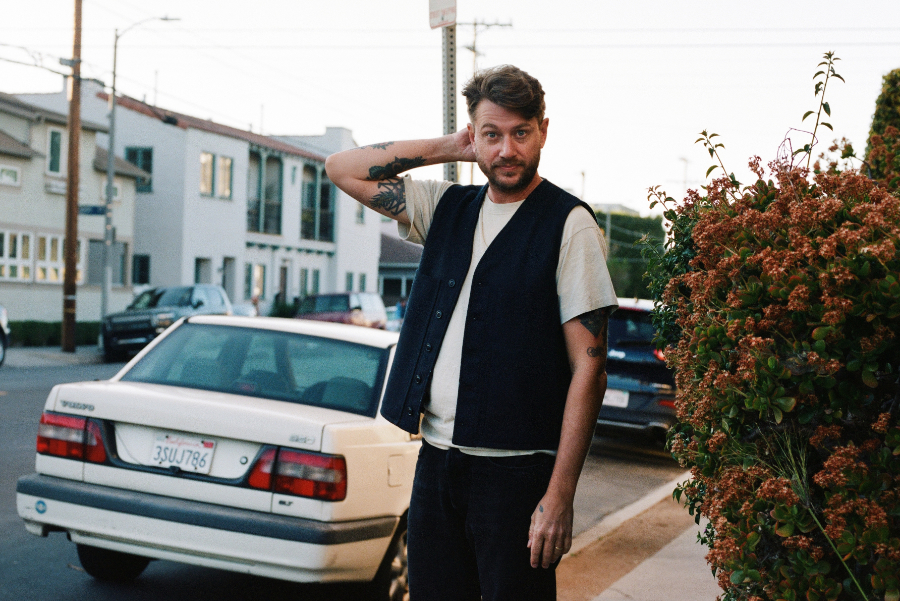
Having cut his teeth in Stockholm’s techno scene in the 1990s, Axel Boman has infused the underground with playful charm for more than two decades.
On the production front, he first broke through with the Holy Love EP on DJ Koze’s Pampa Records in 2010, also releasing on labels such as Play It Down, Hypercolour and his own Studio Barnhus, which he launched in 2009 alongside compatriots Kornél Kovács and Petter Nordkvist.
To date, he’s released more than 20 EPs and four full-length albums on various labels, and he kicked off 2026 with the From Riches To Rags EP on Aus, which is available – like much of his catalogue, on Bandcamp. Elsewhere, a personal favourite around 909originals HQ is his 2020 release Eyes Of My Mind – an anthemic psychedelic banger whose accompanying video, created by artist Malin Gabriella Nordin, was exhibited at Stockholm gallery Steinsland Berliner.
As part of a busy summer festival schedule, Boman is set to appear at the forthcoming Éalú Le Grá festival, taking place in Galway from 29 May to 1 June. On a recent trip to Dublin, to play at Fidelity Studio, 909originals’ Emer O’ Connor caught up with him.
Hi Axel, thanks for talking to us. Recently you played a six-hour set to a sold out Fidelity, and you’ll be hopping back here again very soon to Galway’s bewitching musical festival Éalú Le Grá, over the June bank holiday weekend. But this is not your first time to escape the west of Ireland, so tell us why you decided to come back again for this micro-Glasto?
Well it was one of the most magic weekends, it was so beautiful. I arrived here in an Ireland that hadn’t seen rain for weeks – everything was beach yellow, like fields. It was just so warm and full of life. I was blown away, because I didn’t expect this. I’d been to Ireland a couple of times before, so I knew what weather to expect.
I’m Swedish, so trust me, I know a rainy summer, so coming to this weird savannah was so wild. Then, with this festival, you can tell that it is a passion project for someone – you can see everybody comes there, whether it’s for art or just attending the festival, or maybe you’re with a band or a performance actor of some sort.
It attracted this very colourful crowd and I could tell, ‘wow, this is so unique’, because there are so many ways this could grow and become one of the most important festivals. Because, if these are the people you attract from when it’s this small and beautiful and nice, well, this is how every good festival starts – people loving something, and meeting and having a good time.
I believe you actually ask your management to black out time in your diary for gigs that are good for your soul, is this what Éalú means to you? Is it to replenish your soul?
In my experience, some shows you have to do to remember why you are doing music in the first place – to remind yourself of what’s important – and this is one of those places. It became very clear that you deal more with instinct and love than with other things.
With some situations I end up in, you have to be a little bit more calculated, I suppose, depending on the audience and the circumstances, and your set time and all of these things. You have to imagine what version of you will work the best. Whereas with this place, I feel I just tried to be as true as myself, my true self, as I possibly can.
This year you are headlining with the mighty Mano Le Tough, have you played together before or how do you approach a new performance pairing – would you chat ahead of the time, or would you keep it as a surprise between the boys?
We are good friends for many years, but the first time, if I’m correct, we played together was last year. It was an amazing festival, in the north of Ireland [Celtronic, Derry City] and it was pouring rain. Closing the stage of quite a big festival was so fun to play together, and so getting asked to do this again was just like a no-brainer.
So, with him I wouldn’t approach it any differently – just be prepared. He knows a lot about music and he’s a really open-minded guy. Now that I know the festival a bit, I would think it could go anywhere. So, after I prepare myself a little bit – if it’s going to go trippy, if people want to get down – one thing is for sure, I’m not going to hold back on an old curve ball or two, like an old track here and there. Or, I’m going to at least take that chance, because I know that even if it doesn’t fall the right way, he’s still going to be there to pick it up.
To be able to trust an audience and the audience to trust you – all these things are important things too. So with Mano, I’m just going to go with it.
Get stuck in and see how she blows?
Maybe ask him to play the first track, let him set the tone.
Home turf advantage?
That’s it exactly, you take the first kick.
Very good. I have to say myself and my editor at 909originals really got down at your gig in Fidelity. I mean, you got a serious groove going – I think at one stage he was asking you for the name of a track with his phone, he was nerding out so much. But unfortunately, for you and us, disaster struck near the end when the amp blew, or it malfunctioned somehow. It’s so frustrating when technology fails you. I believe you lost your laptop in many moons ago, and you had to start from scratch, but you thought of it as a blessing in disguise. Is this kind of you like your ethos in life – some things happen for a reason, and you kind of have to find your way around them?
I’ve had so many of these things happen that I’ve learned that the best way to deal with these things is to just go with it. If you’re too much of a control person, you need to prepare, but sometimes these things are going to blow up in your face. It must be a nightmare for people doing intricate live shows and they don’t even have a backup, because at that point you just have to cancel your show.
I remember sharing a ride with Floating Points to a festival – it was at a time when he was just playing solo, a live show by himself. It was him and a video guy. He showed me his setup, but he was so paranoid that everything could crash, so he had a double set up running at the same time. So if one crashed, the other would pick up exactly where we left off.
So, that’s the way you have to do it, or just wing it, you know? I think I’m way more of a ‘wing it’ person than a ‘making sure that failure can’t happen’ person.
And you learn much more from failure than you do, from everything going perfect all the time.
I suppose so, yeah.
Do you still keep your 40,000 plus vinyl in your batcave there [the video call shows the Studio Barnhaus basement in the background]? How many vinyls do you have now?
It’s divided between here and some other spaces, and my home.
Lots of vinyl, then. And you’ve ripped most to USB’s now?
Well I had this accident when I was ripping, I was being really good at ripping all the stuff, and organising and everything, and then I had this external drive that broke on me, so all those countless hours of ripping was completely gone.
Oh, jayziz, that is so frustrating.
I’m still grieving for that. It’s been a couple of years, so I haven’t mustered the energy to get on top of it again. But in the near future, during the summer, I think I’m going to have this project of getting rid of at least a third of the records, organise it really well, and then start meticulously making sure it’s digitised. But also, at the same time as I say this, I kind of hate myself because I don’t like to be super organised…
Haha. No I don’t see you as a librarian.
Sometimes, it’s because I kind of have a sixth sense of where to source the record: I just go in, pick something, and I end up finding three other things I should look up – ‘oh I’ll bring these, these are awesome’.
I really believe in luck and circumstance, especially when it comes to artistic performance and execution. I cannot underplay how important these things are. When it comes to painting as well, it’s all about luck and circumstance – and you have to create, of course.
Research is the foundation of everything, knowing a lot about what you can do and then the limitations of the way to approach these things. I don’t necessarily believe that the person who has the best organised record collection is the best DJ. I think the person that is more willing to dare to f*** around is the person who is going to come out on top.
The night before you played in Dublin, you played in the iconic Corsica studios, London, one of its closing parties. Did you come out on top that night?
Yeah, it was a spectacular show. l’ve experienced so many good gigs, bad gigs – seeing and hearing other DJ’s, different parties. That place was so, like ‘yeah!’. It’s a shame that it’s like going to be around anymore.
It’s devastating, I’ve been there myself several times, for Daniel Wang and Colleen Cosmo Murphy…
So for sure, one of the last nights was very wild and fun. I was there with John Talabot as well, as Talaboman. One weekend, we did a full Talaboman weekend there, playing Friday and Saturday, and people could buy tickets for both nights. I was like, ‘wow, this is big for me, to play Corsica Friday and Saturday’.
I wanted to get involved with this Australian set designer/sonographer/artist I know, and I said, “Hey, what if we pay you, I don’t know, €500? Could you make some decorations for that?” He said, “Well, yeah, yeah, f*** yeah, I’ll take care of it.” We just connected him with the venue – I arrived on Friday and didn’t know what I was walking into.
He said, “Yeah, I got the keys, I got everything.” So when we arrived, it was just like – he had decorated the whole DJ booth and the whole place with bones – huge human bones and hands – and Halloween-ish vibes, plus a lot of tropical plants. It was everywhere. You could hardly see us in the DJ booth because it used to be on the side, so you could just about see us behind these bones and tropical things. It looked really freaky and nice.
We were like, “Wow, you really outdid yourself.” He also put UV lights on it so it all glowed in the dark. It looked really f***ing cool. And it was clever, because you didn’t necessarily need to stare at us to see what we were doing, but if you wanted to get closer, you could.
So the night was really cool. We played the two shows, everything went really well. Then, six months later, I’m back in the venue for another show, and I realise… ‘oh s***, we never took the decorations down’. No one did. They just kept it, and it became the natural décor for the club for maybe the next year. I don’t know how long exactly, but that’s how good it was. That’s how it became the Corsica Studio décor for the next year.
Ha ha, part of the fabric.
Part of the fabric, that’s how good it was.
Has it been a while since you last played with John Talbot as Taloboman? Have you maintained regular creative contact over the years?
It’s been a while, we’ve been on our break. We haven’t really done music together – there hasn’t been any natural sort of situations where we just end up together. But recently, we’ve been starting to make music together, and so we have a lot of new music that we made. I just got back from Barcelona and I was in his studio, he was in my studio just before that. We are going to finish music this year that I really, really hope and believe will be released in 2027.
A scoop for 909originals, then? 🙂
We’ve got a lot of cool new music, and it’s kind of fun because we’ve been out on separate adventures – doing different things, playing different types of shows, exploring different ideas. Now, seeing each other again, it’s like the friendship, the frenzy, the activity, and the studio haven’t changed – but we have completely new perspectives. So it’s really fun to be together again.
Oh, I know, I can imagine you both nerding out. So you go from playing in tiny little shoebox kind of clubs to playing to the likes of Primavera with 15,000 punters. Do you prefer big gigs as Talaboman or as Axel Boman, and what’s the difference in their preparation from small to super large-scale?
Well, the small places are really fun because you can improvise. The big places, I come a bit more prepared, you know? I remember, for example, that Primavera show – I have almost no memory of it at all, except that my mouth was so dry before we went on stage. That shows how important it was.
I just remember going on stage, and there was this dialogue between me and Ori [Oriel Riverola, aka John Talabot] that I didn’t even consciously think about. We were just playing, thinking, “This is going to work.” If my brain malfunctions, I know the tracks – I can rely on them – and they’re going to represent what we want to do.
But at the same time, I was straying away from that, listening to what Ori was playing, feeding off it… so yeah, these types of shows definitely come with a lot more preparation.
You’re well-known for your successful Studio Barnhaus label with Kornél Kovács and Petter Nordkvist, and you’ve got almost 125-plus releases? Is that right?
Yeah, if we include side labels and stuff that’s closing in 170-something.
You need to update your Discogs…
I know, but I like that it’s a mystery. I like that some releases are that you don’t know we did it. The catalogue number doesn’t kind of match.
How does your dynamic work, as a trio running an independent label?
Well, we have to, like, at this point. It could not be possible without our excellent label manager Matilda Munte Gottberg, who is the one keeping the randomness less random. She’s such a powerhouse, she’s really, really keeping us in check.
Besides that, we have this one rule that we cannot release any record without there being a majority of people wanting to release it. So let’s say me and Petter love a release, and Kornél has to fold, and we haven’t released the record yet. That’s happened a few times. One person will say “I’m not really feeling this”, but once the record is out, they always come around to say, “Awww guys, f***, you were right. You’re right, and thank you. This is great.” So you have to trust each other, in a way.
Whatever happened to your grandchild, the sub label Barnbarn that you created in 2017 for your personal projects?
I don’t know.
You only had one release on it and that was it?
Yeah, it should have continued because it was so good. Barnbarn – the name of the label – means grandchild. It’s such a good name.
Well I think you should revive your grandchild… Let’s take a trip further back down memory lane, when you were in your five-year masters programme in the Art Academy of Gothenburg, and you spent a lot of your time making “weird polyrhythmic experimental noise”, as you called it. Would you like to return to do further education – a PhD, perhaps – with a focus on music?
Well, I really, truly miss the art world. I try to involve myself as opportunities knock. I always say yes to branch out to the more experimental sides of my practice.
But going back to take a PhD? No, that’s not on the map at the moment. I feel like I’m better serving the muse called inspiration right now because, you know, I’ve been thinking at least about preparing, developing, and keeping on working on some type of lecture – talking about creativity, talking about the music industry, contemporary music.
I’ve gathered so much information about how things work, but also how to produce, how to produce content, how to manage and monetise content. All of these things, I feel, could make a really relevant lecture for people who are like me when I was in college or university.
I think that is something I’ve thought about for a long time: trying to give back to people, giving a course or a guest lecture. It’s always so fun to connect with young ideas and young people because, in my head, I’m still kind of the same person I was back in school. But it’s been a few years, and I’ve gathered a lot of information that I take for granted, which could be really valuable for a young person to dive into.
Even if it’s stuff like how to run a company, little things that come from my perspective – a person who never, ever was interested in these things but had to become good at them.
But being able to talk about creativity and the creative process… that feels really relevant.
Speaking of the creative process, do you still stick to those 4–6 tracks that you did a decade ago, or when did you decide to expand your horizons? Technically speaking, do you continue to center your music around that core and then build around it with all the bass, bells, and whistles, or how do you approach your productions?
Oh I’ve gone way beyond that now, and I’m capable of doing a lot of things. And also, like, if you can see here, I’m sitting in a studio that is full of gear, mixers, synthesizers, records, and everything – you can paint, you can listen to music, you can do art.
So, in a way, I still do believe less is more, but I’ve done enough productions to know that you have to work things through before they become something. And maybe, yes, maybe I’m in a way expanding 6–8 tracks to 12 tracks, but not less, not more. I will render a version, then add another 12 tracks, and render another version of another.
Now I know how to deliver something before it should get mixed or mastered, that process. I finally managed to understand what other producers do to make their song sound big or small, close or far away, and play with perception. I’m playing with perception a lot – it has to do with dealing with dynamics, that things have to be blurry in order for other things to be sharp, and all of these things.
I would never limit myself, but the best music I did was with those limitations. So now, I always have that in my head: ‘okay, do I really need this?’ Or am I doing this because something’s itching in me that I can solve by doing something else.
You said before, in an interview, that when you were young, you were “daring and experimental,” and then when you became successful over a decade ago, you may have subconsciously thought about the commercialisation and the realisation of your output, and whether certain sounds might appeal to certain labels. When COVID put a stop to your gallop, did it have a profound impact on the way you view music production and DJing, or were you more determined to make things commercially viable, because you have a family to raise?
Hmm, that’s a good question. I think that it’s always going to haunt me a little bit – the fact that you could make something accessible or not. It’s always going to be haunting me that you could know how to make something more commercial or better.
At the same time, I’ve managed in COVID, and after COVID, to prove to myself that wasn’t necessary in order to make a song that was successful. So I think at the same time, COVID changed the playing field for everyone, because like, you thought you knew that ‘this is what you need to do to make a song’ or to ‘contextualise this piece of music into that work’, but it changed the game completely. Because all of a sudden, people weren’t listening and exposed to music the same way they were before.
So after COVID, you have to re-learn these things a little bit. And I don’t necessarily think that the most commercially made song is what’s going to help your career take the next leap. But I’m also saying this with the perspective of a person who did things before COVID.
So, giving that advice to a young person, for example, maybe it’s not what they need. Maybe they need to also find out by themselves how it is to make a song that will get some traction, in order to kind of break away from that, because you need to do that in order to kind of move to the next level, or whatever level you feel that you want to move in.
To preserve artistic integrity?
Yeah, exactly. Dealing with integrity is way more important than dealing with… unless you’re, if you’re a songwriter, you should be aware of all of these things. But if you’re an artist… I consider myself more an artist than a songwriter, for example.
Great. I definitely don’t believe you were commercially driven when you got your inspiration for Luz / Quest For Fire from the French science-fantasy adventure set in the Paleolithic era. Tell us more about the making of that double album, alongside Trensum Tribe.
Hahaha. Well, I really like to cross and marry different artistic genres. I’ve always been working with the same designer, a childhood friend of mine who’s a great, great designer. And together with this other friend of mine who is a conceptual artist, as the music was being made, we were developing this mythology. It was kind of something that grew together.
This is also great advice for anybody: just f***ing work with a poet, work with a painter, work with someone else – whatever. Work with a bard, work with a shaman, work with… I don’t know, find a person that has something to talk about that has nothing to do with your own branch expertise, and then from there…
We started obsessing about this movie, and it kind of fell together as the music was being made. Everything was cross-feeding into each other, which I now look at as, like, “Wow, this is a wildly conceptual, strange piece of art that I’m very proud of having been part of.”
Sometimes it feels unfair that my name is on the record, because I wouldn’t have been able to do it without all the others. But I hope people who dive deeper into it, like you, are going to see that this is a collaboration with many people who were part of that journey.
Absolutely. And you have a new collaboration coming out this week as well. You’ve just done the Portlandia remix of Crunch Time for Peanut Butter Orchestra, which is exciting – that’s Konrad Ritter and Georg Wodel on their Pete Samples EP, released on Unreal Records. I had a little listen earlier, and I really enjoyed it. I thought it had a cool sparkly punch to it, and at the same time was kind of wavy, yet sparkly. I look forward to dancing to it.
That was one of those situations where it was friends meeting friends. A friend of mine introduced me to them – I didn’t know them before, but I loved them. So, I ended up doing two remixes, even though at first I was thinking, “The original is too good for a remix, it doesn’t need one.” In the end, I decided to just try it, and I ended up doing both.
One of them was super slow, making it feel like the Portlandia soundtrack. I don’t know if you love that show, but I do. So, it kind of sounds like the theme song for Portlandia – really basic, slowed down and pitched, like a disco song being played at the wrong speed. That was exactly what I was going for.
That’s what I meant by wavy yet sparkly…
I got it. 🙂
So you’re emerging from your winter darkness dream state at home, and this is the time when you make a lot of music, right? Or do you sometimes hightail to where the sunshine is, maybe to Tulum, and play there in January?
Every year, I usually escape winter. My wife is from Colombia and she grew up in California.
Qué bueno!
Yeah, qué bueno! And so we either go to visit family in Los Angeles or to visit family in Colombia. So this is the first winter that we’ve spent a full winter in Sweden, and let me tell you, she’s depressed.
I was gonna say, how did she like them apples?! Not really, haha.
I can handle it, but I’m also like, ‘dude, this winter is so long’. I forgot how long it was. I forgot it’s never-ending darkness and gloom, but at the same time, yeah, I’ve been so productive. There’s something to be said about the Swedish music phenomenon. It’s partly because of the long, dark winter. I think that you have to use your imagination to kind of escape this.
Yeah, absolutely. Anything that’s around the Arctic Circle has to think in a different way. I think that’s why you have the likes of Björk in Iceland, Röyksopp in Norway, not to mention Adam Beyer, and that quite specific Swedish techno sound. Now, I know you’ve played some wonderful festivals throughout the year, but one that caught my eye there is Love International because I’m going there this summer for the first time. I’m very excited!
Oh yeah, nice.
Can you tell me a bit about the most famous boat party in 2017, where you had your incredible – not VIPs, but ‘VIDs’?
It was the most hilarious time. I remember Kornél – he always plays the perfect song at the perfect moment – starts playing Enya’s Orinoco Flow. And at the same time that happens – this is just too much, the most ultimate Balearic experience ever – we see dolphins start following the boat.
They are jumping as we’re listening to Enya – do you know when you’re just laughing, like, ‘this is not happening, this is not happening?’ We’re listening to Enya, watching dolphins jumping alongside a boat in Croatia. It was magical.
And you played there last year as well? How did you get? Is it still as good as ever?
It’s as good as ever. I’ve seen this festival grow since it was called Garden Festival. It was just a couple of hundred people, a tiny little festival, and then I saw it grow and grow until it became this big, very well-organised festival, but without losing at all its original spirit, its absolute freedom – do whatever you want, as late as you want. There will be DJs playing amazing music at any hour of the day, depending on what you like.
So whatever mood you’re in, maybe you’re into more of a chill vacation, with the occasional good set here and there. Maybe you’re in for a good after-hours, see the sunrise – they’ve got you covered. You want to do a boat party? You want to swim in the most beautiful waters you’ve ever seen? It’s got everything.
Croatia is amazing. They’re tough people, but they’re honest, really fun. It’s not hard to deal with them at all – they’ve seen a couple of drunks in their day. You get away with a lot of messing.
Let the good times roll! Apart from doing Talaboman, is there any other back-to-back you’d like to do in the future, or what is your dream collab, dead or alive?
Ron Hardy back-to-back at the Music Box in Chicago – that’s the ultimate dream. Or having a studio session with Lee ‘Scratch’ Perry. Just seeing what Frankie Knuckles did in the booth. In terms of a contemporary DJ, hmm….
The big man of the moment, of course, is Fred Again. What do you make of him? Do you think it’s all just commercial, or do you think he has artistic integrity? I know he’s doing a lot of very famous collabs right now.
Dude, he’s the real shit. The guy seems like the absolute real deal. Jesus Christ, can he get any more… he was on stage with Thomas Bangalter from Daft Punk, my biggest heroes.
You bastard!
Yeah exactly, you f***ing bastard. But also, I’ve come to this point in my life, where I’m just amazed by when people do good things. What a moment, to see One More Time being played in that context for a new generation who knows the lyrics, who might not know the importance, but have heard it. It’s a f***ing great disco song.
Oh, it’s fantastic. If you look at their really old videos, they were spectacular. It’s crazy the music that they made.
I also have to say, one of my heroes was Armand Van Helden – he was always putting out the cheesiest house music but done in the deepest way and the most elegant way. That was always how I wanted to make music myself. So, in a way, I’ve been trying to emulate a version of Daft Punk and Armand Van Helden my whole life.
That’s cool, but then I think, what is underground music at this point? Sometimes it’s just, ‘okay, I need to play the weirdest music in the world now, in order to contrast this’.
Haha, I know what you mean. Actually, speaking of weird, did you ever have any dealings with Ralph Lundberg or do any work in his crazy pink mansion, or Andromeda Studios in Stockholm?
No, but a friend of mine did, here in Stockholm. She has this jazz imprint and brand, and holds parties everywhere, and before he passed, she was visiting him and becoming some sort of friend to this nutter – an absolute nutter. He was doing electronic music when synthesizers were new. He was doing weird music with strange tape machines and…
His productions go back to 1966, I think…
Yeah, he put out some of the craziest disco records, but apparently was also into orgies…
I saw that album cover with the naked ladies on it, and I was like, hmmmm, this guy’s a little bit kinky!
I heard he was kind of a naughty old man. But it doesn’t make the mythology of him any worse in my book, but not knowing any details. Also that he used to host the occasional weird electronic sex party back in the 60s.
The sauna parties of Sweden!
Yeah, exactly. They turned his house into a museum. I don’t know if it’s open yet, but you should be able to come and see his pink villa, his studio, Andromeda…
Yeah, I’d love to visit that actually.
You’d be able to see what kind of gear he was using, so it would be quite cool.
Apparently there’s a really cool museum in Glasgow that’s been open three years now, and it’s got an unbelievable collection of analog machinery. Also, you can go and use them – you can actually book in there for a couple of hours. It’s like a museum, or a beautiful electronic library.
Oh really, what’s it called?
Glasgow Library of Synthesized Sound, or GLOSS.
Sounds great, I’ll check it out next time I’m over.
Do you still check out Recordmania in Stockholm when updating your collection? Some of the records that you played Fidelity that night were next-level vibes!
I have a tab with them. I haven’t paid, I’ve gotta go this week – not this week, it’s Easter – next week. They know I’m good for it. I spent a lot of money there.
I spent a bit of money there last year myself – so much quirky stuff. I got a bit of world music and jazz for my parents. I was in Gothenburg for Midsommar visiting my besties Hanna and Maja, where I discovered Swedish traditional cuisine, including pickled herrings and Akvavit.
Haha, skål!
Which local Irish delicacies do you enjoy apart from the Guinness?
Ehmmm, apart from Guinness?
You haven’t had any lamb stew, beef pies or salmon and potatoes?
Salmon and potatoes, yes. I love good potatoes. I always get good food. Really good drinks, really good food, and yeah, being a potato guy myself, I love Ireland.
Well listen, we’ll get you well fed at Éalú le Grá anyway. I know the guys have some great food trucks, including the inimitable Bish Bosh, organised for this summer, and I’m really looking forward to dancing to your music.
Are you going to be there too?
Absolutely, I wouldn’t miss it. We can have a beer.
For sure.
Tusen takk, Axel Boman!
Words by Emer O’Connor. Axel Boman is set to play at Éalú Le Grá, taking place in Galway from 29 May to 1 June.
About Post Author