


Most people, ourselves included, first discovered Morcheeba by osmosis, with their CDs on constant rotation at after-club gaff parties, alongside the likes of Massive Attack, Kruder & Dorfmeister, and the latest Global Underground mix.
But with singles such as Trigger Hippie, Part of the Process, and Rome Wasn’t Built In A Day, it didn’t take long for Morcheeba to emerge from the chillout/trip-hop circuit to take their place in the pop pantheon, while staying true to their roots – something that has remained the case for thirty years now.
Still comprising original members Skye Edwards and Ross Godfrey, along with their backing band – Ross’s brother Paul stepped away around a decade ago – Morcheeba last year released Escape The Chaos, their 11th studio album, following that up with Remix the Chaos, a remix project that has seen artists such as Paula Tape and Trance Wax reinterpret their work.
Remix the Chaos is set to be released across several volumes this year, the first of which is due to land on 17 April – more information here.
Just back from a tour of Australia, they’ve also lined up several festival appearances over the summer, as well as a forthcoming performance at Vicar Street in Dublin on 12 October, in association with Selective Memory. More details can be found here.
909originals caught up with vocalist Skye Edwards to chat about the group’s latest project, and the Morcheeba story so far.
Hi Skye, thanks for talking to us. To start, let’s focus on your new project, Remix the Chaos, which is an extension of Escape the Chaos. How did that come together?
It’s nice to try and reach a different audience. We just so happen to have a great team at 100% Records – younger people that have got their finger on the pulse.
They suggested a couple of people that would be ideal for remixes. And actually, one of them came out of the blue. Aria [Wells] from Greentea Peng was DJing a Morcheeba remix that wasn’t approved, and was actually really cool. So we reached out.
During our career, we’ve always done remixes, so this is a way to keep Escape the Chaos in people’s peripheral with different versions of the tracks.

Some of the remixes are quite intense, right? Take the Trance Wax remix, for example – it leans into drum & bass. Listeners might initially think, ‘Oh, this is something entirely new’, and then end up stumbling into Escape the Chaos.
Exactly. That’s kind of how it works. I won’t say that happens to all of them, though.
Back in the 90s, in some instances, the remix became bigger than the actual single. Like with a band called Olive. I don’t know if you remember them.
They’re the ones that did You’re Not Alone.
There you go. Exactly. You’re Not Alone.
Also, when Tori Amos – Professional Widow came out, everyone thought it was originally an uptempo house track, but it was more of a piano ballad. With Remix the Chaos, does working with other artists influence how you approach your own music as well? Do those collaborations shape the creative process itself?
It’s probably more of a case of ‘I like what they did there. We should incorporate some of that’.
I would actually like to do a whole album of ambient dance music – I’m not sure if that’s what it’s called – of four-to-the-floor with soft vocals.
I think a lot of dance music recently has become so fast that it’s important to bring it back to a more manageable tempo, around 100–110 BPM, with a nice groove.
I like dance music that’s got lyrics that you can sing along to, as well. And has a hook. You want it to dip down, and come up, and then you want to hear the chorus and stuff.
It’s been a while, actually, since I’ve been out dancing. So I wouldn’t know where to go – I’m kind out of the loop.
There’s also this new thing I’ve seen – clubbing during the day. There’s no alcohol, and everyone’s in their gym wear. Maybe that’s the new way to go clubbing.
You’ve been at the top of your game for some time, as Morcheeba has – it’s now 30 years since Who Can You Trust? I’m sure you get asked this all the time, Skye, but in your own words, could you tell me how the journey began? How did Morcheeba come together, and what do you remember from those formative days?
I owe it all to my best friend, Julie. We’re still friends. We met in college. When we left college, she’d started working in an office reception, and the guy who was the courier would come in and get chatting to her.
Then, one time, he invited her to a party over in Greenwich. And she’s like, ‘I don’t know this fella very well’. So she asked me, ‘Will you come? Make sure you get there at 11. It’s a house party’. I mean, who goes to a house party at 11? It’s like, ‘Get there at 11’. So I got there.
There was nobody there except for Ross and his really tall, handsome friend, Justin. And so I asked them for some skins and rolled a joint, and we got chatting. I never met Paul that evening, but he was DJing upstairs, apparently, in the house.
This was July 1994. I used to play the drums – not very well, mind you. I was living in a one-bed flat in Stratford, and I just thought it was impossible. I can’t be playing the drums in a flat.
So I got Ross’s number – I was going to sell him my drum kit. And I got Justin’s number as well. We started seeing each other.
Then, Justin told Ross and Paul – Ross had moved to London, and was kipping on Justin’s floor in Dalston – that I could sing. And I was like, ‘What did you tell him that for? I can’t sing.’
So I went down to meet them with my guitar and sang them some songs. They asked me ‘Who do you sound like?’ I’m like, ‘I don’t know. I don’t really sound like anyone.’
I sang really quietly. I was really shy. They had a demo of a song called Col, which is on the first album. The singer on there was singing it more soulfully. And it was a case of ‘I can’t sing like that’.
So they changed everything. They removed a lot of instrumentation from some of the demos and slowed things down a bit. Then we recorded Trigger Hippie, which was our first proper demo, and that’s the one that they sent off to the label. That’s also the one that got us the deal.

It’s interesting that you describe yourself as shy, because your vocal delivery carries a tenderness and a comforting element to it. I wonder, if you had been more naturally confident, perhaps your style might have been more forceful?
Absolutely. It definitely was an influence on the Morcheeba sound back then. And I guess it still is now, although I’m way more confident now and I’ve managed to develop a powerful voice thanks to Roger Kain. He’s no longer with us, sadly.
We did our first gig at the Jazz Café in Camden – and the mic was feeding back, so loud. So the band had to play really quietly. It was a disaster.
After that, I went in the Yellow Pages and looked for a singing teacher and found Roger Kain. I remember going to him and saying, ‘I don’t want to sound like Whitney Houston. I want to sound like me, but just louder.’
I would go there with my son, Jaega. He was just a baby. I’d walk him round to Roger’s house, and he would fall asleep. I’d do my hour lesson, and then he would wake up at the end of the lesson.
Over time, your work came to be associated with the trip-hop genre, but at the time, that style was only just beginning to emerge. What elements did you draw on when creating the Morcheeba sound in those early days?
The sort of music that I listened to. I mean, I loved Sade and I was also into John Martyn. I loved a bit of Shirley Bassey, too, and some folk music. I also listened a lot to my sister’s records, which were R&B and reggae.
Paul was more into hip hop – old school hip hop, Slick Rick, Schoolly D, Biz Markie – that kind of stuff. And for Ross, Jimi Hendrix was at the top, and then anything under that umbrella, really.
There’s a movie called Performance – Ross and Paul absolutely loved that movie. There’s even a couple of lines on Trigger Hippie – ‘Alive and well, you push the buttons’ – that are a direct quote from the movie.
They also rented a little flat in North London and painted the wall red, like the movie. They got me stoned and took me to see it, and then we came back to the flat, and I was like, ‘I’m still in the movie. What’s going on?’
We recorded the first demos there – in this little flat and this little bedroom. We had tissue and cotton wool around the headphones because it was so loud, and I was singing so quietly. Paul would light his cigarettes in time with the beat.
Egg boxes on the walls, and all that kind of thing.
Exactly. Very lo-fi. But it worked.
Is that where the first album was recorded?
We went to a place – I think it was called Rondor – that’s where we met Pete Norris, who became an integral part of the studio side of things.
There was an Irish pub around the corner, and I do remember drinking two pints of Guinness and then going back and recording Trigger Hippie. And that’s why you’ve got that slurred vocal of ‘love, love, love’, because I was just having it.
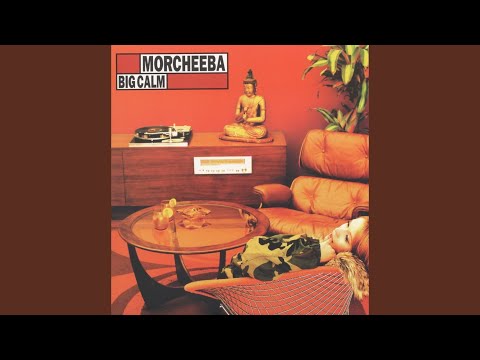
When did you start to realise that things were really taking off?Trigger Hippie gained traction, the album performed well, and then Big Calm seemed to elevate you to a whole new level. At what point did it sink in that this wasn’t just ‘having a bit of fun’, but that you had something genuinely capturing the zeitgeist, so to speak?
It was really not until years and years later.
For me, I always felt like Massive Attack or Portishead were the cool bands, and we were the laughable cousins… like we weren’t as cool, you know what I mean? We weren’t as underground.
But for our first show, people were queuing out of the building. The record company didn’t really think that we were going to sell any tickets, so they bought half of them for their family and friends. And then you’re just in it.
I remember someone telling me that whenever there was a compilation, if Morcheeba was on it, it was a positive sign. It was a good compilation. And I’m like, ‘really?’
Even now, I met this wonderful lady, Jacqueline, she works at the Victoria & Albert Museum, and she asked Morcheeba to be part of an exhibition called The Music is Black. I was like, ‘why don’t you get Miss Dynamite or Beverley Knight or somebody?’ And she said, ‘no, we want Morcheeba’. That was a really nice thing to hear.
At the same time, there were those ‘zero-out-of-five’ reviews in the NME and Melody Maker – you remember the pain as well as the joy.
You mentioned that around 20 years ago, it began to resonate that you had ‘made it’, so to speak, with Morcheeba. But that period also coincided with your time away from the band. Did stepping away from the group help you truly realise that?
I think all of us needed to have that little gap to find a new appreciation of each other. Do you know what I mean? When you’re young, you don’t realise how good you’ve got it.
We’d be touring three months non-stop around Europe – today, the maximum would be three and a half weeks – and then back home a week, and then three months around America, on a tour bus that was bigger than my flat. And then you’d see Madonna’s name on the guest list, Ozzy Osbourne – another fan – and the bass player from Metallica.
We had all of these sort of famous – I was going to say ‘celebrity’, but hate that word – musical icons that were fans. But you just don’t realise that you’re onto something when you’re in the middle of it.
This was a period defined by constant new singles, new albums, tours, and then back to new singles and albums again. When I speak to other artists from that era, they often say they didn’t really get to enjoy the moment because there was always pressure to be doing something else. Did you get a chance to enjoy it?
I mean, I was also a mum of a little toddler. I was pregnant when we recorded the album. He was born in November ’95, and the album came out in April ’96. So I was touring and being a mum at the same time.
I always say that I joined Ross and Paul’s dream – they were the ones that worried and stressed about things – ‘we need another this, or that’. I didn’t really – I was just in the bubble, so to speak.
That’s interesting. It seems that you’ve maintained a good work-life balance, then?
I had to keep up with the boys, that’s for sure. Definitely. But at the same time, I didn’t ever want them to say, ‘Oh, we can’t do that because Skye’s got a kid.’ I would always just say ‘yes’ to everything. So it was a case of album recorded, baby born, interview, go on tour, interview, and so on.
I don’t really know how I did it, but you just do it when you’re young. I was 23 when I had Jaega. So I just got on with it.

When it comes to some of the tracks that really defined Morcheeba in the early days – like Trigger Hippie, The Sea, Part of the Process, and Rome Wasn’t Built in a Day– do you still feel the same affinity for them? Do you view these songs differently now?
Yeah, definitely with Rome Wasn’t Built in a Day. I wasn’t happy about that song when it came out, because we were Morcheeba – the downtempo band, the band that people get stoned to, the band that people chill out to. But Paul was just like, ‘no, I’m sick of people coming to our gig and sitting down. I want people to stand up’.
Yeah, you’re not The Orb.
Exactly. But I didn’t like the song. I remember speaking to our A&R guy, and he said, ‘Yeah, that Rome was a good song’. I thought it was really cheesy. He thought it sounded like The Blues Brothers.
Now that I see how much people love that song – even the people that are cool and down with The Sea and Trigger Hippie. Everyone’s singing and jumping and clapping along to Rome Wasn’t Built in a Day, and so that’s given me a new love and appreciation for the song,
And in terms of what it’s done for our career – it was Top 10 in ten countries. It turned us into a headline band.
Also, The Sea wasn’t even a single. The record label was too nervous to release that as a single. They did rush it out a couple of years later – if anyone’s got a vinyl of The Sea, it’s very rare. It was on that TV show on Channel 4, which was kind of the first version of I’m A Celebrity Get Me Out of Here – Shipwrecked.
You stepped away from Morcheeba in 2003, and then returned around 2009 or 2010. What brought you back?
I didn’t leave the band – they left me. I remember getting a phone call from my manager, telling me that Morcheeba is over – or that ‘they’re going to continue without you’. And I was actually relieved at the time, because I couldn’t understand either of them.
So, how did it come back together?
They asked me to rejoin for [2008 album] Dive Deep. They wanted me to sing Enjoy the Ride.
And I just thought, ‘why would I want to do that?’ It was like ‘you’ve got a new wife, and you’re asking me to come back and sleep in my old bed’. I didn’t want to do that.
That then turned into an argument with my husband, Steve, because he was telling me ‘You should go back. You owe it to the fans. You owe it to the Morcheeba legacy.’
And then one day in London, I was coming out of our manager’s office and Ross was across the road. I was just like, ‘Oh my God, quick, hide.’
But then I thought, actually, let me go and say hello. And we hugged each other. Then we went for a drink in a restaurant called Julie’s, which is quite significant because it was my best friend, Julie, who first got me into this. We had some drinks and decided ‘let’s give it a go’.
By that point, you had already moved on somewhat as an artist, having released two albums at that stage. You were probably thinking, ‘No, thanks – I’ve got my own projects now, and that’s fine.’
Yeah. I remember we were recording The Best Of. We were in the studio and Paul said that he wanted to take a break from Morcheeba. And then I thought, ‘shit, what am I going to do when he’s having a break?’
So that’s when I started writing my first solo album. That was 20 years ago now, and I’m delighted that it’s going to come out on vinyl on Record Store Day. It’s all anniversaries this year – between that and Who Can You Trust?
You’ve got five solo albums, right?
I’m working on my fifth one now.
And you’ve done four albums with Morcheeba since coming back, is it?
Oh, gosh. So there’s Blood Like Lemonade [released in 2010] and then Head Up High [2013], followed by Blaze Away [2018] and Blackest Blue [2021]. And then Escape the Chaos, which was last year. We did a Skye & Ross album as well, but because it doesn’t have the Morcheeba name, it doesn’t necessarily get the same amount of airplay.
With both your solo career and your work with Morcheeba, how do you decide which music belongs to which project?
With Morcheeba, it tends to be the case that Ross will come up with the idea – some chords on guitar or piano, or a drum loop, or a slight half-finished demo. That then becomes a Morcheeba track. The Skye solo stuff is completely separate.
There was one track where I thought, ‘oh, this could be a Morcheeba track’. But it turns out that it felt too similar to something we’d already done before.

In terms of what you do now compared with earlier in your career, how do you keep things interesting for yourself? When you’ve been making music for decades – more than thirty years – there’s an expectation to keep it fresh and continue evolving, rather than simply replicating past work. How do you continue to look forward creatively and push your boundaries?
The major difference is that I’m writing lyrics for Morcheeba now because it was always Paul that wrote the lyrics, and I wrote the melody. So now that he’s not part of the band, I’ve stepped up.
In terms of how we keep it interesting? I don’t know – we just love doing it. We try not to repeat ourselves My voice has definitely changed and gotten stronger. So we can kind of push ourselves in that way musically.
We just keep doing what we do, and sometimes collaborate with younger people. But at the same time, it’s like we’re not trying to reinvent the wheel. And it’s mainly just doing what we love rather than what everybody else would love – what would get us on the radio, and so forth.
I was going to ask about that, because over the past decade or so, it seems you’ve increasingly worked on your own terms. You have stepped away from the sort of industry treadmill you were on before. That sense of independence must be very important?
Absolutely. There’s no A&R guy saying, ‘We don’t hear a single for the radio’, but to our minds, it’s more a case of, ‘Well, we’re not going to throw it in the bin’. You have to do what you love.
I put out a call on social media to see if anyone had any questions, and one came up that I suspect I already know the answer to: why the name Morcheeba? I understand it may have some connection to certain herbs…
That’s right. There’s a rapper called Schooly D, and he would chant ‘Cheeba cheeba y’all’, which was slang for marijuana. And back in the day, we wanted ‘more weed’ – hence, Morcheeba.
Actually, this is a funny story. We went to China. We were invited by the British consulate to represent the UK as a multicultural band, and they invited us to play in China.
Apparently, we were the first band to tour China in venues where people could stand up – you had Wham playing there back in the day, but everyone was sitting down.
So anyway, in China, Morcheeba means ‘touch the dick’ – so they changed the name of the band to ‘Exotic Flower’ when we went there.
Brilliant. That leads to another question: what are your current sources of inspiration as an artist? Do you draw from what’s happening in music at the moment?
I’m inspired by the people that my son’s now playing with, including Gorillaz, Wu-Lu and Greentea Peng. Also, what inspires me lyrically is my life and my family, and the dramas and chaos that go on within that family unit.
I want to write songs that reflect that, and can be quite healing and expressive of the pain families go through.
Escaping the chaos, in other words. In terms of this summer, then, you’re going on tour?
Always. Summer is touring, festivals, and I’m also doing something really out there – some shows with a classical pianist called Beatrice Berrut. I’m kind of stepping into the classical world and she’s stepping into the trip hop world.
I don’t know how it’s going to work, but we’re going to be playing in really beautiful theatres in Switzerland and France – completely out of my comfort zone.
Always good to keep things interesting. You’ve come a long way since bumping into Ross at a house party, in other words. I remember parties like those, across multiple floors – I’m sure kids today have something similar.
Actually, you know what’s happening now? So all those parents, the people our age who were getting stoned when they got into us, have had kids, and now their kids are coming to our gigs.
There are now young people in their 20s singing along to the new songs and to the old songs, which has totally blown my mind. I think it’s absolutely amazing.
Thanks to Skye for talking to us. Morcheeba – Remix The Chaos is released on 17 April. Morcheeba play at Vicar Street in Dublin on 12 October – tickets are available here.


